Rizzi Silvia, Vaupel James W
Interdisciplinary Centre on Population Dynamics, University of Southern Denmark, 5230 Odense M, Denmark.
Interdisciplinary Centre on Population Dynamics, University of Southern Denmark, 5230 Odense M, Denmark
Proc Natl Acad Sci U S A. 2021 Apr 13;118(15). doi: 10.1073/pnas.2025324118.
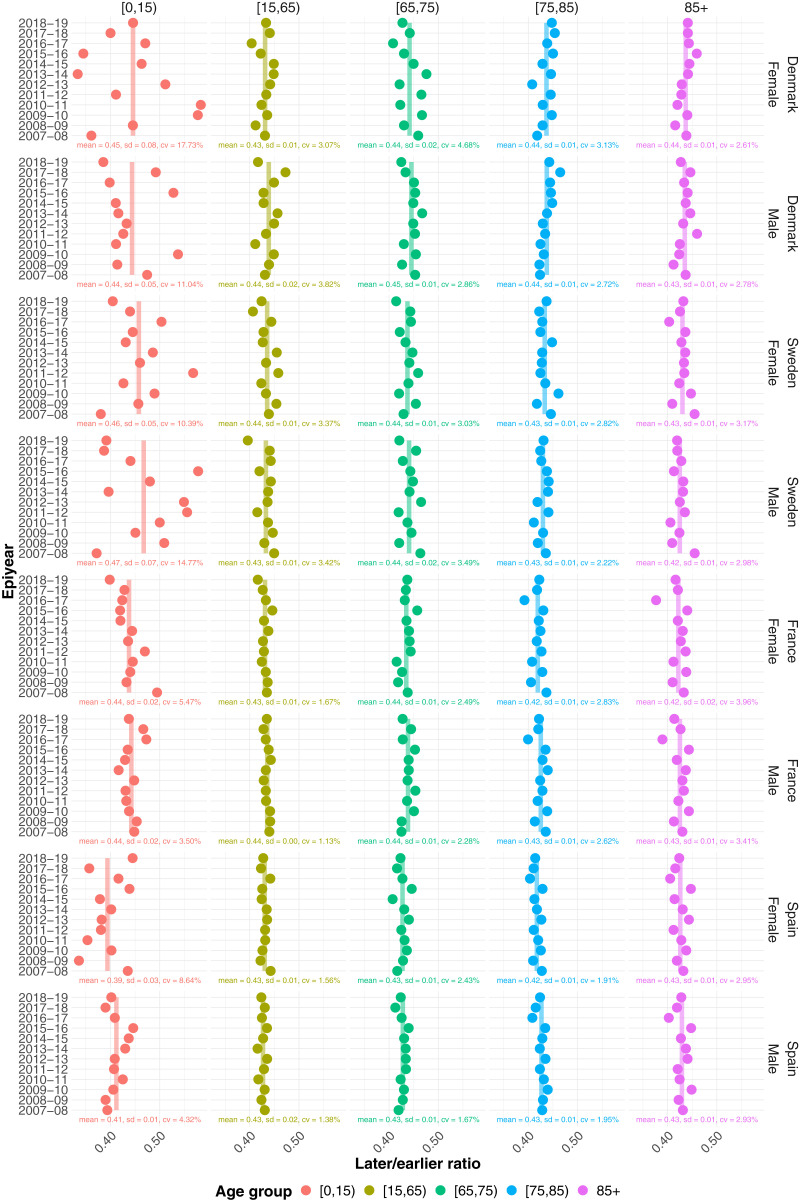
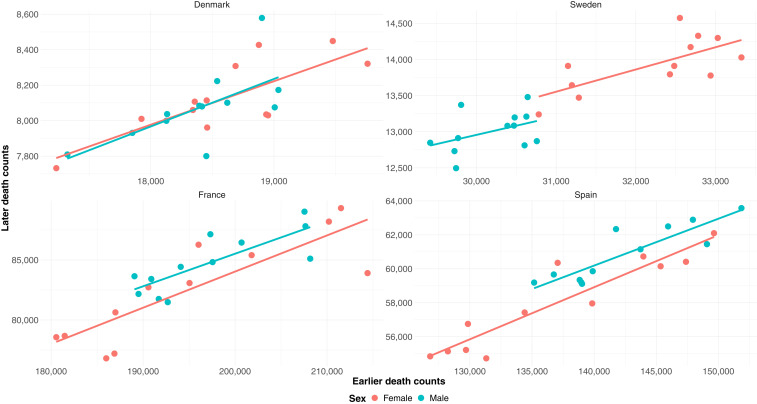
We introduce a method for making short-term mortality forecasts of a few months, illustrating it by estimating how many deaths might have happened if some major shock had not occurred. We apply the method to assess excess mortality from March to June 2020 in Denmark and Sweden as a result of the first wave of the coronavirus pandemic; associated policy interventions; and behavioral, healthcare, social, and economic changes. We chose to compare Denmark and Sweden because reliable data were available and because the two countries are similar but chose different responses to COVID-19: Denmark imposed a rather severe lockdown; Sweden did not. We make forecasts by age and sex to predict expected deaths if COVID-19 had not struck. Subtracting these forecasts from observed deaths gives the excess death count. Excess deaths were lower in Denmark than Sweden during the first wave of the pandemic. The later/earlier ratio we propose for shortcasting is easy to understand, requires less data than more elaborate approaches, and may be useful in many countries in making both predictions about the future and the past to study the impact on mortality of coronavirus and other epidemics. In the application to Denmark and Sweden, prediction intervals are narrower and bias is less than when forecasts are based on averages of the last 5 y, as is often done. More generally, later/earlier ratios may prove useful in short-term forecasting of illnesses and births as well as economic and other activity that varies seasonally or periodically.
我们介绍了一种用于进行几个月短期死亡率预测的方法,并通过估计如果没有发生某些重大冲击可能会发生多少死亡来加以说明。我们将该方法应用于评估丹麦和瑞典在2020年3月至6月因新冠疫情第一波、相关政策干预措施以及行为、医疗保健、社会和经济变化而导致的超额死亡率。我们选择比较丹麦和瑞典,是因为有可靠的数据可用,而且两国情况相似,但对新冠疫情采取了不同的应对措施:丹麦实施了相当严格的封锁;瑞典则没有。我们按年龄和性别进行预测,以预测如果没有新冠疫情爆发预期的死亡人数。用观察到的死亡人数减去这些预测值,就得到超额死亡人数。在疫情第一波期间,丹麦的超额死亡人数低于瑞典。我们提出的用于短期预测的后期/前期比率易于理解,所需数据比更复杂的方法少,并且在许多国家对于研究新冠病毒和其他流行病对死亡率的影响、对未来和过去进行预测可能都很有用。在应用于丹麦和瑞典时,预测区间比通常基于过去5年平均值进行预测时更窄,偏差也更小。更普遍地说,后期/前期比率可能在疾病、出生以及季节性或周期性变化的经济和其他活动的短期预测中证明是有用的。