Niriella Madunil Anuk, Ediriweera Dileepa Senajith, Withanage Madhuri Yasodha, Darshika Selani, De Silva Shamila Thivanshi, Janaka de Silva Hithanadura
Faculty of Medicine, Department of Medicine, University of Kelaniya, Ragama, Sri Lanka.
Health Data Science Unit, Faculty of Medicine, University of Kelaniya, Ragama, Sri Lanka.
Lancet Reg Health Southeast Asia. 2023 May 24;15:100220. doi: 10.1016/j.lansea.2023.100220. eCollection 2023 Aug.
Non-alcoholic fatty liver disease (NAFLD) is the commonest chronic liver disease worldwide. We estimated the prevalence and predefined associated factors for NAFLD among South-Asian adults.
We searched PubMed and included descriptive, epidemiological studies with satisfactory methodology, reporting the prevalence of NAFLD with ultrasound. Two authors screened and extracted data independently. Gender, urban/rural settings, general population and individuals with metabolic diseases (MetD) stratified the analysis. In addition, a random-effects meta-analysis of the prevalence and effect sizes of associations of NAFLD was performed.
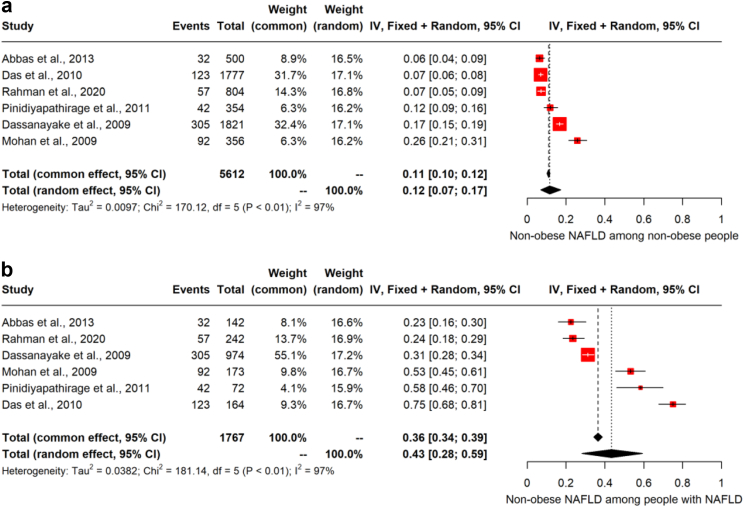
Twenty-two publications were included after the quality assurance process. The difference in the NAFLD prevalence between the general population and people with MetD was found to be statistically significant (Q = 15.8, DF = 1, P < 0.001). The pooled overall prevalence of NAFLD in the general population was 26.9% (95% CI: 18.9-35.8%) with high heterogeneity. The prevalence was similar among men and women (Q = 0.06, DF = 1, P = 0.806). The NAFLD prevalence in the rural communities was 22.6% (95% CI: 13.6-33.1%), and the prevalence in urban communities was 32.9% (95% CI: 22.8-43.8%) and the difference was not statistically significant (Q = 1.92, DF = 1, P = 0.166). The pooled overall prevalence of NAFLD in patients with MetD was 54.1% (95% CI: 44.1-63.9%) with high heterogeneity. The pooled overall prevalence of NAFLD in the non-obese population was 11.7% (95% CI: 7.0-17.3%). The pooled prevalence of non-obese NAFLD in the NAFLD population was 43.4% (95% CI: 28.1-59.4%). Meta-analysis of binary variables showed that NAFLD in the South Asian population was associated with diabetes mellitus, hypertension, dyslipidaemia, general obesity, central obesity and metabolic syndrome. Gender was not associated with NAFLD.
The overall prevalence of NAFLD among adults in South Asia is high, especially in those with MetD, and a considerable proportion is non-obese. In the South Asian population, NAFLD was associated with diabetes mellitus, hypertension, dyslipidaemia, general obesity, central obesity, and metabolic syndrome.
None.
非酒精性脂肪性肝病(NAFLD)是全球最常见的慢性肝病。我们估算了南亚成年人中NAFLD的患病率及预先设定的相关因素。
我们检索了PubMed,并纳入了方法学令人满意的描述性、流行病学研究,这些研究报告了通过超声检查得出的NAFLD患病率。两位作者独立筛选并提取数据。分析按性别、城乡环境、普通人群以及患有代谢疾病(MetD)的个体进行分层。此外,还对NAFLD的患病率及关联效应大小进行了随机效应荟萃分析。
经过质量保证流程后,共纳入22篇出版物。发现普通人群与患有MetD的人群在NAFLD患病率上的差异具有统计学意义(Q = 15.8,自由度 = 1,P < 0.001)。普通人群中NAFLD的合并总体患病率为26.9%(95%置信区间:18.9 - 35.8%),异质性较高。男性和女性的患病率相似(Q = 0.06,自由度 = 1,P = 0.806)。农村社区的NAFLD患病率为22.6%(95%置信区间:13.6 - 33.1%),城市社区的患病率为32.9%(95%置信区间:22.8 - 43.8%),差异无统计学意义(Q = 1.92,自由度 = 1,P = 0.166)。患有MetD的患者中NAFLD的合并总体患病率为54.1%(95%置信区间:44.1 - 63.9%),异质性较高。非肥胖人群中NAFLD的合并总体患病率为11.7%(95%置信区间:7.0 - 17.3%)。NAFLD人群中非肥胖型NAFLD的合并患病率为43.4%(95%置信区间:28.1 - 59.4%)。二元变量的荟萃分析表明,南亚人群中的NAFLD与糖尿病、高血压、血脂异常、全身性肥胖、中心性肥胖和代谢综合征相关。性别与NAFLD无关。
南亚成年人中NAFLD的总体患病率较高,尤其是在患有MetD的人群中,且相当一部分为非肥胖型。在南亚人群中,NAFLD与糖尿病、高血压、血脂异常、全身性肥胖、中心性肥胖和代谢综合征相关。
无。