Pan Zhaobing, Yang Qiaoshan, Zhang Xiaojing, Xu Xiaoqing, Sun Yao, Zhou Fusheng, Wen Leilei
Department of Dermatology, The First Affiliated Hospital, Anhui Medical University, Hefei, Anhui, People's Republic of China.
Institute of Dermatology, Anhui Medical University, Hefei, Anhui, People's Republic of China.
Int J Gen Med. 2023 Aug 18;16:3567-3580. doi: 10.2147/IJGM.S416493. eCollection 2023.
Systemic lupus erythematosus (SLE) is a typical autoimmune disease characterized by the involvement of multiple organs and the production of antinuclear antibodies. This study aimed to investigate the molecular mechanism of SLE.
We retrieved genome-wide gene expression levels from five public datasets with relatively large sample sizes from the Gene Expression Omnibus (GEO), and we compared the expression profiles of peripheral blood mononuclear cells (PBMCs) from SLE patients and healthy controls (HCs). The expression of seven target genes in PBMCs from 25 cases and 3 HCs was further validated by reverse-transcription quantitative PCR (RT‒qPCR). Flow cytometry was used for verifying the proportion of naive CD4(+) T cells and M2 macrophages in PBMCs from 5 cases and 4 HCs.
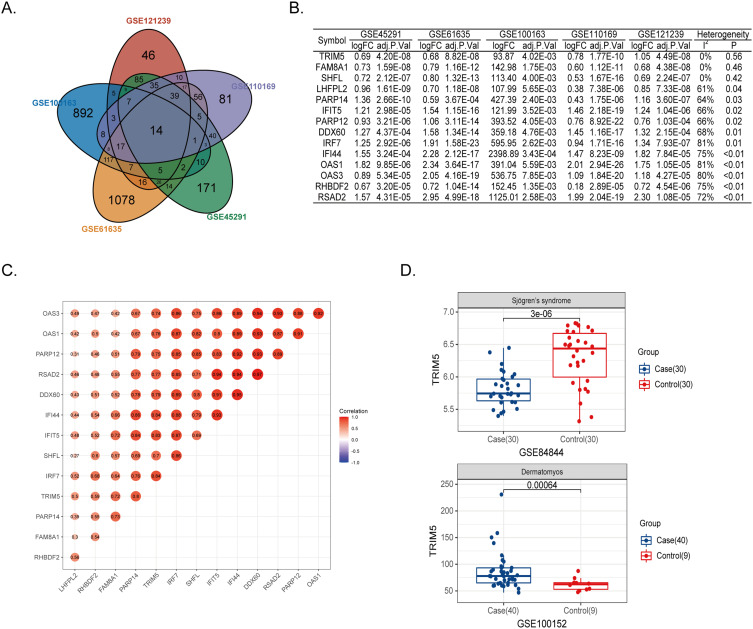
We found 14 genes (TRIM5, FAM8A1, SHFL, LHFPL2, PARP14, IFIT5, PARP12, DDX60, IRF7, IF144, OAS1, OAS3, RHBDF2, and RSAD2) that were differentially expressed among all five datasets. The heterogeneity test under the fixed effect model showed no obvious heterogeneity of TRIM5, FAM8A1, and SHFL across different populations. TRIM5 was positively correlated with the remaining 13 genes. By separating patient samples into TRIM5-high and TRIM5-low groups, we found that up-regulated genes in the TRIM5-high group were mainly enriched in virus-related pathways. Immune cell proportion analysis and flow cytometry revealed that naive CD4(+) T cells were significantly decreased while M2 macrophages were increased in the SLE group. TRIM5 expression levels were negatively correlated with naive CD4(+) T cells but positively correlated with M2 macrophages.
Our data indicated that TRIM5 might be a key factor that modulates SLE etiology, possibly through naive CD4(+) T cells and M2 macrophages.
系统性红斑狼疮(SLE)是一种典型的自身免疫性疾病,其特征为多器官受累及抗核抗体产生。本研究旨在探究SLE的分子机制。
我们从基因表达综合数据库(GEO)中检索了五个样本量相对较大的公共数据集的全基因组基因表达水平,并比较了SLE患者和健康对照(HCs)外周血单个核细胞(PBMCs)的表达谱。通过逆转录定量PCR(RT-qPCR)进一步验证了25例患者和3例健康对照的PBMCs中七个靶基因的表达。采用流式细胞术检测了5例患者和4例健康对照的PBMCs中初始CD4(+) T细胞和M2巨噬细胞的比例。
我们发现14个基因(TRIM5、FAM8A1、SHFL、LHFPL2、PARP14、IFIT5、PARP12、DDX60、IRF7、IF144、OAS1、OAS3、RHBDF2和RSAD2)在所有五个数据集中差异表达。固定效应模型下的异质性检验显示,TRIM5、FAM8A1和SHFL在不同人群中无明显异质性。TRIM5与其余13个基因呈正相关。通过将患者样本分为TRIM5高表达组和TRIM5低表达组,我们发现TRIM5高表达组中上调的基因主要富集于病毒相关通路。免疫细胞比例分析和流式细胞术显示,SLE组中初始CD4(+) T细胞显著减少而M2巨噬细胞增加。TRIM5表达水平与初始CD4(+) T细胞呈负相关,但与M2巨噬细胞呈正相关。
我们的数据表明,TRIM5可能是调节SLE病因的关键因素,可能通过初始CD4(+) T细胞和M2巨噬细胞发挥作用。