
在饲养过程中,供体蜂群和保育蜂群中病毒丰度对 的蜂王的影响。
Influence of virus abundances in donor colonies and nurse hives on queens of during the rearing process.
机构信息
Bezirk Oberbayern, Fachberatung für Imkerei, München, Germany.
Lower Saxony State Office for Consumer Protection and Food Safety, Institute for Apiculture, Celle, Germany.
出版信息
Open Vet J. 2023 Jul;13(7):879-893. doi: 10.5455/OVJ.2023.v13.i7.10. Epub 2023 Jul 31.
BACKGROUND
Honeybees are one of the three most important animals for mankind. In order to be safe and increase number of bee colonies for pollination, the breeding of queens is necessary. For several decades, bees were selected on economic and behavioral aspects. With the appearance of the neozootic mite beekeepers were forced to adapt their methods. can act as a vector for many different bee pathogenic viruses and by this potentiates its devastating impact.
AIM
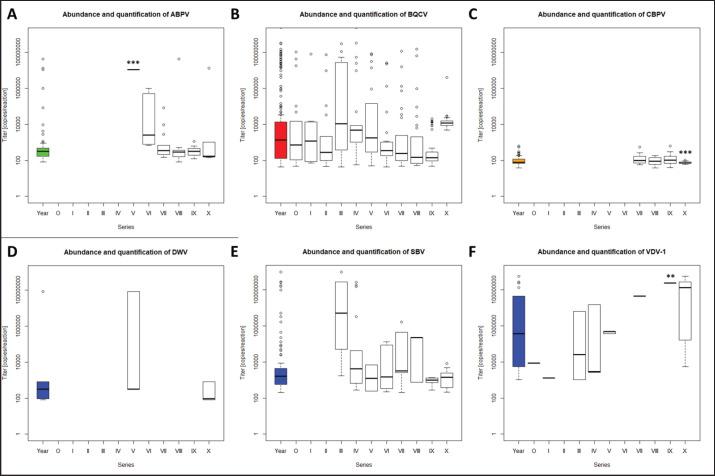
Methods of rearing queens were not evaluated since the mites' appearance. Besides scientific approaches, viruses received too little attention in regard to the rearing process of honeybee queens. Herein, we present a detailed analysis of virus abundances [, acute bee paralysis virus (ABPV); Triatovirus, black queen cell virus (BQCV); , chronic bee paralysis virus (CBPV); and , deformed wings virus (DWV), Sacbrood virus (SBV), VDV-1] in breeding hives, donating first instar larvae, hives that are nursing these larvae until the pupa stage, and on queens of in a breeding apiary.
METHODS
Nurse and donor colonies of the queen-rearing process were sampled in the year 2020 and analyzed by RT qPCR. Virus quantifications were correlated with queen mortalities and seasonal effects.
RESULTS
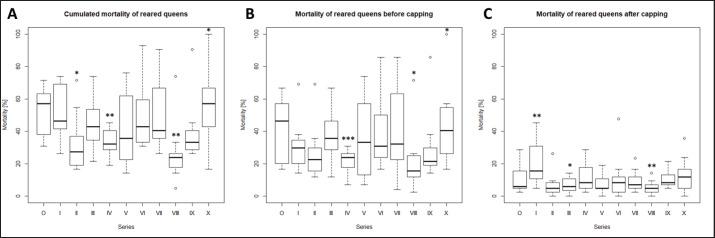
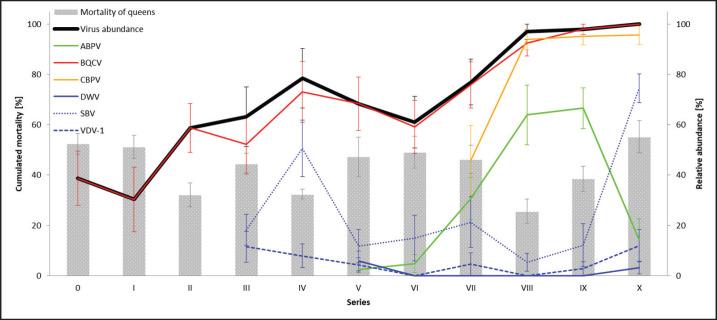
Virus detections increased in reared queens, however, the elevated virus titers did not increase the mortality of the queens until their exclosure. Moreover, we observed a lower interrelation between virus abundance in queens and their original donor colonies, than between nurse hives and their nursed queens.
CONCLUSION
The bee pathogenic viruses ABPV, BQCV, CBPV, DWV, SBV, and VDV-1 do not influence the mortality of bee queens during the rearing process. Whether respective virus loads result in sublethal or long-term effects remains to be elucidated.
背景
蜜蜂是人类最重要的三种动物之一。为了安全并增加授粉的蜂群数量,有必要培育蜂王。几十年来,蜜蜂一直是在经济和行为方面进行选择。随着新出现的节肢动物螨的出现,养蜂人不得不改变他们的方法。它可以作为许多不同的蜜蜂致病病毒的载体,并因此增强其破坏性影响。
目的
自螨出现以来,尚未评估蜂王的饲养方法。除了科学方法外,病毒在蜜蜂蜂王饲养过程中也没有得到太多关注。在此,我们详细分析了育蜂箱、提供第一龄幼虫的蜂群、正在哺育这些幼虫直至蛹期的蜂群以及繁殖蜂场中的蜂王[急性麻痹病毒(ABPV);Triatovirus,黑皇后细胞病毒(BQCV);Circovirus,慢性麻痹病毒(CBPV);和Densovirus,变形翅膀病毒(DWV),Sacbrood 病毒(SBV),VDV-1]中的病毒丰度。
方法
在 2020 年,对女王饲养过程中的护理和供体蜂群进行了取样,并通过 RT-qPCR 进行了分析。将病毒定量与蜂王死亡率和季节性效应相关联。
结果
在饲养的蜂王中检测到了病毒,但升高的病毒滴度并未增加蜂王的死亡率,直到它们被隔离。此外,我们观察到蜂王与其原始供体蜂群之间的病毒丰度相关性较低,而护理蜂群与其护理的蜂王之间的相关性较高。
结论
蜜蜂致病病毒 ABPV、BQCV、CBPV、DWV、SBV 和 VDV-1 不会影响蜂王在饲养过程中的死亡率。各自的病毒载量是否会导致亚致死或长期影响仍有待阐明。



 Zotero 插件