Department of Microbiology, University of Washington School of Medicine, Seattle, WA, United States of America.
Division of Allergy and Infectious Diseases, Department of Medicine, Center for Emerging and Reemerging Infectious Diseases (CERID), University of Washington School of Medicine, Seattle, WA, United States of America.
PLoS One. 2023 Aug 24;18(8):e0290675. doi: 10.1371/journal.pone.0290675. eCollection 2023.
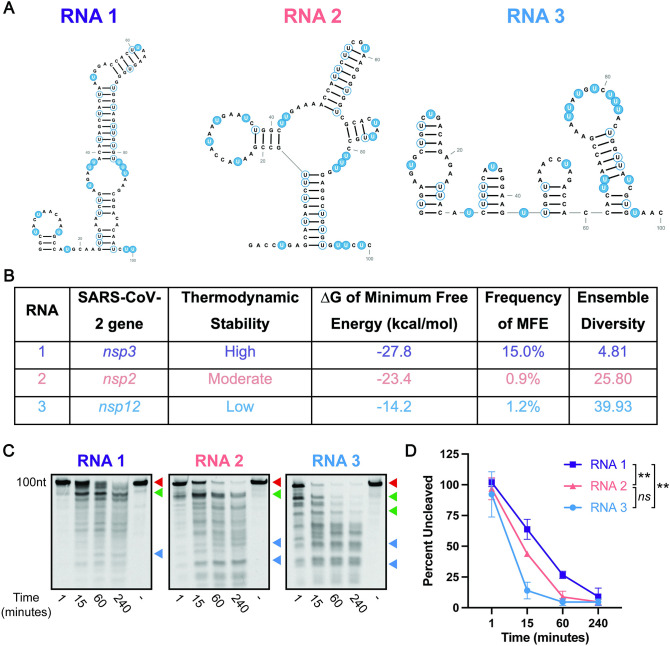
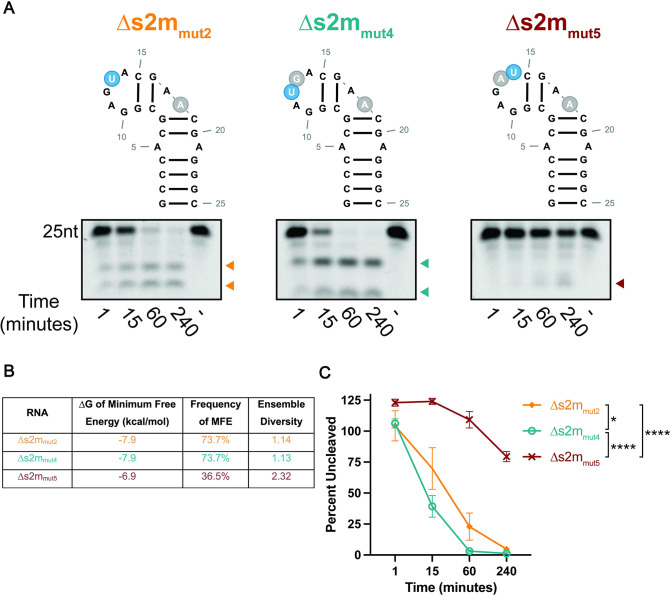
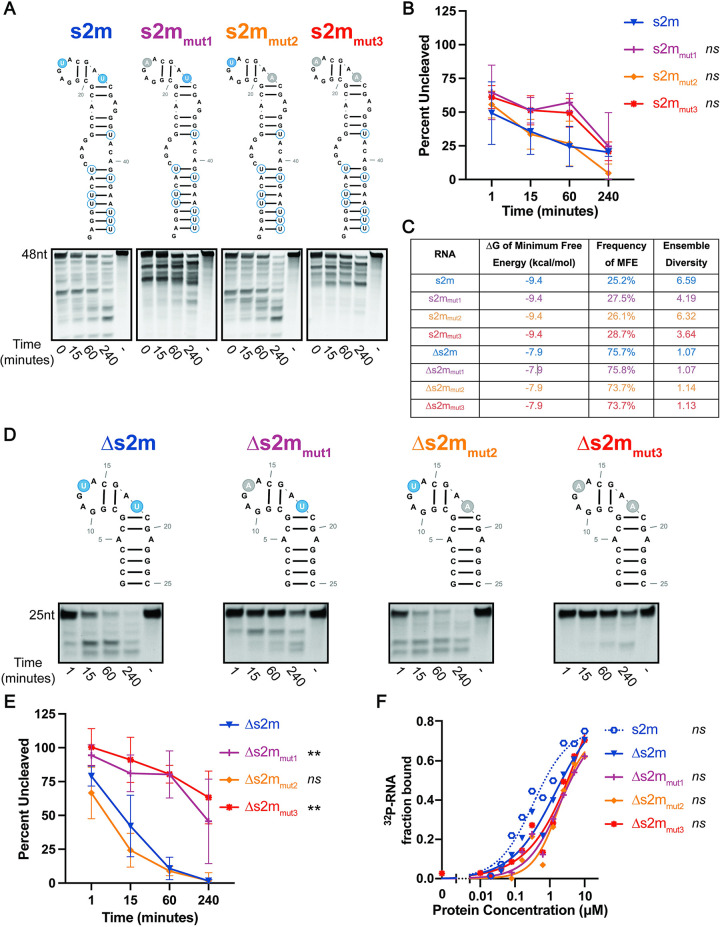
SARS-CoV-2, the etiologic agent of the COVID-19 pandemic, has had an enduring impact on global public health. However, SARS-CoV-2 is only one of multiple pathogenic human coronaviruses (CoVs) to have emerged since the turn of the century. CoVs encode for several nonstructural proteins (nsps) that are essential for viral replication and pathogenesis. Among them is nsp15, a uridine-specific viral endonuclease that is important in evading the host immune response and promoting viral replication. Despite the established endonuclease function of nsp15, little is known about other determinants of its cleavage specificity. In this study we investigate the role of RNA secondary structure in SARS-CoV-2 nsp15 endonuclease activity. Using a series of in vitro endonuclease assays, we observed that thermodynamically stable RNA structures were protected from nsp15 cleavage relative to RNAs lacking stable structure. We leveraged the s2m RNA from the SARS-CoV-1 3'UTR as a model for our structural studies as it adopts a well-defined structure with several uridines, two of which are unpaired and thus highly probable targets for nsp15 cleavage. We found that SARS-CoV-2 nsp15 specifically cleaves s2m at the unpaired uridine within the GNRNA pentaloop of the RNA. Further investigation revealed that the position of uridine within the pentaloop also impacted nsp15 cleavage efficiency suggesting that positioning within the pentaloop is necessary for optimal presentation of the scissile uridine and alignment within the nsp15 catalytic pocket. Our findings indicate that RNA secondary structure is an important determinant of nsp15 cleavage and provides insight into the molecular mechanisms of RNA recognition by nsp15.
SARS-CoV-2 是 COVID-19 大流行的病原体,对全球公共卫生产生了持久的影响。然而,SARS-CoV-2 只是本世纪以来出现的多种致病性人类冠状病毒(CoV)之一。CoV 编码几种非结构蛋白(nsps),这些蛋白对于病毒复制和发病机制至关重要。其中,nsp15 是一种尿嘧啶特异性病毒内切核酸酶,对于逃避宿主免疫反应和促进病毒复制非常重要。尽管 nsp15 具有已确立的内切核酸酶功能,但对于其切割特异性的其他决定因素知之甚少。在这项研究中,我们研究了 RNA 二级结构在 SARS-CoV-2 nsp15 内切核酸酶活性中的作用。通过一系列体外内切核酸酶实验,我们观察到与缺乏稳定结构的 RNA 相比,热力学稳定的 RNA 结构受到 nsp15 切割的保护。我们利用 SARS-CoV-1 3'UTR 的 s2m RNA 作为我们结构研究的模型,因为它采用了一种具有几个尿嘧啶的明确结构,其中两个未配对,因此很可能成为 nsp15 切割的靶标。我们发现,SARS-CoV-2 nsp15 特异性地在 RNA 的 GNRNA 五核苷酸环内未配对的尿嘧啶处切割 s2m。进一步的研究表明,尿嘧啶在五核苷酸环内的位置也影响 nsp15 切割效率,这表明在五核苷酸环内的定位对于最佳呈现切割尿嘧啶和在 nsp15 催化口袋内的对齐是必要的。我们的研究结果表明,RNA 二级结构是 nsp15 切割的重要决定因素,并深入了解了 nsp15 对 RNA 的分子识别机制。