• 文献检索
  • 文档翻译
  • 深度研究
  • 学术资讯
  • Suppr Zotero 插件Zotero 插件
  • 邀请有礼
  • 套餐&价格
  • 历史记录
应用&插件
Suppr Zotero 插件Zotero 插件浏览器插件Mac 客户端Windows 客户端微信小程序
定价
高级版会员购买积分包购买API积分包
服务
文献检索文档翻译深度研究API 文档MCP 服务
关于我们
关于 Suppr公司介绍联系我们用户协议隐私条款
关注我们

Suppr 超能文献

核心技术专利:CN118964589B侵权必究
粤ICP备2023148730 号-1Suppr @ 2026

文献检索

告别复杂PubMed语法,用中文像聊天一样搜索,搜遍4000万医学文献。AI智能推荐,让科研检索更轻松。

立即免费搜索

文件翻译

保留排版,准确专业,支持PDF/Word/PPT等文件格式,支持 12+语言互译。

免费翻译文档

深度研究

AI帮你快速写综述,25分钟生成高质量综述,智能提取关键信息,辅助科研写作。

立即免费体验

基于机器学习的急性心肌梗死后心力衰竭预测模型的开发与比较。

Development and comparison of machine learning-based models for predicting heart failure after acute myocardial infarction.

机构信息

Department of Laboratory Medicine, First Hospital of Jilin University, Changchun, China.

Information center, First Hospital of Jilin University, Changchun, China.

出版信息

BMC Med Inform Decis Mak. 2023 Aug 24;23(1):165. doi: 10.1186/s12911-023-02240-1.

DOI:10.1186/s12911-023-02240-1
PMID:37620904
原文链接:https://pmc.ncbi.nlm.nih.gov/articles/PMC10463624/
Abstract

AIMS

Heart failure (HF) is one of the common adverse cardiovascular events after acute myocardial infarction (AMI), but the predictive efficacy of numerous machine learning (ML) built models is unclear. This study aimed to build an optimal model to predict the occurrence of HF in AMI patients by comparing seven ML algorithms.

METHODS

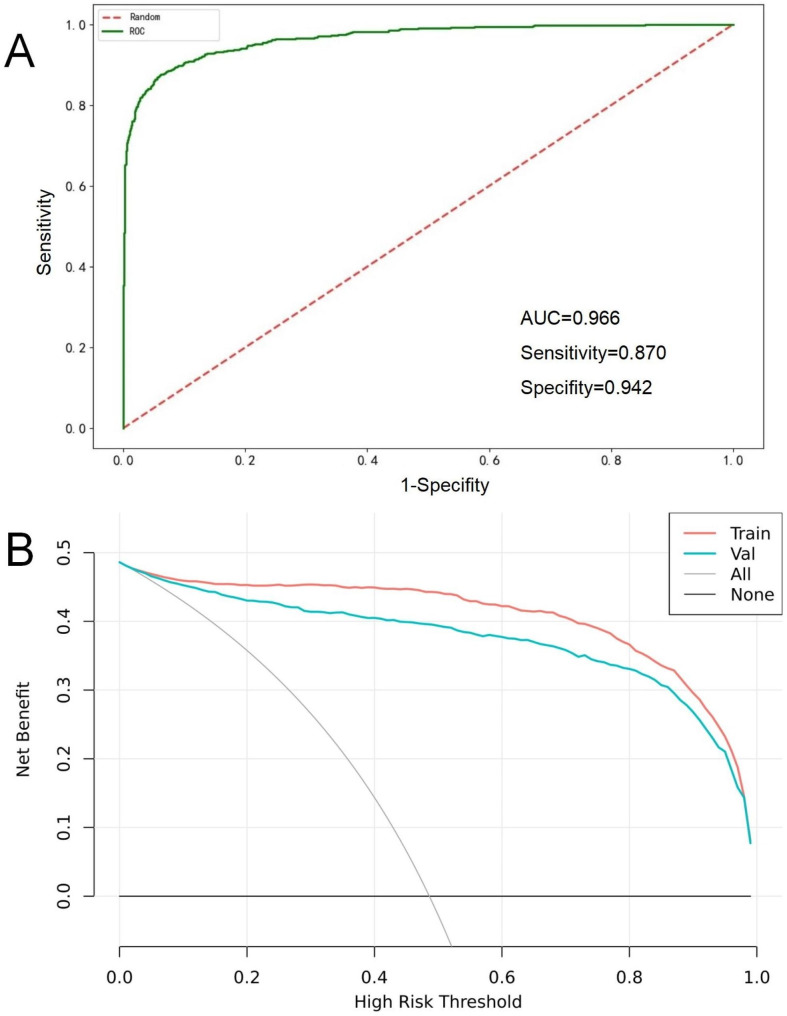
Cohort 1 included AMI patients from 2018 to 2019 divided into HF and control groups. All first routine test data of the study subjects were collected as the features to be selected for the model, and seven ML algorithms with screenable features were evaluated. Cohort 2 contains AMI patients from 2020 to 2021 to establish an early warning model with external validation. ROC curve and DCA curve to analyze the diagnostic efficacy and clinical benefit of the model respectively.

RESULTS

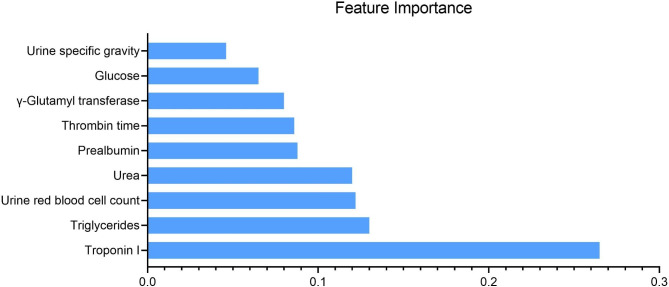
The best performer among the seven ML algorithms was XgBoost, and the features of XgBoost algorithm for troponin I, triglycerides, urine red blood cell count, γ-glutamyl transpeptidase, glucose, urine specific gravity, prothrombin time, prealbumin, and urea were ranked high in importance. The AUC of the HF-Lab9 prediction model built by the XgBoost algorithm was 0.966 and had good clinical benefits.

CONCLUSIONS

This study screened the optimal ML algorithm as XgBoost and developed the model HF-Lab9 will improve the accuracy of clinicians in assessing the occurrence of HF after AMI and provide a reference for the selection of subsequent model-building algorithms.

摘要

目的

心力衰竭(HF)是急性心肌梗死(AMI)后常见的心血管不良事件之一,但众多机器学习(ML)构建模型的预测效果尚不清楚。本研究旨在通过比较 7 种 ML 算法,构建一个最优模型来预测 AMI 患者 HF 的发生。

方法

队列 1 纳入了 2018 年至 2019 年的 AMI 患者,分为 HF 组和对照组。收集研究对象的所有首次常规检查数据作为特征,用于筛选模型,并评估具有筛选特征的 7 种 ML 算法。队列 2 纳入了 2020 年至 2021 年的 AMI 患者,用于建立外部验证的预警模型。分别通过 ROC 曲线和 DCA 曲线分析模型的诊断效果和临床获益。

结果

7 种 ML 算法中表现最佳的是 XgBoost,XgBoost 算法的特征重要性排名较高的有肌钙蛋白 I、甘油三酯、尿红细胞计数、γ-谷氨酰转肽酶、血糖、尿比重、凝血酶原时间、前白蛋白和尿素。XgBoost 算法构建的 HF-Lab9 预测模型的 AUC 为 0.966,具有良好的临床获益。

结论

本研究筛选出最优的 ML 算法为 XgBoost,并开发了模型 HF-Lab9,将提高临床医生评估 AMI 后 HF 发生的准确性,并为后续模型构建算法的选择提供参考。
https://cdn.ncbi.nlm.nih.gov/pmc/blobs/9a9d/10463624/74ba458271a2/12911_2023_2240_Fig2_HTML.jpg
https://cdn.ncbi.nlm.nih.gov/pmc/blobs/9a9d/10463624/c34896be59c1/12911_2023_2240_Fig1_HTML.jpg
https://cdn.ncbi.nlm.nih.gov/pmc/blobs/9a9d/10463624/74ba458271a2/12911_2023_2240_Fig2_HTML.jpg
https://cdn.ncbi.nlm.nih.gov/pmc/blobs/9a9d/10463624/c34896be59c1/12911_2023_2240_Fig1_HTML.jpg
https://cdn.ncbi.nlm.nih.gov/pmc/blobs/9a9d/10463624/74ba458271a2/12911_2023_2240_Fig2_HTML.jpg

相似文献

1
Development and comparison of machine learning-based models for predicting heart failure after acute myocardial infarction.基于机器学习的急性心肌梗死后心力衰竭预测模型的开发与比较。
BMC Med Inform Decis Mak. 2023 Aug 24;23(1):165. doi: 10.1186/s12911-023-02240-1.
2
Machine learning-based risk prediction of malignant arrhythmia in hospitalized patients with heart failure.基于机器学习的心力衰竭住院患者恶性心律失常风险预测。
ESC Heart Fail. 2021 Dec;8(6):5363-5371. doi: 10.1002/ehf2.13627. Epub 2021 Sep 28.
3
Predicting Mortality in Intensive Care Unit Patients With Heart Failure Using an Interpretable Machine Learning Model: Retrospective Cohort Study.利用可解释机器学习模型预测重症监护病房心力衰竭患者的死亡率:回顾性队列研究。
J Med Internet Res. 2022 Aug 9;24(8):e38082. doi: 10.2196/38082.
4
[Application of machine learning model based on XGBoost algorithm in early prediction of patients with acute severe pancreatitis].基于XGBoost算法的机器学习模型在急性重症胰腺炎患者早期预测中的应用
Zhonghua Wei Zhong Bing Ji Jiu Yi Xue. 2023 Apr;35(4):421-426. doi: 10.3760/cma.j.cn121430-20221019-00930.
5
Predicting acute kidney injury risk in acute myocardial infarction patients: An artificial intelligence model using medical information mart for intensive care databases.预测急性心肌梗死患者的急性肾损伤风险:一种使用重症监护数据库医学信息集市的人工智能模型。
Front Cardiovasc Med. 2022 Sep 7;9:964894. doi: 10.3389/fcvm.2022.964894. eCollection 2022.
6
Development and validation of a prediction model to predict major adverse cardiovascular events in elderly patients undergoing noncardiac surgery: A retrospective cohort study.开发和验证预测模型以预测老年非心脏手术患者发生主要不良心血管事件的风险:一项回顾性队列研究。
Atherosclerosis. 2023 Jul;376:71-79. doi: 10.1016/j.atherosclerosis.2023.06.008. Epub 2023 Jun 8.
7
Establishment and validation of a prediction nomogram for heart failure risk in patients with acute myocardial infarction during hospitalization.建立并验证了一个预测住院急性心肌梗死患者心力衰竭风险的列线图。
BMC Cardiovasc Disord. 2023 Dec 18;23(1):619. doi: 10.1186/s12872-023-03665-2.
8
Application of machine learning to predict the occurrence of arrhythmia after acute myocardial infarction.机器学习在预测急性心肌梗死后心律失常发生中的应用。
BMC Med Inform Decis Mak. 2021 Nov 2;21(1):301. doi: 10.1186/s12911-021-01667-8.
9
Development of a machine learning-based risk prediction model for cerebral infarction and comparison with nomogram model.基于机器学习的脑梗死风险预测模型的建立及与列线图模型的比较。
J Affect Disord. 2022 Oct 1;314:341-348. doi: 10.1016/j.jad.2022.07.045. Epub 2022 Jul 23.
10
Using Machine Learning Algorithms to Predict High-Risk Factors for Postoperative Delirium in Elderly Patients.运用机器学习算法预测老年患者术后谵妄的高危因素。
Clin Interv Aging. 2023 Feb 8;18:157-168. doi: 10.2147/CIA.S398314. eCollection 2023.

引用本文的文献

1
Single-cell RNA sequencing reveals the potential role of Postn(+) fibroblasts in promoting the progression of myocardial fibrosis after myocardial infarction.单细胞RNA测序揭示了Postn(+)成纤维细胞在心肌梗死后促进心肌纤维化进展中的潜在作用。
Sci Rep. 2025 Jul 1;15(1):22390. doi: 10.1038/s41598-025-04990-6.
2
Machine learning algorithms to predict heart failure with preserved ejection fraction among patients with premature myocardial infarction.用于预测心肌梗死患者射血分数保留的心力衰竭的机器学习算法。
Front Cardiovasc Med. 2025 May 7;12:1571185. doi: 10.3389/fcvm.2025.1571185. eCollection 2025.
3
Interpretable artificial intelligence model for predicting heart failure severity after acute myocardial infarction.

本文引用的文献

1
Application of an Interpretable Machine Learning Model to Predict Lymph Node Metastasis in Patients with Laryngeal Carcinoma.一种可解释的机器学习模型在预测喉癌患者淋巴结转移中的应用
J Oncol. 2022 Nov 12;2022:6356399. doi: 10.1155/2022/6356399. eCollection 2022.
2
Predicting Mortality in Intensive Care Unit Patients With Heart Failure Using an Interpretable Machine Learning Model: Retrospective Cohort Study.利用可解释机器学习模型预测重症监护病房心力衰竭患者的死亡率:回顾性队列研究。
J Med Internet Res. 2022 Aug 9;24(8):e38082. doi: 10.2196/38082.
3
Development of a machine learning-based risk prediction model for cerebral infarction and comparison with nomogram model.
用于预测急性心肌梗死后心力衰竭严重程度的可解释人工智能模型。
BMC Cardiovasc Disord. 2025 May 12;25(1):362. doi: 10.1186/s12872-025-04818-1.
4
Development and validation of a machine learning model for online predicting the risk of in heart failure: based on the routine blood test and their derived parameters.基于常规血液检测及其衍生参数的在线预测心力衰竭风险的机器学习模型的开发与验证
Front Cardiovasc Med. 2025 Mar 17;12:1539966. doi: 10.3389/fcvm.2025.1539966. eCollection 2025.
5
Development and validation of machine learning models based on stacked generalization to predict psychosocial maladjustment in patients with acute myocardial infarction.基于堆叠泛化的机器学习模型的开发与验证,用于预测急性心肌梗死患者的心理社会适应不良。
BMC Psychiatry. 2025 Feb 19;25(1):152. doi: 10.1186/s12888-025-06549-1.
6
Predicting the risk of heart failure after acute myocardial infarction using an interpretable machine learning model.使用可解释的机器学习模型预测急性心肌梗死后心力衰竭的风险。
Front Cardiovasc Med. 2025 Jan 24;12:1444323. doi: 10.3389/fcvm.2025.1444323. eCollection 2025.
7
Advancements and challenges in high-sensitivity cardiac troponin assays: diagnostic, pathophysiological, and clinical perspectives.高敏心肌肌钙蛋白检测的进展与挑战:诊断、病理生理及临床视角
Clin Chem Lab Med. 2025 Feb 7;63(7):1260-1278. doi: 10.1515/cclm-2024-1090. Print 2025 Jun 26.
8
Construction of Clinical Predictive Models for Heart Failure Detection Using Six Different Machine Learning Algorithms: Identification of Key Clinical Prognostic Features.使用六种不同机器学习算法构建心力衰竭检测临床预测模型:关键临床预后特征的识别
Int J Gen Med. 2024 Dec 28;17:6523-6534. doi: 10.2147/IJGM.S493789. eCollection 2024.
9
Are we ready to integrate advanced artificial intelligence models in clinical laboratory?我们准备好将先进的人工智能模型整合到临床实验室中了吗?
Biochem Med (Zagreb). 2025 Feb 15;35(1):010501. doi: 10.11613/BM.2025.010501. Epub 2024 Dec 15.
10
Machine Learning Applications in Acute Coronary Syndrome: Diagnosis, Outcomes and Management.机器学习在急性冠状动脉综合征中的应用:诊断、预后与管理
Adv Ther. 2025 Feb;42(2):636-665. doi: 10.1007/s12325-024-03060-z. Epub 2024 Dec 6.
基于机器学习的脑梗死风险预测模型的建立及与列线图模型的比较。
J Affect Disord. 2022 Oct 1;314:341-348. doi: 10.1016/j.jad.2022.07.045. Epub 2022 Jul 23.
4
PRKAR1A and SDCBP Serve as Potential Predictors of Heart Failure Following Acute Myocardial Infarction.PRKAR1A 和 SDCBP 可作为急性心肌梗死后心力衰竭的潜在预测因子。
Front Immunol. 2022 May 3;13:878876. doi: 10.3389/fimmu.2022.878876. eCollection 2022.
5
B-Lines by Lung Ultrasound Can Predict Worsening Heart Failure in Acute Myocardial Infarction During Hospitalization and Short-Term Follow-Up.肺部超声的B线可预测急性心肌梗死患者住院期间及短期随访中心力衰竭的恶化情况。
Front Cardiovasc Med. 2022 May 2;9:895133. doi: 10.3389/fcvm.2022.895133. eCollection 2022.
6
Establishment and Validation of a Non-invasive Diagnostic Nomogram to Identify Heart Failure in Patients With Coronary Heart Disease.用于识别冠心病患者心力衰竭的非侵入性诊断列线图的建立与验证
Front Cardiovasc Med. 2022 Apr 7;9:875702. doi: 10.3389/fcvm.2022.875702. eCollection 2022.
7
Machine learning algorithms are comparable to conventional regression models in predicting distant metastasis of follicular thyroid carcinoma.在预测滤泡性甲状腺癌远处转移方面,机器学习算法与传统回归模型相当。
Clin Endocrinol (Oxf). 2023 Jan;98(1):98-109. doi: 10.1111/cen.14693. Epub 2022 Feb 25.
8
Development and validation of an artificial neural network algorithm to predict mortality and admission to hospital for heart failure after myocardial infarction: a nationwide population-based study.开发和验证一种用于预测心肌梗死后心力衰竭患者死亡率和住院的人工神经网络算法:一项全国范围内基于人群的研究。
Lancet Digit Health. 2022 Jan;4(1):e37-e45. doi: 10.1016/S2589-7500(21)00228-4.
9
Admission Glucose Levels and Associated Risk for Heart Failure After Myocardial Infarction in Patients Without Diabetes.入院时血糖水平与无糖尿病心肌梗死患者心力衰竭发生的相关性研究。
J Am Heart Assoc. 2021 Nov 16;10(22):e022667. doi: 10.1161/JAHA.121.022667. Epub 2021 Oct 30.
10
Machine learning-based risk prediction of malignant arrhythmia in hospitalized patients with heart failure.基于机器学习的心力衰竭住院患者恶性心律失常风险预测。
ESC Heart Fail. 2021 Dec;8(6):5363-5371. doi: 10.1002/ehf2.13627. Epub 2021 Sep 28.