Energy and Engineering Department, Leitat Technological Center, 08225 Terrassa, Barcelona, Spain.
Mechanical Engineering Department, Technical University of Catalonia, 08222 Terrassa, Barcelona, Spain.
Biosensors (Basel). 2023 Aug 21;13(8):832. doi: 10.3390/bios13080832.
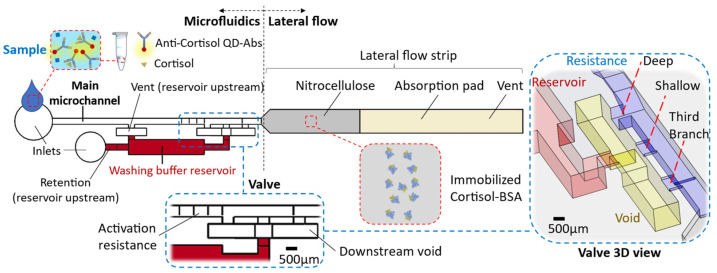
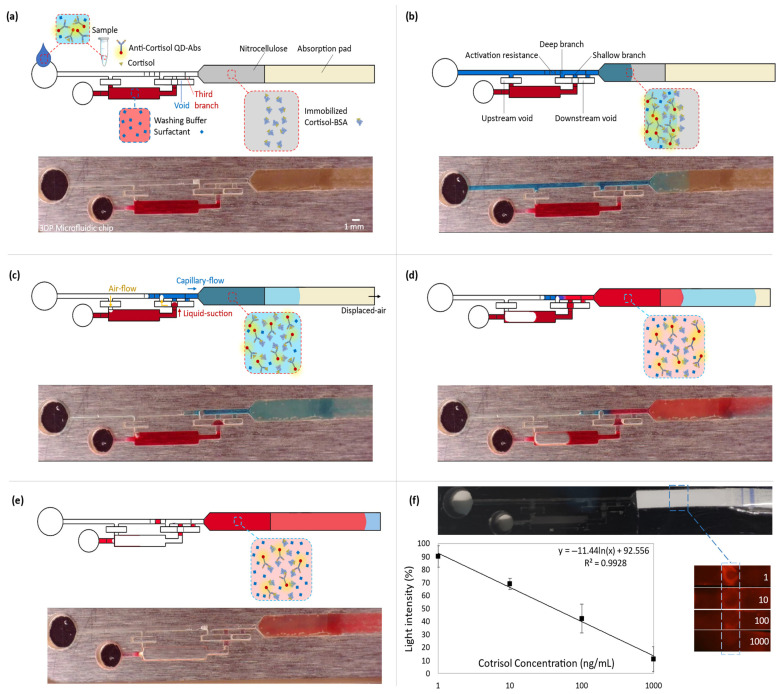
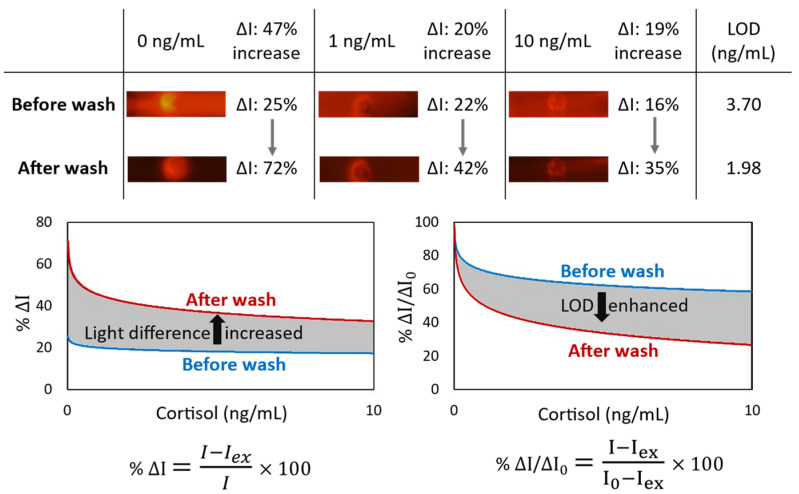
Microfluidics has emerged as a versatile technology that is applied to enhance the performance of analytical techniques, among others. Pursuing this, we present a capillary-driven microfluidic device that improves the sensitivity of lateral flow immunoassay rapid tests thanks to offering an automated washing step. A novel multilevel microfluidic chip was 3D-printed with a photocurable black resin, sealed by an optically clear pressure-sensitive adhesive, and linked to the lateral flow strip. To depict the efficacy of microfluidics and the washing step, cortisol was measured quantitatively within the proposed device. Measuring cortisol levels is a way to capture physiological stress responses. Among biofluids, saliva is less infectious and easier to sample than others. However, higher sensitivity is demanded because the salivary cortisol concentrations are much lower than in blood. We carried out a competitive lateral flow immunoassay protocol with the difference that the microfluidic device applies an automated washing step after the sample is drained downstream. It washes the trapped quantum-dot-labeled antibodies out from nitrocellulose, diminishing background noise as these are bonded to cortisols and not to the immobilized receptors. Fluorescence spectroscopy, as a high-precision analysis, was successfully applied to determine clinically relevant salivary cortisol concentrations within a buffer quantitatively. The microfluidic design relied on a 3D valve that avoids reagent cross-contamination. This cross-contamination could make the washing buffer impure and undesirably dilute the sample. The proposed device is cost-effective, self-powered, robust, and ideal for non-expert users.
微流控技术已经成为一种多功能的技术,除其他外,它被应用于提高分析技术的性能。为了实现这一目标,我们提出了一种毛细管驱动的微流控装置,通过提供自动化的洗涤步骤,提高了侧向流动免疫分析快速检测的灵敏度。一种新型的多级微流控芯片采用光固化黑色树脂 3D 打印,用光学透明压敏胶密封,并与侧向流动条连接。为了说明微流控和洗涤步骤的效果,我们在提出的装置中定量测量了皮质醇。测量皮质醇水平是捕捉生理应激反应的一种方法。在生物体液中,唾液比其他体液的传染性更小,更容易采集。然而,由于唾液皮质醇浓度比血液低得多,因此需要更高的灵敏度。我们进行了竞争性侧向流动免疫分析协议,不同之处在于微流控装置在样品下游排出后应用自动化洗涤步骤。它将被量子点标记的抗体从硝酸纤维素中冲洗出来,减少背景噪声,因为这些抗体与皮质醇结合,而不是与固定化受体结合。荧光光谱学作为一种高精度分析方法,成功地应用于定量测定缓冲液中的临床相关唾液皮质醇浓度。微流控设计依赖于 3D 阀,可避免试剂交叉污染。这种交叉污染可能会使洗涤缓冲液不纯,并不可取地稀释样品。该装置具有成本效益、自供电、坚固耐用等特点,非常适合非专业用户使用。