TUM School of Natural Sciences, Department of Chemistry, Technical University of Munich, Werner-Siemens Chair for Synthetic Biotechnology (WSSB), Lichtenbergstr. 4, 85748 Garching, Germany.
Mar Drugs. 2023 Aug 15;21(8):448. doi: 10.3390/md21080448.
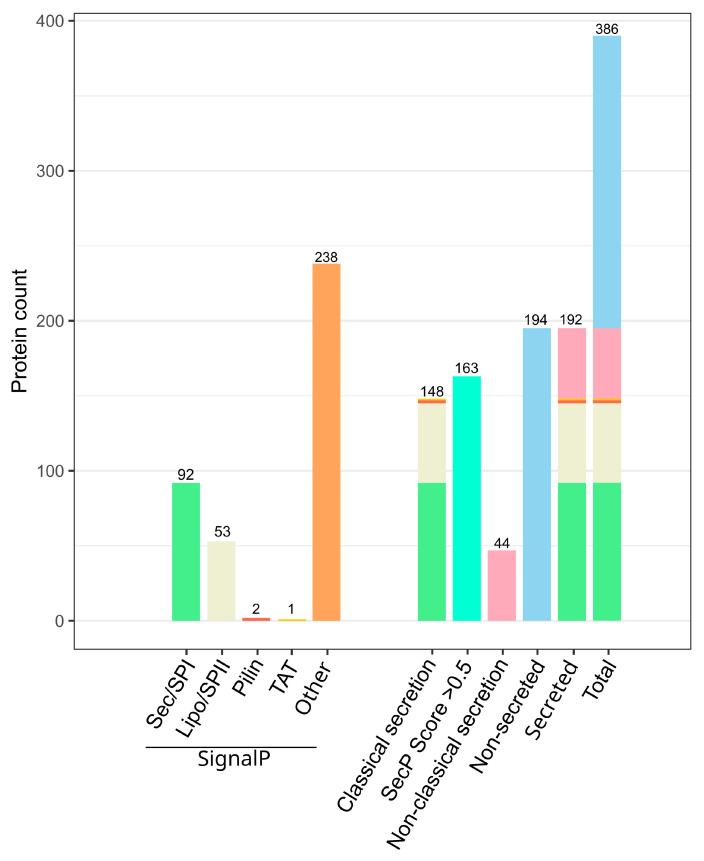
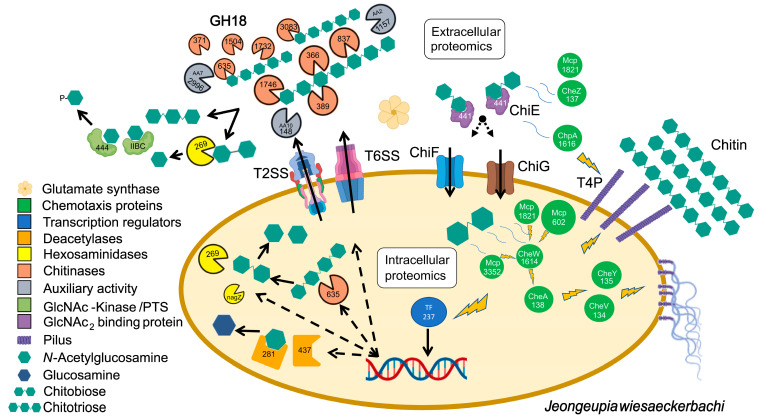
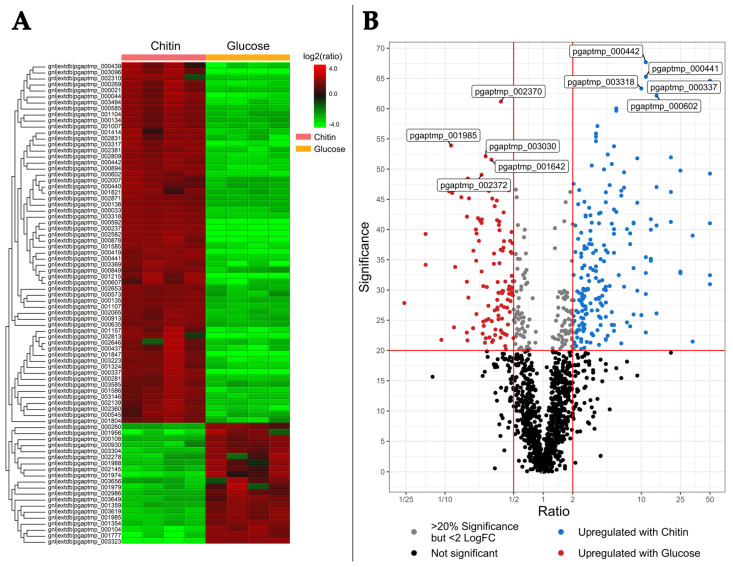
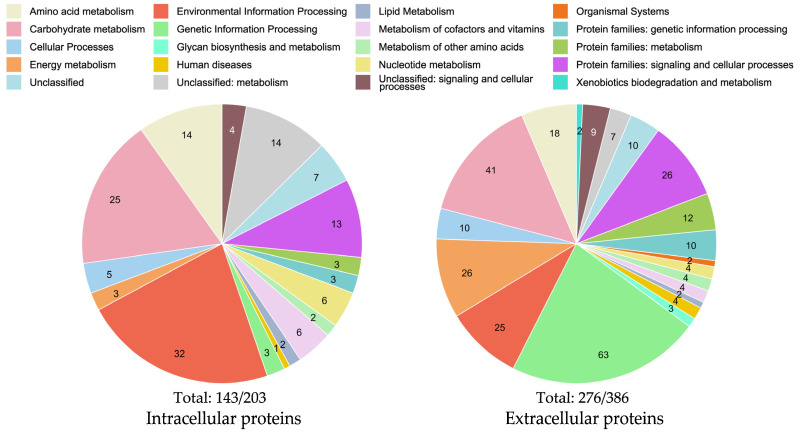
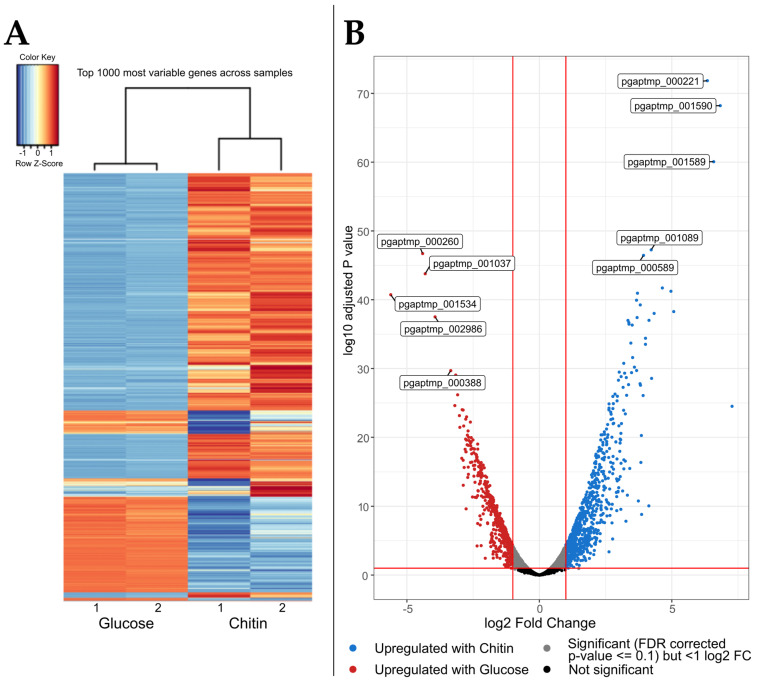
In nature, chitin, the most abundant marine biopolymer, does not accumulate due to the action of chitinolytic organisms, whose saccharification systems provide instructional blueprints for effective chitin conversion. Therefore, discovery and deconstruction of chitinolytic machineries and associated enzyme systems are essential for the advancement of biotechnological chitin valorization. Through combined investigation of the chitin-induced secretome with differential proteomic and transcriptomic analyses, a holistic system biology approach has been applied to unravel the chitin response mechanisms in the Gram-negative . Hereby, the majority of the genome-encoded chitinolytic machinery, consisting of various glycoside hydrolases and a lytic polysaccharide monooxygenase, could be detected extracellularly. Intracellular proteomics revealed a distinct translation pattern with significant upregulation of glucosamine transport, metabolism, and chemotaxis-associated proteins. While the differential transcriptomic results suggested the overall recruitment of more genes during chitin metabolism compared to that of glucose, the detected protein-mRNA correlation was low. As one of the first studies of its kind, the involvement of over 350 unique enzymes and 570 unique genes in the catabolic chitin response of a Gram-negative bacterium could be identified through a three-way systems biology approach. Based on the cumulative data, a holistic model for the chitinolytic machinery of spp. is proposed.
在自然界中,由于几丁质分解生物体的作用,最丰富的海洋生物聚合物几丁质不会积累,而这些生物体的糖化系统为有效的几丁质转化提供了指导蓝图。因此,发现和解构几丁质分解机器和相关的酶系统对于生物技术几丁质增值的发展至关重要。通过对几丁质诱导的分泌组进行联合研究,并结合差异蛋白质组学和转录组学分析,采用整体系统生物学方法来揭示革兰氏阴性菌中的几丁质响应机制。通过这种方法,可以检测到大多数基因组编码的几丁质分解机器,包括各种糖苷水解酶和裂解多糖单加氧酶,这些酶可以在细胞外检测到。细胞内蛋白质组学揭示了一种独特的翻译模式,其中葡萄糖胺的转运、代谢和趋化相关蛋白显著上调。虽然差异转录组学结果表明,与葡萄糖代谢相比,几丁质代谢过程中总体上招募了更多的基因,但检测到的蛋白质-mRNA 相关性较低。作为此类研究中的首例之一,通过三向系统生物学方法可以鉴定出革兰氏阴性菌中参与几丁质分解代谢的超过 350 种独特酶和 570 种独特基因。基于累积数据,提出了一种关于 spp.几丁质分解机器的整体模型。