Genetics and Metabolism Section, Liver Diseases Branch, National Institutes of Diabetes and Digestive and Kidney Diseases, National Institutes of Health, Bethesda, MD.
Section on Human Iron Metabolism, Eunice Kennedy Shriver National Institute of Child Health and Human Development, National Institutes of Health, Bethesda, MD.
Blood. 2023 Nov 9;142(19):1658-1671. doi: 10.1182/blood.2023020504.
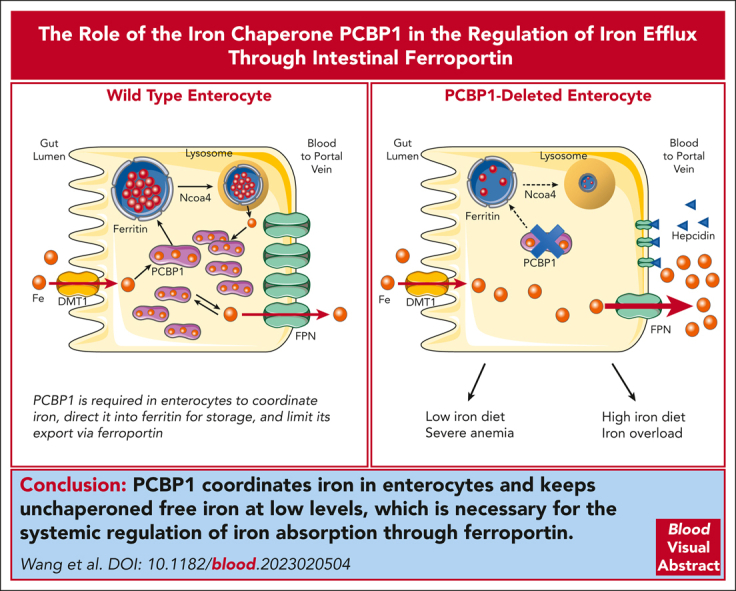
Iron is an essential nutrient required by all cells but used primarily for red blood cell production. Because humans have no effective mechanism for ridding the body of excess iron, the absorption of dietary iron must be precisely regulated. The critical site of regulation is the transfer of iron from the absorptive enterocyte to the portal circulation via the sole iron efflux transporter, ferroportin. Here, we report that poly(rC)-binding protein 1 (PCBP1), the major cytosolic iron chaperone, is necessary for the regulation of iron flux through ferroportin in the intestine of mice. Mice lacking PCBP1 in the intestinal epithelium exhibit low levels of enterocyte iron, poor retention of dietary iron in enterocyte ferritin, and excess efflux of iron through ferroportin. Excess iron efflux occurred despite lower levels of ferroportin protein in enterocytes and upregulation of the iron regulatory hormone hepcidin. PCBP1 deletion and the resulting unregulated dietary iron absorption led to poor growth, severe anemia on a low-iron diet, and liver oxidative stress with iron loading on a high-iron diet. Ex vivo culture of PCBP1-depleted enteroids demonstrated no defects in hepcidin-mediated ferroportin turnover. However, measurement of kinetically labile iron pools in enteroids competent or blocked for iron efflux indicated that PCBP1 functioned to bind and retain cytosolic iron and limit its availability for ferroportin-mediated efflux. Thus, PCBP1 coordinates enterocyte iron and reduces the concentration of unchaperoned "free" iron to a low level that is necessary for hepcidin-mediated regulation of ferroportin activity.
铁是所有细胞都需要的必需营养素,但主要用于红细胞的生成。由于人体没有有效清除体内多余铁的机制,因此必须精确调节膳食铁的吸收。调节的关键部位是通过唯一的铁外排转运蛋白 ferroportin 将铁从吸收肠细胞转移到门静脉循环。在这里,我们报告多聚(C)结合蛋白 1(PCBP1),主要的细胞质铁伴侣,是调节小鼠肠道中铁通过 ferroportin 的通量所必需的。肠上皮细胞中缺乏 PCBP1 的小鼠表现出低水平的肠细胞铁、肠细胞铁蛋白中膳食铁的保留不良以及铁通过 ferroportin 的过度外排。尽管肠细胞中 ferroportin 蛋白水平较低且铁调节激素 hepcidin 上调,但铁外排仍过多。PCBP1 缺失和由此导致的不受调节的膳食铁吸收导致生长不良、低铁饮食严重贫血以及高铁饮食时肝脏铁负荷引起的氧化应激。PCBP1 耗尽的肠类器官的体外培养显示 hepcidin 介导的 ferroportin 周转没有缺陷。然而,对能够或阻止铁外排的肠类器官中动力学不稳定铁池的测量表明,PCBP1 发挥作用以结合和保留细胞质铁并限制其用于 ferroportin 介导的外排。因此,PCBP1 协调肠细胞铁并将无伴侣“游离”铁的浓度降低到 hepcidin 介导的 ferroportin 活性调节所必需的低水平。