Department of Neurology, Copenhagen University Hospital - Herlev Gentofte, Copenhagen, Denmark.
Emergency Medical Services Copenhagen, University of Copenhagen, Telegrafvej 5, 2750, Copenhagen, Denmark.
BMC Emerg Med. 2023 Aug 25;23(1):96. doi: 10.1186/s12873-023-00870-2.
Identification of visual symptoms as a sign of acute stroke can be challenging for both first line healthcare professionals and lay persons. Failed recognition of visual symptoms by medical dispatchers at the Emergency Medical Dispatch Center (EMDC-112) or personnel at the Out-of-Hours Health Service (OOHS) may delay stroke revascularization. We aimed to identify correct system response to visual symptoms in emergency calls.
Phone calls from patient or bystander to the EMDC-112 or OOHS, which included visual symptoms on patients later verified with stroke/Transient ischemic attack (TIA) diagnosis, were analyzed. Data were stratified according to hospitalization within and after 4.5 h from symptom onset. Descriptive and multiple logistic regression analysis were performed.
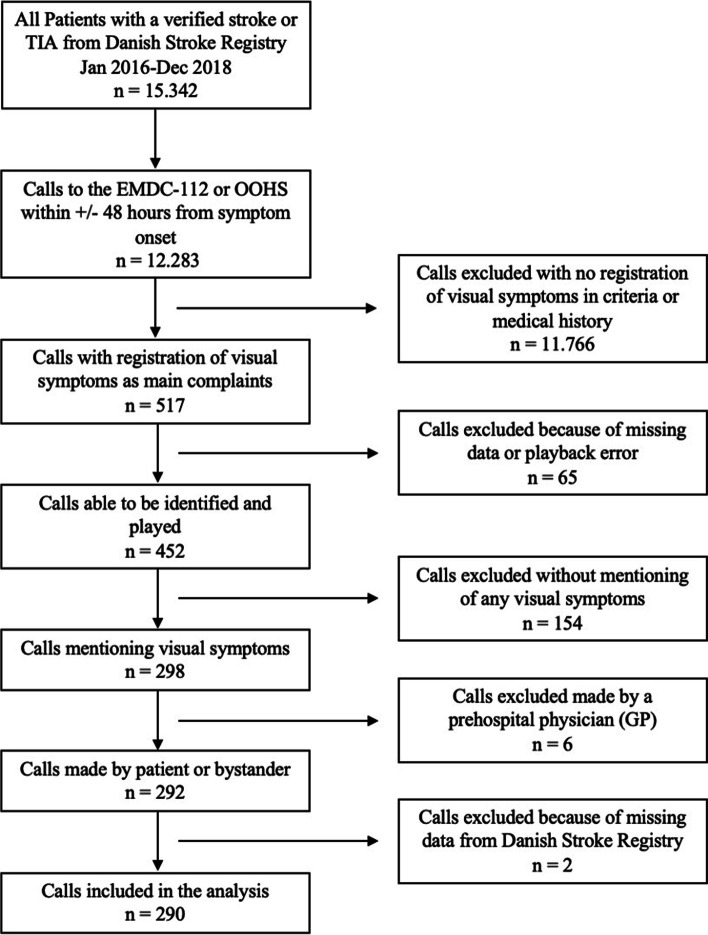
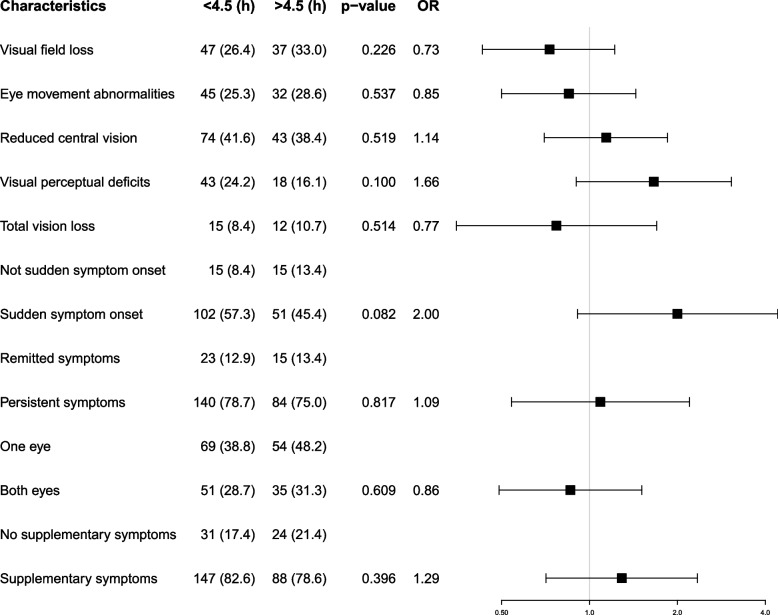
Of 517 calls identified, 290 calls fulfilled inclusion criteria. Only 30% of the patients received correct visitation by the medical dispatchers and referral to the hospital by a high-priority ambulance. Correct visitation was associated with early contact (adjusted OR: 2.37, 95% CI: 1.11, 5.03), contact to the EMDC-112 (adjusted OR: 3.18, 95% CI: 1.80, 5.62), and when the medical dispatcher asked additional questions on typical stroke symptoms (adjusted OR: 6.36, 95% CI: 3.01, 13.43). No specific visual symptom was associated with stroke recognition and fast hospitalization.
First line healthcare professionals had significant problems in identifying visual symptoms as a sign of acute stroke and eliciting correct response. This highlights an urgent need to improve knowledge of visual symptoms in acute stroke and emphasize correct response to stroke symptoms in general.
对于一线医护人员和非专业人士来说,识别急性中风的视觉症状具有挑战性。如果医疗调度员在紧急医疗调度中心(EMDC-112)或非工作时间医疗服务(OOHS)人员未能识别出视觉症状,可能会延迟中风再灌注治疗。我们旨在确定正确的系统对紧急呼叫中视觉症状的反应。
分析了来自患者或旁观者拨打 EMDC-112 或 OOHS 的电话,这些电话包括后来确诊为中风/短暂性脑缺血发作(TIA)的患者的视觉症状。数据根据症状发作后 4.5 小时内和 4.5 小时后的住院情况进行分层。进行了描述性和多因素逻辑回归分析。
在确定的 517 个电话中,有 290 个电话符合纳入标准。只有 30%的患者得到了医疗调度员的正确探视,并通过高优先级救护车转诊到医院。正确的探视与早期联系(调整后的 OR:2.37,95%CI:1.11,5.03)、与 EMDC-112 的联系(调整后的 OR:3.18,95%CI:1.80,5.62)以及医疗调度员询问典型中风症状的额外问题有关(调整后的 OR:6.36,95%CI:3.01,13.43)。没有特定的视觉症状与中风识别和快速住院有关。
一线医护人员在识别急性中风的视觉症状并引发正确反应方面存在重大问题。这突出表明迫切需要提高对急性中风视觉症状的认识,并强调对一般中风症状的正确反应。