Donders Institute for Brain, Cognition and Behaviour, Radboud University Medical Center, Kapittelweg 29, Nijmegen, 6525 EN, The Netherlands.
Research Division of Mind and Brain, Department of Psychiatry and Neurosciences CCM, Charité - Universitätsmedizin Berlin, Corporate Member of Freie Universität Berlin, Humboldt-Universität Zu Berlin, and Berlin Institute of Health, Berlin, Germany.
BMC Psychol. 2023 Aug 25;11(1):245. doi: 10.1186/s40359-023-01249-5.
Stress-related disorders such as anxiety and depression are highly prevalent and cause a tremendous burden for affected individuals and society. In order to improve prevention strategies, knowledge regarding resilience mechanisms and ways to boost them is highly needed. In the Dynamic Modelling of Resilience - interventional multicenter study (DynaM-INT), we will conduct a large-scale feasibility and preliminary efficacy test for two mobile- and wearable-based just-in-time adaptive interventions (JITAIs), designed to target putative resilience mechanisms. Deep participant phenotyping at baseline serves to identify individual predictors for intervention success in terms of target engagement and stress resilience.
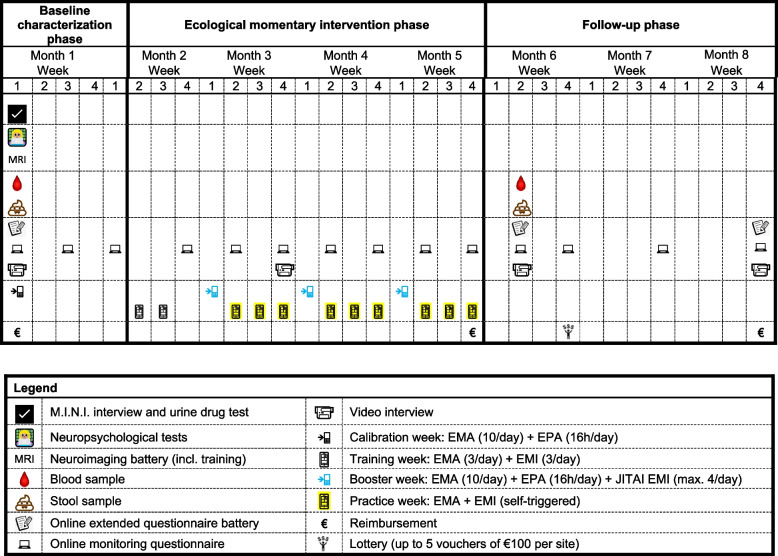
DynaM-INT aims to recruit N = 250 healthy but vulnerable young adults in the transition phase between adolescence and adulthood (18-27 years) across five research sites (Berlin, Mainz, Nijmegen, Tel Aviv, and Warsaw). Participants are included if they report at least three negative burdensome past life events and show increased levels of internalizing symptoms while not being affected by any major mental disorder. Participants are characterized in a multimodal baseline phase, which includes neuropsychological tests, neuroimaging, bio-samples, sociodemographic and psychological questionnaires, a video-recorded interview, as well as ecological momentary assessments (EMA) and ecological physiological assessments (EPA). Subsequently, participants are randomly assigned to one of two ecological momentary interventions (EMIs), targeting either positive cognitive reappraisal or reward sensitivity. During the following intervention phase, participants' stress responses are tracked using EMA and EPA, and JITAIs are triggered if an individually calibrated stress threshold is crossed. In a three-month-long follow-up phase, parts of the baseline characterization phase are repeated. Throughout the entire study, stressor exposure and mental health are regularly monitored to calculate stressor reactivity as a proxy for outcome resilience. The online monitoring questionnaires and the repetition of the baseline questionnaires also serve to assess target engagement.
The DynaM-INT study intends to advance the field of resilience research by feasibility-testing two new mechanistically targeted JITAIs that aim at increasing individual stress resilience and identifying predictors for successful intervention response. Determining these predictors is an important step toward future randomized controlled trials to establish the efficacy of these interventions.
与压力相关的障碍,如焦虑和抑郁,非常普遍,给受影响的个人和社会带来了巨大的负担。为了改善预防策略,非常需要了解韧性机制和增强韧性的方法。在动态韧性建模 - 干预性多中心研究(DynaM-INT)中,我们将对两种基于移动和可穿戴设备的即时自适应干预措施(JITAI)进行大规模可行性和初步疗效测试,这些干预措施旨在针对假设的韧性机制。在基线进行深入的参与者表型分析,以确定在目标参与度和压力韧性方面干预成功的个体预测因素。
DynaM-INT 的目标是在五个研究地点(柏林、美因茨、奈梅亨、特拉维夫和华沙)招募 250 名处于青春期和成年期之间过渡阶段的健康但脆弱的年轻成年人(18-27 岁)。如果参与者报告至少有三个负面的负担过重的过去生活事件,并且表现出内化症状增加,但没有任何主要精神障碍,他们就会被纳入研究。参与者在多模态基线阶段进行特征描述,包括神经心理学测试、神经影像学、生物样本、社会人口学和心理问卷、视频记录访谈,以及生态瞬时评估(EMA)和生态生理评估(EPA)。随后,参与者被随机分配到两种生态瞬时干预措施(EMI)之一,分别针对积极的认知重评或奖励敏感性。在随后的干预阶段,使用 EMA 和 EPA 跟踪参与者的压力反应,如果个体校准的压力阈值被超过,则触发 JITAI。在为期三个月的随访阶段,重复基线特征描述阶段的一部分。在整个研究过程中,定期监测应激源暴露和心理健康状况,以计算应激反应性作为结果韧性的替代指标。在线监测问卷和基线问卷的重复也用于评估目标参与度。
DynaM-INT 研究旨在通过对两种新的机制靶向 JITAI 进行可行性测试,来推进韧性研究领域的发展,这些干预措施旨在提高个体的压力韧性,并确定成功干预反应的预测因素。确定这些预测因素是未来随机对照试验以确定这些干预措施疗效的重要步骤。