Programa de Pós-Graduação de Ciências Médicas, Faculdade de Medicina, Universidade de Brasília, Brasília, DF, Brazil.
Programa de Pós-Graduação de Ciências Médicas, Faculdade de Medicina, Universidade de Brasília, Brasília, DF, Brazil; Serviço de Dermatologia, Hospital Universitário de Brasília, Brasília, DF, Brazil.
An Bras Dermatol. 2024 Jan-Feb;99(1):34-42. doi: 10.1016/j.abd.2023.03.002. Epub 2023 Aug 25.
Real-world, primary data on the treatment of psoriasis are scarce, especially concerning the role of soluble biomarkers as outcome predictors.
The authors evaluated the utility of Th1/Th17 serum cytokines along with clinical characteristics as predictors of drug survival in the treatment of psoriasis.
The authors consecutively included participants with moderate to severe psoriasis who were followed up for 6 years. Baseline interferon-α, tumor necrosis factor-α, and interleukin (IL)-2, IL-4, IL-6, IL-10, and IL-17A were measured using a cytometric bead array; clinical data were assessed. The authors calculated hazard ratios (HRs) for drug survival using a Cox proportional hazards model.
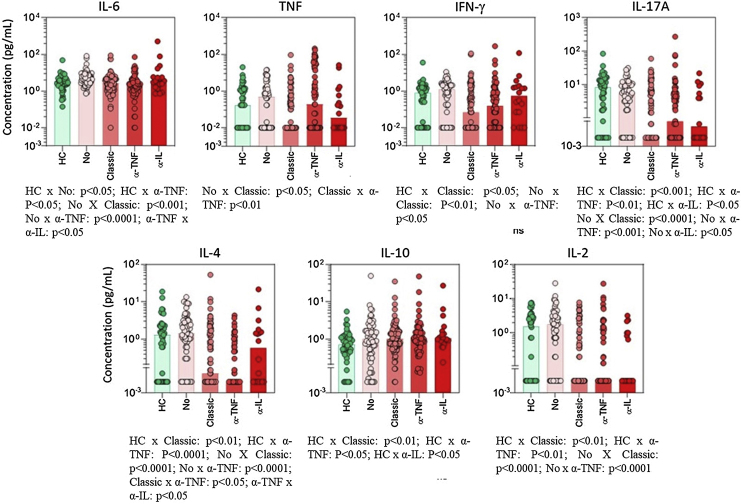
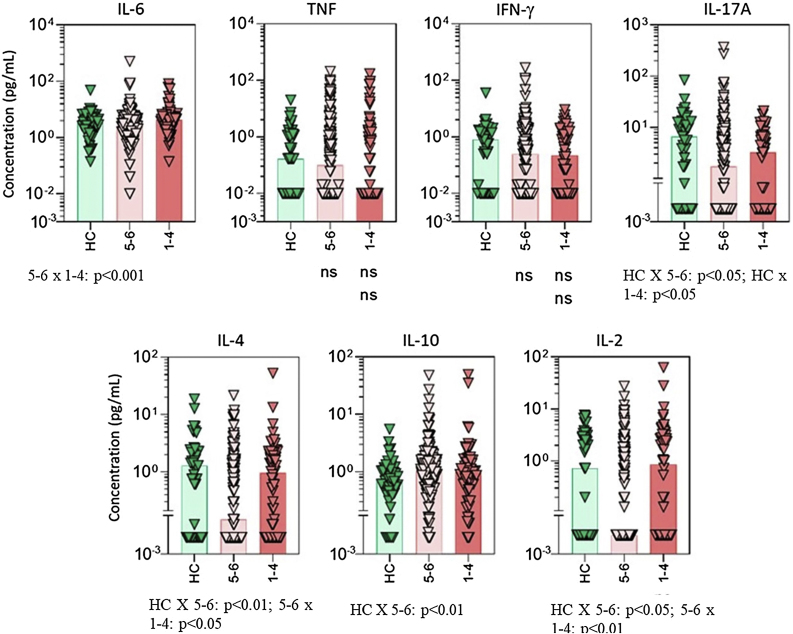
The authors included 262 patients, most of whom used systemic immunosuppressants or biologics. In the multivariate model, poor quality of life measured by the Dermatology Life Quality Index (HR = 1.04; 95% CI 1.01‒1.07; p = 0.012) and elevated baseline IL-6 (HR = 1.99; 95% CI 1.29‒3.08; p = 0.002) were associated with treatment interruption.
The main limitation of any cohort study is the presence of confounders that could not be detected in clinical evaluation.
Poor quality of life and elevated baseline serum IL-6 level predicted treatment interruption in patients with moderate to severe psoriasis. Although IL-6 is not the most important mediator of the inflammatory pathway in the skin environment, it is an interesting biomarker candidate for predicting psoriasis treatment response.
关于银屑病治疗的真实世界、原始数据十分匮乏,特别是关于可溶性生物标志物作为结局预测因子的作用。
作者评估了 Th1/Th17 血清细胞因子与临床特征作为预测银屑病治疗药物生存的作用。
作者连续纳入了 262 例中重度银屑病患者,对其进行了 6 年的随访。采用流式细胞术检测干扰素-α、肿瘤坏死因子-α 及白细胞介素(IL)-2、IL-4、IL-6、IL-10 和 IL-17A。评估临床数据。采用 Cox 比例风险模型计算药物生存的风险比(HR)。
作者纳入的大多数患者(n=262)接受了全身免疫抑制剂或生物制剂治疗。在多变量模型中,使用皮肤病生活质量指数(Dermatology Life Quality Index,DLQI)评估的生活质量较差(HR=1.04;95%CI 1.01‒1.07;p=0.012)和基线 IL-6 升高(HR=1.99;95%CI 1.29‒3.08;p=0.002)与治疗中断相关。
任何队列研究的主要局限性是临床评估中可能无法检测到的混杂因素。
生活质量较差和基线血清 IL-6 水平升高预测了中重度银屑病患者的治疗中断。虽然 IL-6 不是皮肤环境中炎症通路的最重要介质,但它是预测银屑病治疗反应的一个有趣的生物标志物候选物。