Mahyoub Jazem A, Algamdi Abdullah G, Aljameeli Mohammad M
Department of Biological Sciences, Faculty of Science, King Abdulaziz University, P. O. Box: 80203, Jeddah, Saudi Arabia.
Department of Biology, College of Arts and Sciences, Northern Border University, Rafha, Saudi Arabia.
Saudi J Biol Sci. 2023 Sep;30(9):103776. doi: 10.1016/j.sjbs.2023.103776. Epub 2023 Aug 11.
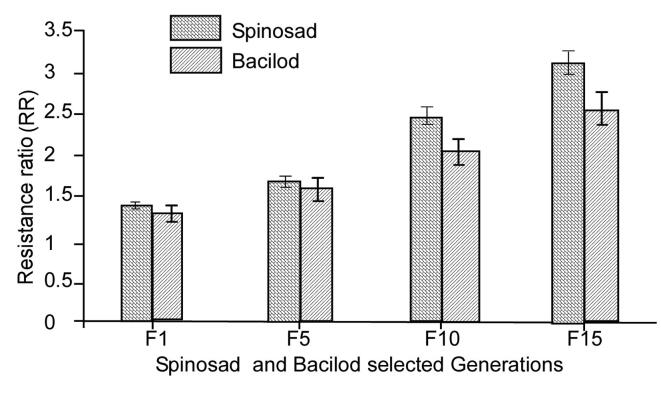
A laboratory strain of (L) was subjected repeatedly to larval selection pressure with two bacterial insecticides, spinosad (a) and bacilod (). The results indicated that the mosquito acquired low resistance to spinosad and bacilod by about 3.1 and 2.4-fold, respectively, due to selection pressure for fifteen successive generations. The slope values of the selected strains were increased gradually from one generation to the next, indicating moderate homogeneity between individuals in their response to the test bio-insecticide. Moreover, larval selection with current bacterial bioinsecticides prolonged the time required to digest a blood meal. It showed an evident decrease in the reproductive potential of adult mosquitoes surviving selected larvae.
一种实验室品系的(L)埃及伊蚊反复受到两种细菌杀虫剂多杀菌素(a)和芽孢杆菌()的幼虫选择压力。结果表明,由于连续15代的选择压力,该品系蚊子对多杀菌素和芽孢杆菌分别产生了约3.1倍和2.4倍的低抗性。所选品系的斜率值逐代逐渐增加,表明个体对测试生物杀虫剂的反应具有中等同质性。此外,用当前的细菌生物杀虫剂进行幼虫选择延长了消化血餐所需的时间。它显示出经选择的幼虫存活下来的成年蚊子的繁殖潜力明显下降。