Wang Faming, Liu Jihua, Qin Guoming, Zhang Jingfan, Zhou Jinge, Wu Jingtao, Zhang Lulu, Thapa Poonam, Sanders Christian J, Santos Isaac R, Li Xiuzhen, Lin Guanghui, Weng Qihao, Tang Jianwu, Jiao Nianzhi, Ren Hai
Xiaoliang Research Station of Tropical Coastal Ecosystems, Key Laboratory of Vegetation Restoration and Management of Degraded Ecosystems, and the CAS Engineering Laboratory for Ecological Restoration of Island and Coastal Ecosystems, South China Botanical Garden, Chinese Academy of Sciences, Guangzhou 510650, China.
Southern Marine Science and Engineering Guangdong Laboratory (Guangzhou), Guangzhou 510650, China.
Innovation (Camb). 2023 Jul 21;4(5):100481. doi: 10.1016/j.xinn.2023.100481. eCollection 2023 Sep 11.
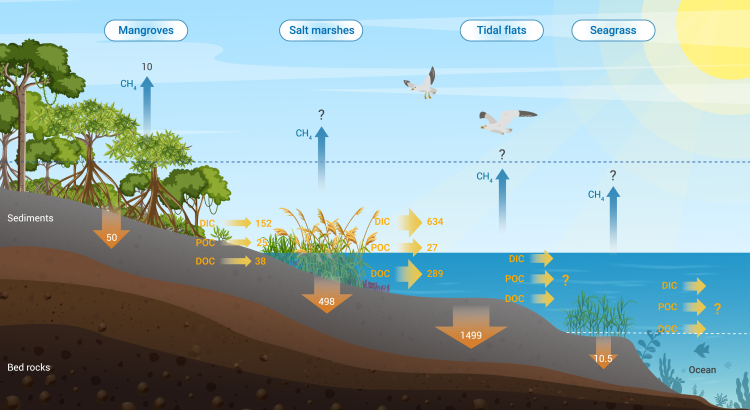
To achieve the Paris Agreement, China pledged to become "Carbon Neutral" by the 2060s. In addition to massive decarbonization, this would require significant changes in ecosystems toward negative CO emissions. The ability of coastal blue carbon ecosystems (BCEs), including mangrove, salt marsh, and seagrass meadows, to sequester large amounts of CO makes their conservation and restoration an important "nature-based solution (NbS)" for climate adaptation and mitigation. In this review, we examine how BCEs in China can contribute to climate mitigation. On the national scale, the BCEs in China store up to 118 Tg C across a total area of 1,440,377 ha, including over 75% as unvegetated tidal flats. The annual sedimental C burial of these BCEs reaches up to 2.06 Tg C year, of which most occurs in salt marshes and tidal flats. The lateral C flux of mangroves and salt marshes contributes to 1.17 Tg C year along the Chinese coastline. Conservation and restoration of BCEs benefit climate change mitigation and provide other ecological services with a value of $32,000 ha year. The potential practices and technologies that can be implemented in China to improve BCE C sequestration, including their constraints and feasibility, are also outlined. Future directions are suggested to improve blue carbon estimates on aerial extent, carbon stocks, sequestration, and mitigation potential. Restoring and preserving BCEs would be a cost-effective step to achieve Carbon Neutral by 2060 in China despite various barriers that should be removed.
为实现《巴黎协定》目标,中国承诺在21世纪60年代实现“碳中和”。除大规模脱碳外,这还需要生态系统朝着负碳排放方向发生重大变化。包括红树林、盐沼和海草草甸在内的沿海蓝碳生态系统具有大量固碳能力,这使得对它们的保护和恢复成为气候适应和缓解的一项重要“基于自然的解决方案(NbS)”。在本综述中,我们研究了中国的蓝碳生态系统如何有助于缓解气候变化。在国家层面,中国的蓝碳生态系统在总面积达1440377公顷的区域内储存了高达118太克碳,其中超过75%为无植被潮滩。这些蓝碳生态系统的年沉积物碳埋藏量高达每年2.06太克碳,其中大部分发生在盐沼和潮滩。红树林和盐沼的侧向碳通量在中国海岸线沿线每年贡献1.17太克碳。蓝碳生态系统的保护和恢复有利于缓解气候变化,并提供价值为每年每公顷32000美元的其他生态系统服务。文中还概述了中国可实施的提高蓝碳生态系统碳固存的潜在实践和技术,包括其限制因素和可行性。建议了未来的发展方向,以改进蓝碳在面积范围、碳储量、固存和缓解潜力方面的估算。尽管存在各种需要消除的障碍,但恢复和保护蓝碳生态系统将是中国在2060年实现碳中和的一个具有成本效益的步骤。