• 文献检索
  • 文档翻译
  • 深度研究
  • 学术资讯
  • Suppr Zotero 插件Zotero 插件
  • 邀请有礼
  • 套餐&价格
  • 历史记录
应用&插件
Suppr Zotero 插件Zotero 插件浏览器插件Mac 客户端Windows 客户端微信小程序
定价
高级版会员购买积分包购买API积分包
服务
文献检索文档翻译深度研究API 文档MCP 服务
关于我们
关于 Suppr公司介绍联系我们用户协议隐私条款
关注我们

Suppr 超能文献

核心技术专利:CN118964589B侵权必究
粤ICP备2023148730 号-1Suppr @ 2026

文献检索

告别复杂PubMed语法,用中文像聊天一样搜索,搜遍4000万医学文献。AI智能推荐,让科研检索更轻松。

立即免费搜索

文件翻译

保留排版,准确专业,支持PDF/Word/PPT等文件格式,支持 12+语言互译。

免费翻译文档

深度研究

AI帮你快速写综述,25分钟生成高质量综述,智能提取关键信息,辅助科研写作。

立即免费体验

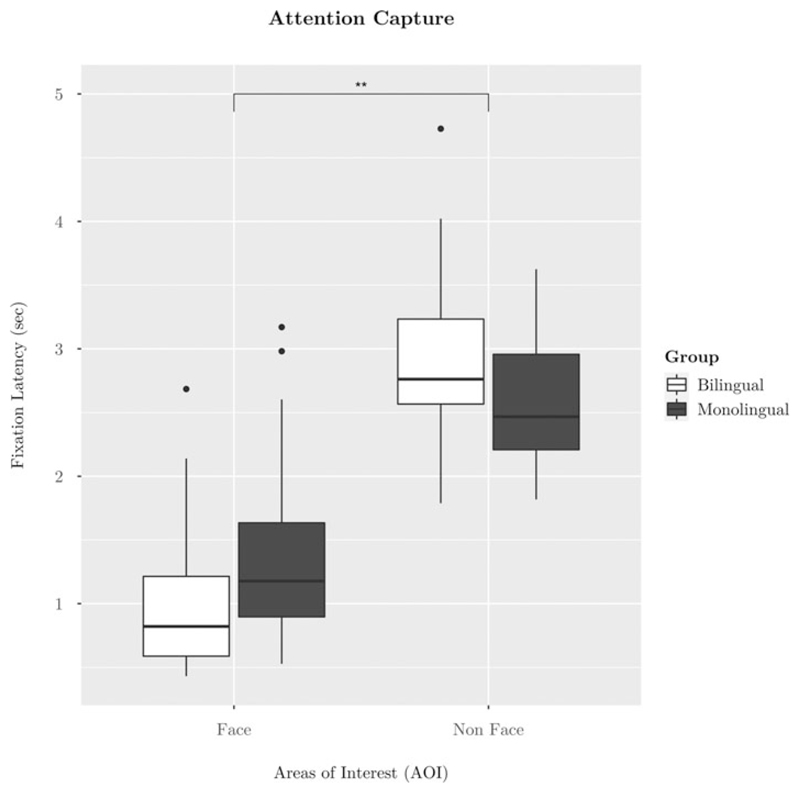
与单语儿童相比,双语学步儿童对静态面孔的注意力捕捉能力更强。

Bilingual toddlers show increased attention capture by static faces compared to monolinguals.

作者信息

Mousley Victoria L, MacSweeney Mairéad, Mercure Evelyne

机构信息

Institute of Cognitive Neuroscience, University College London, London, United Kingdom.

Deafness, Cognition and Language Research Centre, University College London, London, United Kingdom.

出版信息

Biling (Camb Engl). 2023 Aug;26(4):835-844. doi: 10.1017/S136672892200092X. Epub 2023 Jan 20.

DOI:10.1017/S136672892200092X
PMID:37636491
原文链接:https://pmc.ncbi.nlm.nih.gov/articles/PMC7614981/
Abstract

Bilingual infants rely differently than monolinguals on facial information, such as lip patterns, to differentiate their native languages. This may explain, at least in part, why young monolinguals and bilinguals show differences in social attention. For example, in the first year, bilinguals attend faster and more often to static faces over non-faces than do monolinguals (Mercure et al., 2018). However, the developmental trajectories of these differences are unknown. In this pre-registered study, data were collected from 15- to 18-month-old monolinguals (English) and bilinguals (English and another language) to test whether group differences in face-looking behaviour persist into the second year. We predicted that bilinguals would orient more rapidly and more often to static faces than monolinguals. Results supported the first but not the second hypothesis. This suggests that, even into the second year of life, toddlers' rapid visual orientation to static social stimuli is sensitive to early language experience.

摘要

双语婴儿在区分母语时,对面部信息(如嘴唇动作模式)的依赖方式与单语婴儿不同。这至少可以部分解释为什么年幼的单语者和双语者在社会注意力方面存在差异。例如,在第一年,与单语婴儿相比,双语婴儿更快且更频繁地关注静态面孔而非非面孔(Mercure等人,2018年)。然而,这些差异的发展轨迹尚不清楚。在这项预先注册的研究中,收集了15至18个月大的单语者(英语)和双语者(英语和另一种语言)的数据,以测试面部注视行为的群体差异是否持续到第二年。我们预测,与单语者相比,双语者会更快且更频繁地转向静态面孔。结果支持了第一个假设,但不支持第二个假设。这表明,即使到了生命的第二年,幼儿对静态社会刺激的快速视觉定向仍对早期语言经验敏感。

https://cdn.ncbi.nlm.nih.gov/pmc/blobs/d02c/7614981/2c573d4d47d3/EMS158135-f003.jpg
https://cdn.ncbi.nlm.nih.gov/pmc/blobs/d02c/7614981/024478e8c690/EMS158135-f001.jpg
https://cdn.ncbi.nlm.nih.gov/pmc/blobs/d02c/7614981/c32b7df78232/EMS158135-f002.jpg
https://cdn.ncbi.nlm.nih.gov/pmc/blobs/d02c/7614981/2c573d4d47d3/EMS158135-f003.jpg
https://cdn.ncbi.nlm.nih.gov/pmc/blobs/d02c/7614981/024478e8c690/EMS158135-f001.jpg
https://cdn.ncbi.nlm.nih.gov/pmc/blobs/d02c/7614981/c32b7df78232/EMS158135-f002.jpg
https://cdn.ncbi.nlm.nih.gov/pmc/blobs/d02c/7614981/2c573d4d47d3/EMS158135-f003.jpg

相似文献

1
Bilingual toddlers show increased attention capture by static faces compared to monolinguals.与单语儿童相比,双语学步儿童对静态面孔的注意力捕捉能力更强。
Biling (Camb Engl). 2023 Aug;26(4):835-844. doi: 10.1017/S136672892200092X. Epub 2023 Jan 20.
2
Impact of Language Experience on Attention to Faces in Infancy: Evidence From Unimodal and Bimodal Bilingual Infants.语言经验对婴儿期面部注意力的影响:来自单语和双语婴儿的证据。
Front Psychol. 2018 Oct 16;9:1943. doi: 10.3389/fpsyg.2018.01943. eCollection 2018.
3
Bilingual and monolingual brains compared: a functional magnetic resonance imaging investigation of syntactic processing and a possible "neural signature" of bilingualism.双语和单语大脑的比较:一项关于句法处理的功能磁共振成像研究以及双语可能的“神经特征”
J Cogn Neurosci. 2008 Jan;20(1):153-69. doi: 10.1162/jocn.2008.20011.
4
Bilingual toddlers' comprehension of mixed sentences is asymmetrical across their two languages.双语幼儿对混合句的理解在两种语言中是不对称的。
Dev Sci. 2019 Jul;22(4):e12794. doi: 10.1111/desc.12794. Epub 2019 Jan 15.
5
Language experience influences audiovisual speech integration in unimodal and bimodal bilingual infants.语言经验影响单模态和双模态双语婴儿的视听言语整合。
Dev Sci. 2019 Jan;22(1):e12701. doi: 10.1111/desc.12701. Epub 2018 Jul 16.
6
Home language and societal language skills in second-generation bilingual adults.第二代双语成年人的母语和社会语言技能。
Int J Billing. 2020 Oct-Dec;24(5-6):1071-1087. doi: 10.1177/1367006920932221. Epub 2020 Jun 19.
7
Shining new light on the brain's "bilingual signature": a functional Near Infrared Spectroscopy investigation of semantic processing.为大脑的“双语特征”带来新曙光:一项关于语义处理的功能性近红外光谱研究。
Neuroimage. 2008 Feb 1;39(3):1457-71. doi: 10.1016/j.neuroimage.2007.10.017. Epub 2007 Oct 25.
8
Novel word retention in bilingual and monolingual speakers.双语和单语说话者的新词保持。
Front Psychol. 2014 Sep 29;5:1024. doi: 10.3389/fpsyg.2014.01024. eCollection 2014.
9
Selective attention to the mouth of talking faces in monolinguals and bilinguals aged 5 months to 5 years.5 个月至 5 岁的单语者和双语者对说话人脸嘴部的选择性注意。
Dev Psychol. 2019 Aug;55(8):1640-1655. doi: 10.1037/dev0000750. Epub 2019 Jun 6.
10
Sprinting in two languages: Picture naming performance of older Spanish-English bilinguals on the Multilingual Naming Test Sprint 2.0.两种语言的冲刺:多语种命名测试冲刺 2.0 中老年人西班牙语-英语双语者的图片命名表现。
Neuropsychology. 2024 Oct;38(7):653-664. doi: 10.1037/neu0000958. Epub 2024 Jul 11.

本文引用的文献

1
Infants' looking preferences for social versus non-social objects reflect genetic variation.婴儿对社交对象与非社交对象的注视偏好反映了基因变异。
Nat Hum Behav. 2024 Jan;8(1):115-124. doi: 10.1038/s41562-023-01764-w. Epub 2023 Nov 27.
2
Bilingualism Affects Infant Cognition: Insights From New and Open Data.双语影响婴儿认知:来自新的公开数据的见解。
Open Mind (Camb). 2022 Jul 1;6:88-117. doi: 10.1162/opmi_a_00057. eCollection 2022.
3
Face Processing in Early Development: A Systematic Review of Behavioral Studies and Considerations in Times of COVID-19 Pandemic.
早期发育中的面孔加工:行为研究的系统综述及新冠疫情时期的考量
Front Psychol. 2022 Feb 18;13:778247. doi: 10.3389/fpsyg.2022.778247. eCollection 2022.
4
Dual language input and the impact of language separation on early lexical development.双语输入以及语言分离对早期词汇发展的影响。
Infancy. 2020 Jan;25(1):22-45. doi: 10.1111/infa.12315. Epub 2019 Oct 29.
5
Faces Attract Infants' Attention in Complex Displays.在复杂展示中,面孔吸引婴儿的注意力。
Infancy. 2009 Sep 10;14(5):550-562. doi: 10.1080/15250000903144199. Epub 2009 Sep 1.
6
The effects of bilingualism on attentional processes in the first year of life.双语对生命第一年注意过程的影响。
Dev Sci. 2021 Mar;24(2):e13011. doi: 10.1111/desc.13011. Epub 2020 Jul 10.
7
Is mere exposure enough? The effects of bilingual environments on infant cognitive development.仅仅接触就足够了吗?双语环境对婴儿认知发展的影响。
R Soc Open Sci. 2020 Feb 26;7(2):180191. doi: 10.1098/rsos.180191. eCollection 2020 Feb.
8
Selective attention to the mouth of talking faces in monolinguals and bilinguals aged 5 months to 5 years.5 个月至 5 岁的单语者和双语者对说话人脸嘴部的选择性注意。
Dev Psychol. 2019 Aug;55(8):1640-1655. doi: 10.1037/dev0000750. Epub 2019 Jun 6.
9
The impact of bilingual environments on selective attention in infancy.双语环境对婴儿选择性注意的影响。
Dev Sci. 2019 Jul;22(4):e12797. doi: 10.1111/desc.12797. Epub 2019 Jan 30.
10
Bilingual toddlers' comprehension of mixed sentences is asymmetrical across their two languages.双语幼儿对混合句的理解在两种语言中是不对称的。
Dev Sci. 2019 Jul;22(4):e12794. doi: 10.1111/desc.12794. Epub 2019 Jan 15.