Patterson Ashlea R, Elizalde-Segovia Rodrigo, Wyckoff Kira E, Zohar Arava, Ding Patrick P, Turner Wiley M, Poeppelmeier Kenneth R, Narayan Sri R, Clément Raphaële J, Seshadri Ram, Griffith Kent J
Materials Department and Materials Research Laboratory, University of California, Santa Barbara, Santa Barbara, California 93106, United States.
Department of Chemistry, University of Southern California, Los Angeles, California 90007, United States.
Chem Mater. 2023 Aug 2;35(16):6364-6373. doi: 10.1021/acs.chemmater.3c01066. eCollection 2023 Aug 22.
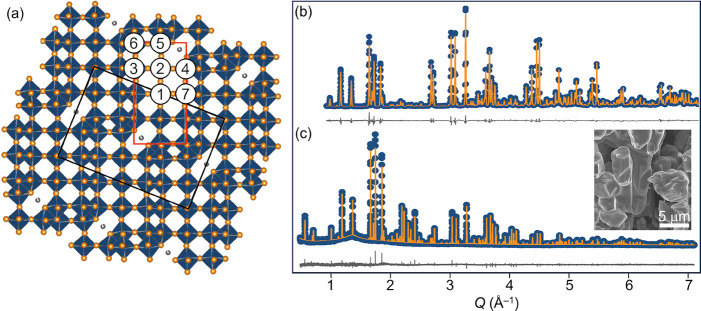
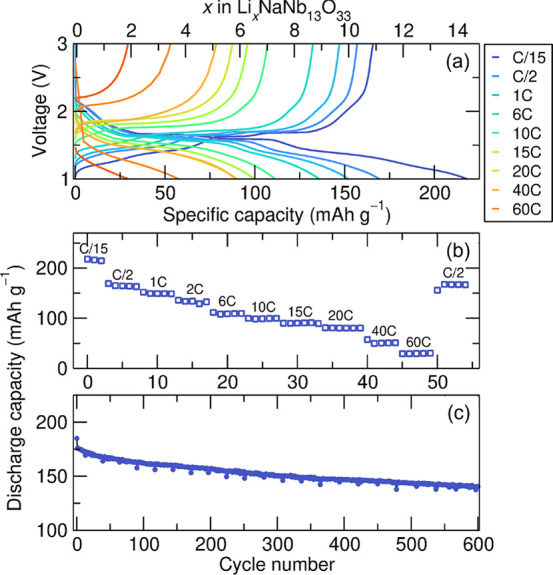
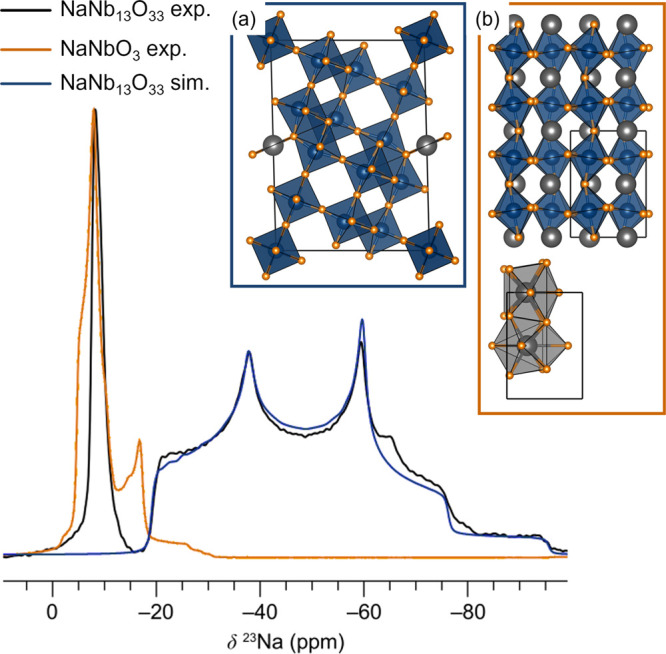
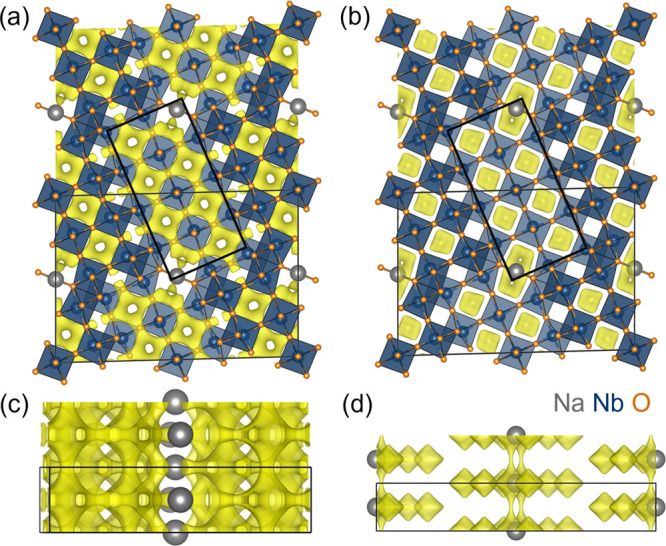
The development of new high-performing battery materials is critical for meeting the energy storage requirements of portable electronics and electrified transportation applications. Owing to their exceptionally high rate capabilities, high volumetric capacities, and long cycle lives, Wadsley-Roth compounds are promising anode materials for fast-charging and high-power lithium-ion batteries. Here, we present a study of the Wadsley-Roth-derived NaNbO phase and examine its structure and lithium insertion behavior. Structural insights from combined neutron and synchrotron diffraction as well as solid-state nuclear magnetic resonance (NMR) are presented. Solid-state NMR, in conjunction with neutron diffraction, reveals the presence of sodium ions in perovskite A-site-like block interior sites as well as square-planar block corner sites. Through combined experimental and computational studies, the high rate performance of this anode material is demonstrated and rationalized. A gravimetric capacity of 225 mA h g, indicating multielectron redox of Nb, is accessible at slow cycling rates. At a high rate, 100 mA h g of capacity is accessible in 3 min for micrometer-scale particles. Bond-valence mapping suggests that this high-rate performance stems from fast multichannel lithium diffusion involving octahedral block interior sites. Differential capacity analysis is used to identify optimal cycling rates for long-term performance, and an 80% capacity retention is achieved over 600 cycles with 30 min charging and discharging intervals. These initial results place NaNbO within the ranks of promising new high-rate lithium-ion battery anode materials that warrant further research.
开发新型高性能电池材料对于满足便携式电子设备和电动交通工具应用的储能需求至关重要。由于其具有极高的倍率性能、高体积容量和长循环寿命,瓦兹利-罗斯化合物是用于快速充电和高功率锂离子电池的有前景的负极材料。在此,我们展示了一项关于源自瓦兹利-罗斯的NaNbO相的研究,并考察了其结构和锂嵌入行为。文中呈现了结合中子衍射和同步辐射衍射以及固态核磁共振(NMR)所获得的结构见解。固态NMR与中子衍射相结合,揭示了在钙钛矿A位类块体内部位点以及平面方形块体角位点存在钠离子。通过实验和计算相结合的研究,证明并阐释了这种负极材料的高倍率性能。在慢循环速率下,可实现225 mA h g的重量容量,这表明Nb发生了多电子氧化还原。对于微米级颗粒,在3分钟内以高倍率可实现100 mA h g的容量。键价映射表明,这种高倍率性能源于涉及八面体块体内部位点的快速多通道锂扩散。通过差分容量分析来确定长期性能的最佳循环速率,在30分钟充放电间隔下经过600次循环可实现80%的容量保持率。这些初步结果使NaNbO跻身于有前景的新型高倍率锂离子电池负极材料之列,值得进一步研究。