He Siyang, Wang Weiwei, Wang Weidong, Hu Haiyang, Xu Ping, Tang Hongzhi
State Key Laboratory of Microbial Metabolism, and School of Life Sciences & Biotechnology, Shanghai Jiao Tong University, Shanghai, 200240, People's Republic of China.
College of Life Science, Northeast Forestry University, Harbin, 150040, China.
Synth Syst Biotechnol. 2023 Aug 9;8(3):536-545. doi: 10.1016/j.synbio.2023.08.001. eCollection 2023 Sep.
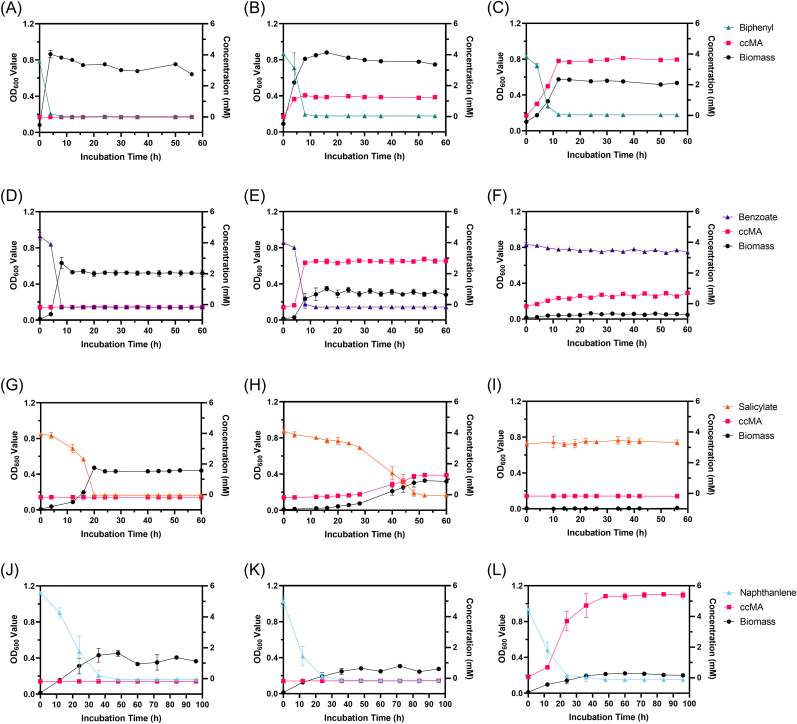
Industrial expansion has led to environmental pollution by xenobiotic compounds like polycyclic aromatic hydrocarbons and monoaromatic hydrocarbons. spp. have broad metabolic potential for degrading aromatic compounds. The objective of this study was to develop a "biological funneling" strategy based on genetic modification to convert complex aromatic compounds into -muconate (ccMA) using B6-2 and MPDS as biocatalysts. The engineered strains B6-2 (B6-2ΔcatBΔsalC) and MPDS (MPDSΔsalC(pUCP18k-catA)) thrived with biphenyl or naphthalene as the sole carbon source and produced ccMA, attaining molar conversions of 95.3% (ccMA/biphenyl) and 100% (ccMA/naphthalene). Under mixed substrates, B6-2ΔcatBΔsalC grew on biphenyl as a carbon source and transformed ccMA from non-growth substrates benzoate or salicylate to obtain higher product concentration. Inserting exogenous clusters like and allowed B6-2 recombinant strains to convert benzene and toluene to ccMA. In mixed substrates, constructed consortia of engineered strains B6-2 and MPDS specialized in catabolism of biphenyl and naphthalene; the highest molar conversion rate of ccMA from mixed substrates was 85.2% when B6-2ΔcatBΔsalC was added after 24 h of MPDSΔsalC(pUCP18k-catA) incubation with biphenyl and naphthalene. This study provides worthwhile insights into efficient production of ccMA from aromatic hydrocarbons by reusing complex pollutants.
工业扩张导致多环芳烃和单环芳烃等外源化合物造成环境污染。某些物种具有降解芳香族化合物的广泛代谢潜力。本研究的目的是基于基因改造开发一种“生物漏斗”策略,以B6 - 2和MPDS作为生物催化剂,将复杂的芳香族化合物转化为衣康酸(ccMA)。工程菌株B6 - 2(B6 - 2ΔcatBΔsalC)和MPDS(MPDSΔsalC(pUCP18k - catA))以联苯或萘作为唯一碳源生长并产生ccMA,衣康酸的摩尔转化率分别达到95.3%(ccMA/联苯)和100%(ccMA/萘)。在混合底物条件下,B6 - 2ΔcatBΔsalC以联苯作为碳源生长,并将非生长底物苯甲酸或水杨酸盐转化为ccMA以获得更高的产物浓度。插入外源基因簇如 和 使B6 - 2重组菌株能够将苯和甲苯转化为ccMA。在混合底物中,构建的工程菌株B6 - 2和MPDS联合体专门用于联苯和萘的分解代谢;当MPDSΔsalC(pUCP18k - catA)与联苯和萘孵育24小时后添加B6 - 2ΔcatBΔsalC时,混合底物中ccMA的最高摩尔转化率为85.2%。本研究为通过再利用复杂污染物从芳烃高效生产ccMA提供了有价值的见解。