Xiang Liang, Li Guoqiang, Wen Luan, Su Cong, Liu Yong, Tang Hongzhi, Dai Junbiao
CAS Key Laboratory of Quantitative Engineering Biology, Guangdong Provincial Key Laboratory of Synthetic Genomics and Shenzhen Key Laboratory of Synthetic Genomics, Shenzhen Institute of Synthetic Biology, Shenzhen Institutes of Advanced Technology, Chinese Academy of Sciences, Shenzhen, 518055, PR China.
State Key Laboratory of Microbial Metabolism, School of Life Sciences and Biotechnology, Shanghai Jiao Tong University, Shanghai, 200240, PR China.
Synth Syst Biotechnol. 2021 Jul 1;6(3):153-162. doi: 10.1016/j.synbio.2021.06.001. eCollection 2021 Sep.
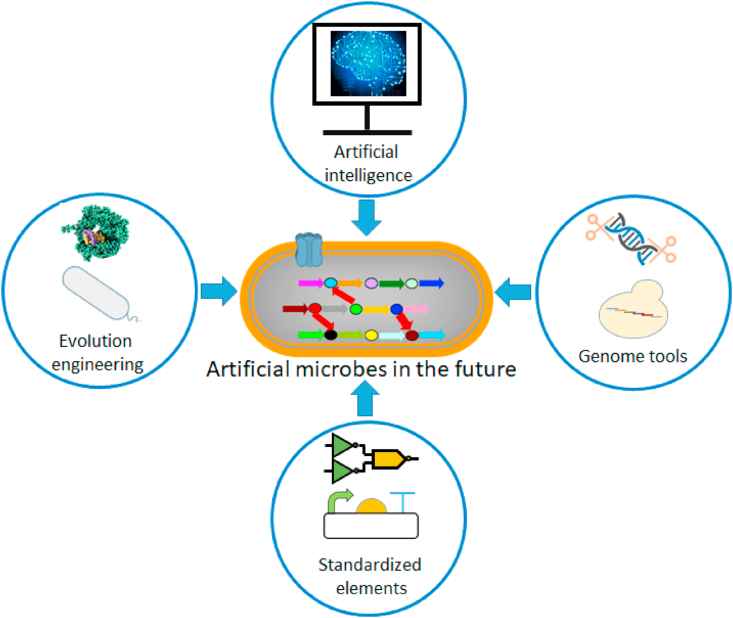
Ubiquitously distributed microorganisms are natural decomposers of environmental pollutants. However, because of continuous generation of novel recalcitrant pollutants due to human activities, it is difficult, if not impossible, for microbes to acquire novel degradation mechanisms through natural evolution. Synthetic biology provides tools to engineer, transform or even re-synthesize an organism purposefully, accelerating transition from unable to able, inefficient to efficient degradation of given pollutants, and therefore, providing new solutions for environmental bioremediation. In this review, we described the pipeline to build chassis cells for the treatment of aromatic pollutants, and presented a proposal to design microbes with emphasis on the strategies applied to modify the target organism at different level. Finally, we discussed challenges and opportunities for future research in this field.
广泛分布的微生物是环境污染物的天然分解者。然而,由于人类活动不断产生新型难降解污染物,微生物即使有可能通过自然进化获得新的降解机制,也是非常困难的。合成生物学提供了有目的地改造、转化甚至重新合成生物体的工具,加速了从无法降解到能够降解、从低效降解到高效降解特定污染物的转变,从而为环境生物修复提供了新的解决方案。在本综述中,我们描述了构建用于处理芳香族污染物的底盘细胞的流程,并提出了设计微生物的建议,重点介绍了在不同层面修饰目标生物体所应用的策略。最后,我们讨论了该领域未来研究面临的挑战和机遇。