Department of Laboratory Medicine, The First Affiliated Hospital of Nanjing Medical University, Nanjing 210029, China.
Branch of National Clinical Research Center for Laboratory Medicine, Nanjing 210029, China.
Int J Clin Pract. 2023 Aug 17;2023:9219067. doi: 10.1155/2023/9219067. eCollection 2023.
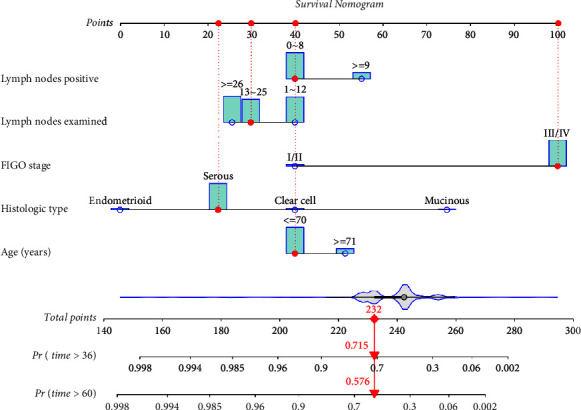
The aim of this study was to explore prognostic factors, develop and internally validate a prognostic nomogram model, and predict the cancer-specific survival (CCS) of epithelial ovarian cancer (EOC) patients with pelvic exenteration (PE) treatment.
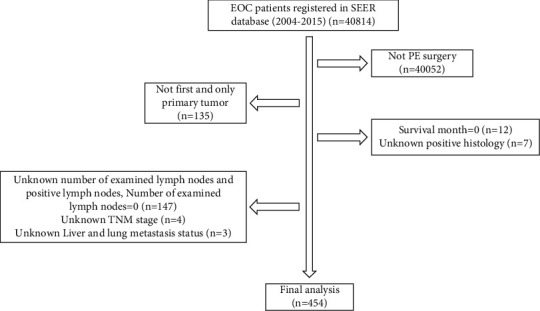
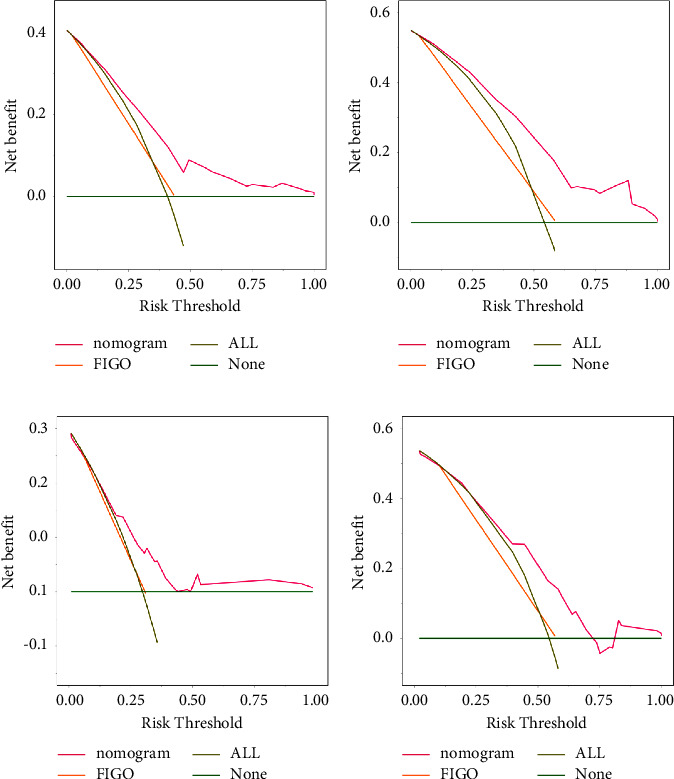
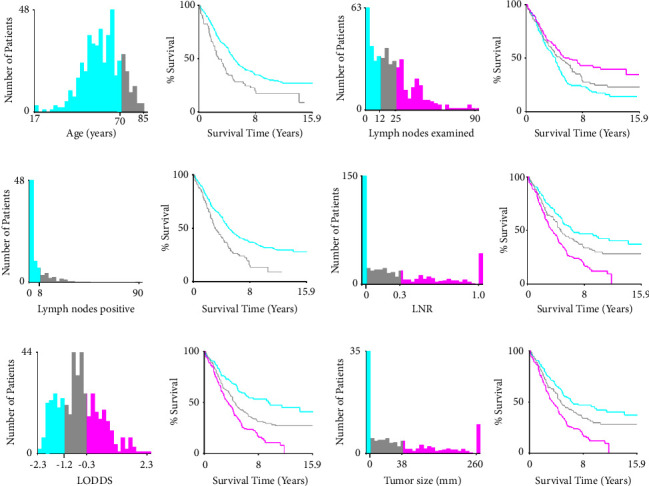
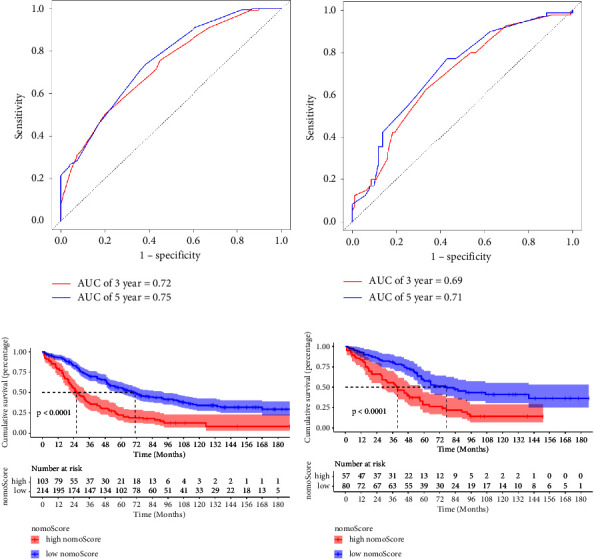
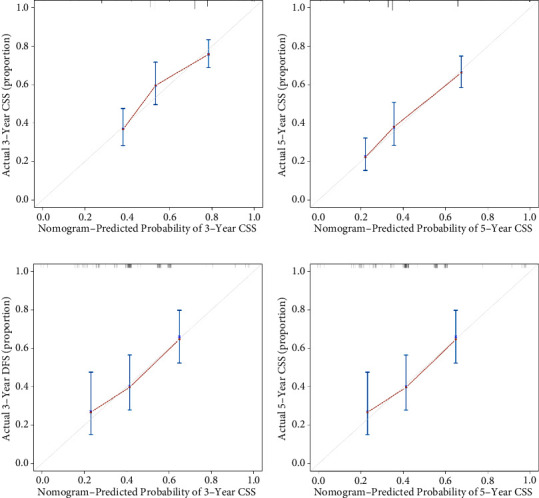
A total of 454 EOC patients from the Surveillance, Epidemiology, and End Results (SEER) database were collected according to the inclusion criteria and randomly divided into the training ( = 317) and validation ( = 137) cohorts. Prognostic factors of EOC patients with PE treatment were explored by univariate and multivariate stepwise Cox regression analyses. A predictive nomogram was constructed based on selected risk factors. The predictive power of the constructed nomogram was assessed by the time-dependent receiver operating characteristic (ROC) curve. Kaplan-Meier (KM) curve stratified by patients' nomoscore was also plotted to assess the risk stratification of the established nomogram. In internal validation, the C index, calibration curve, and decision curve analysis (DCA) were employed to assess the discrimination, calibration, and clinical utility of the models, respectively.
In the training cohort, age, histological type, Federation of Gynecology and Obstetrics (FIGO) stage, number of examined lymph nodes, and number of positive lymph nodes were found to be independent prognostic factors of postoperative CSS. A practical nomogram model of EOC patients with PE treatment was constructed based on these selected risk factors. Time-dependent ROC curves and KM curves showed the superior predictive capability and excellent clinical stratification of the nomogram in both training and validation cohorts. In the internal validation, the C index, calibration plots, and DCA in the training and validation cohorts confirmed that the nomogram presents a high level of prediction accuracy and clinical applicability.
Our nomogram exhibited satisfactory survival prediction and prognostic discrimination. It is a user-friendly tool with high clinical pragmatism for estimating prognosis and guiding the long-term management of EOC patients with PE treatment.
本研究旨在探讨预后因素,建立并内部验证预测接受盆腔廓清术(PE)治疗的上皮性卵巢癌(EOC)患者的癌症特异性生存(CCS)的列线图模型。
根据纳入标准,从监测、流行病学和最终结果(SEER)数据库中收集了 454 名接受 PE 治疗的 EOC 患者,并将其随机分为训练(n=317)和验证(n=137)队列。采用单因素和多因素逐步 Cox 回归分析探讨 EOC 患者接受 PE 治疗的预后因素。基于选定的风险因素构建预测列线图。通过时间依赖性接受者操作特征(ROC)曲线评估构建列线图的预测能力。还绘制了按患者Nomoscore 分层的 Kaplan-Meier(KM)曲线,以评估建立的列线图的风险分层。在内部验证中,分别采用 C 指数、校准曲线和决策曲线分析(DCA)评估模型的区分度、校准度和临床实用性。
在训练队列中,年龄、组织学类型、FIGO 分期、检查的淋巴结数量和阳性淋巴结数量被确定为术后 CCS 的独立预后因素。基于这些选定的风险因素,建立了接受 PE 治疗的 EOC 患者的实用列线图模型。时间依赖性 ROC 曲线和 KM 曲线显示,该列线图在训练和验证队列中均具有优越的预测能力和良好的临床分层能力。在内部验证中,训练和验证队列中的 C 指数、校准图和 DCA 均证实该列线图具有较高的预测准确性和临床适用性。
我们的列线图表现出令人满意的生存预测和预后区分能力。它是一种用户友好的工具,具有高度的临床实用性,可用于估计接受 PE 治疗的 EOC 患者的预后,并指导其长期管理。