Cairney Paul, Kippin Sean
History, Heritage, and Politics, University of Stirling, Stirling, Stirling, FK94LA, UK.
Open Res Eur. 2022 Jan 13;1:78. doi: 10.12688/openreseurope.13834.2. eCollection 2021.
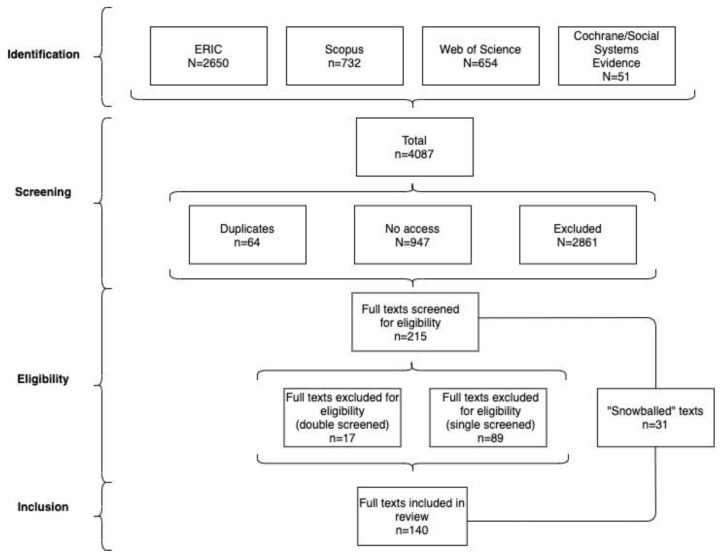
: COVID-19 had a major global impact on education, prompting concerns about its unequal effects and some impetus to reboot equity strategies. Yet, policy processes exhibit major gaps between such expectations and outcomes, and similar inequalities endured for decades before the pandemic. Our objective is to establish how education researchers, drawing on policy concepts and theories, explain and seek to address this problem. : A qualitative systematic review (2020-21), to identify peer reviewed research and commentary articles on education, equity, and policymaking, in specialist and general databases (ERIC, Web of Science, Scopus, Cochrane/ Social Systems Evidence). We did not apply additional quality measures. We used an immersive and inductive approach to identify key themes. We use these texts to produce a general narrative and explore how policy theory articles inform it. : 140 texts (109 articles included; 31 texts snowballed) provide a non-trivial reference to policymaking. Limiting inclusion to English-language produced a bias towards Global North articles. Our comparison with a review of health equity research highlights distinctive elements in education. First, education equity is ambiguous and contested, with no settled global definition or agenda (although some countries and international organisations have disproportionate influence). Second, researchers critique 'neoliberal' approaches that dominate policymaking at the expense of 'social justice'. Third, more studies provide 'bottom-up' analysis of 'implementation gaps'. Fourth, more studies relate inequity to ineffective policymaking to address marginalised groups. : Few studies use policy theories to explain policymaking, but there is an education-specific literature performing a similar role. Compared to health research, there is more use of critical policy analysis to reflect on power and less focus on technical design issues. There is high certainty that current neoliberal policies are failing, but low certainty about how to challenge them successfully.
新冠疫情对全球教育产生了重大影响,引发了人们对其不平等影响的担忧,并推动了重启公平战略的一些动力。然而,政策进程在这些期望与结果之间存在重大差距,而且在疫情之前,类似的不平等现象已经持续了几十年。我们的目标是确定教育研究人员如何借鉴政策概念和理论来解释并试图解决这一问题。
一项定性系统综述(2020 - 2021年),旨在识别专业和综合数据库(教育资源信息中心、科学网、Scopus、Cochrane/社会系统证据库)中关于教育、公平和政策制定的同行评议研究及评论文章。我们没有应用额外的质量衡量标准。我们采用沉浸式和归纳式方法来确定关键主题。我们利用这些文本生成一个总体叙述,并探讨政策理论文章如何为其提供信息。
140篇文本(包括109篇文章;通过滚雪球方式纳入31篇文本)对政策制定有重要参考价值。将纳入范围限制为英语导致偏向于来自全球北方地区的文章。我们与一项健康公平研究综述的比较突出了教育领域的独特要素。首先,教育公平模糊且存在争议,没有既定的全球定义或议程(尽管一些国家和国际组织有不成比例的影响力);其次,研究人员批评以牺牲“社会正义”为代价主导政策制定的“新自由主义”方法;第三,更多研究对“实施差距”进行“自下而上”的分析;第四,更多研究将不平等与未能有效解决边缘化群体问题的政策制定联系起来。
很少有研究使用政策理论来解释政策制定,但有一类特定的教育文献发挥着类似作用。与健康研究相比,更多地使用批判性政策分析来反思权力,而较少关注技术设计问题。目前新自由主义政策正在失败这一点具有高度确定性,但对于如何成功挑战这些政策的确定性较低。