Department of Immunotechnology, Lund University.
Cancer Immunotherapy, Department of Immunology, Genetics and Pathology, Uppsala University, Uppsala.
Haematologica. 2024 Apr 1;109(4):1171-1183. doi: 10.3324/haematol.2023.283352.
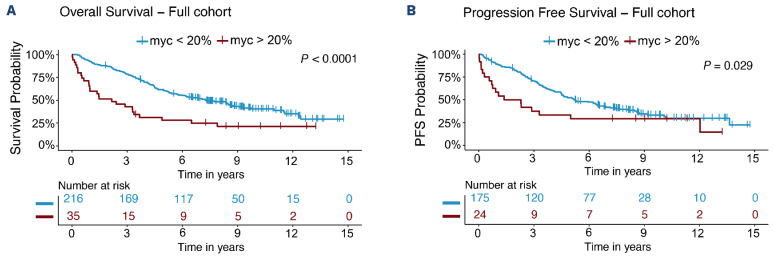
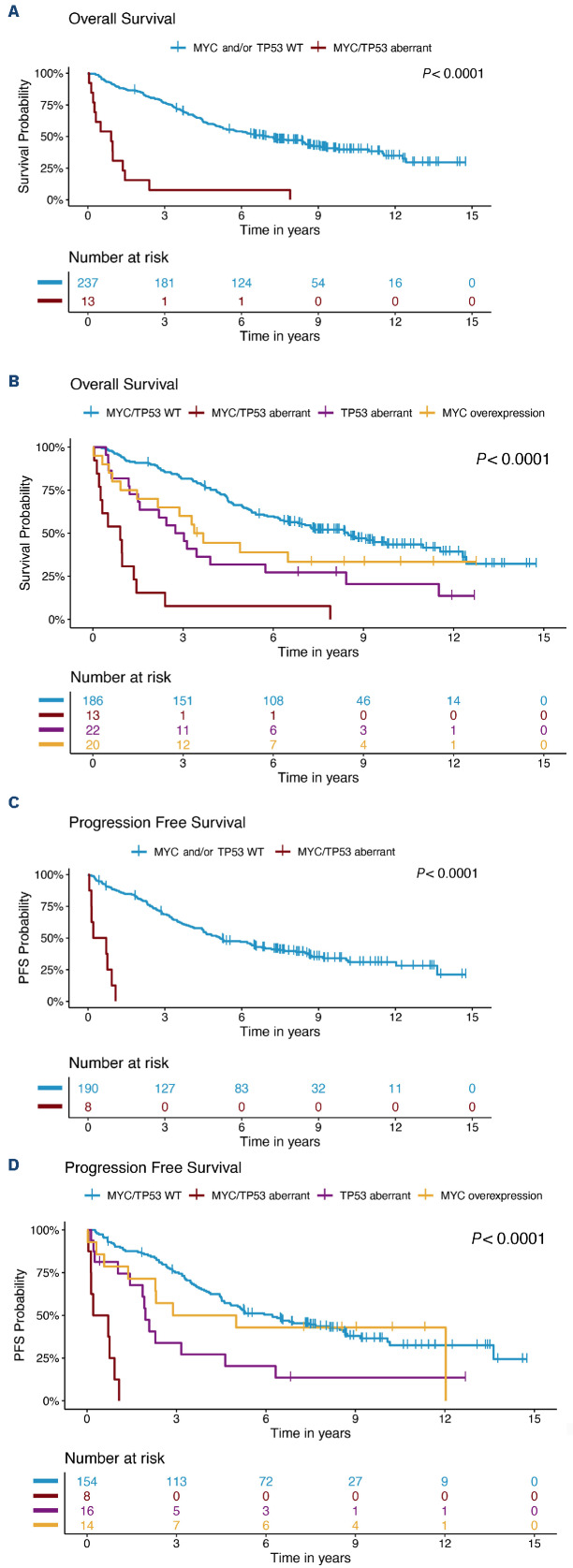
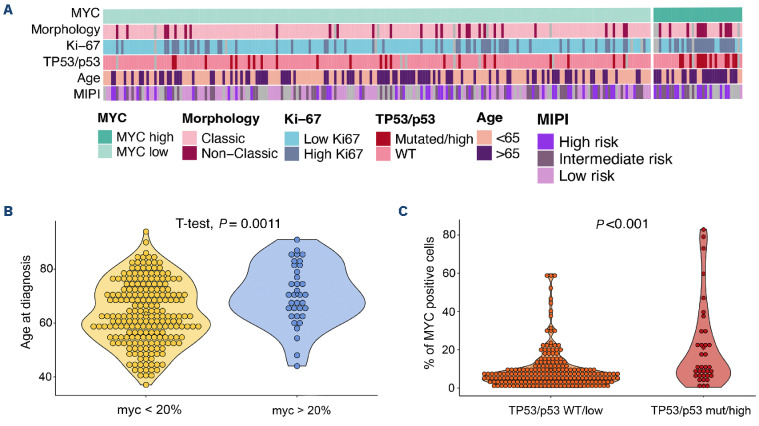
The transcription factor MYC is a well-described oncogene with an important role in lymphomagenesis, but its significance for clinical outcome in mantle cell lymphoma (MCL) remains to be determined. We performed an investigation of the expression of MYC protein in a cohort of 251 MCL patients complemented by analyses of structural aberrations and mRNA, in a sub-cohort of patients. Fourteen percent (n=35) of patients showed high MYC protein expression with >20% positive cells (MYChigh), among whom only one translocation was identified, and 86% (n=216) of patients showed low MYC protein expression. Low copy number gains of MYC were detected in ten patients, but with no correlation to MYC protein levels. However, MYC mRNA levels correlated significantly to MYC protein levels with a R2 value of 0.76. Patients with a MYChigh tumor had both an independent inferior overall survival and an inferior progression-free survival (hazard ratio [HR]=2.03, 95% confidence interval [95% CI]: 1.2-3.4 and HR=2.2, 95% CI: 1.04-4.6, respectively) when adjusted for additional high-risk features. Patients with MYChigh tumors also tended to have additional high-risk features and to be older at diagnosis. A subgroup of 13 patients had concomitant MYChigh expression and TP53/p53 alterations and a substantially increased risk of progression (HR=16.9, 95% CI: 7.4-38.3) and death (HR=7.8, 95% CI: 4.4-14.1) with an average overall survival of only 0.9 years. In summary, we found that at diagnosis a subset of MCL patients (14%) overexpressed MYC protein, and had a poor prognosis but that MYC rearrangements were rare. Tumors with concurrent MYC overexpression and TP53/p53 alterations pinpointed MCL patients with a dismal prognosis with a median overall survival of less than 3 years. We propose that MYC needs to be assessed beyond the current high-risk factors in MCL in order to identify cases in need of alternative treatment.
转录因子 MYC 是一种描述明确的癌基因,在淋巴瘤的发生中具有重要作用,但它在套细胞淋巴瘤(MCL)中的临床预后意义仍有待确定。我们对 251 例 MCL 患者的 MYC 蛋白表达进行了研究,并对部分患者进行了结构异常和 mRNA 分析。14%(n=35)的患者表现出高 MYC 蛋白表达,有>20%的阳性细胞(MYChigh),其中仅鉴定出一个易位,86%(n=216)的患者表现出低 MYC 蛋白表达。在 10 例患者中检测到 MYC 的低拷贝数增益,但与 MYC 蛋白水平无相关性。然而,MYC mRNA 水平与 MYC 蛋白水平显著相关,R2 值为 0.76。在调整其他高危特征后,具有 MYChigh 肿瘤的患者的总生存期和无进展生存期均明显降低(风险比[HR]=2.03,95%置信区间[95%CI]:1.2-3.4 和 HR=2.2,95%CI:1.04-4.6)。具有 MYChigh 肿瘤的患者也倾向于具有其他高危特征,并且在诊断时年龄较大。一个 13 例患者的亚组同时具有 MYChigh 表达和 TP53/p53 改变,进展风险显著增加(HR=16.9,95%CI:7.4-38.3)和死亡风险(HR=7.8,95%CI:4.4-14.1),平均总生存期仅为 0.9 年。总之,我们发现,在诊断时,一部分 MCL 患者(14%)过度表达 MYC 蛋白,预后不良,但 MYC 重排很少见。同时具有 MYC 过表达和 TP53/p53 改变的肿瘤突出了 MCL 患者的预后不良,中位总生存期不到 3 年。我们建议,为了确定需要替代治疗的病例,需要在当前的 MCL 高危因素之外评估 MYC。