Chongqing Institute of Foreign Studies, Chongqing, 401120, China.
Chongqing Youyang No.2 Middle School, Chongqing, 409899, China.
BMC Public Health. 2023 Aug 31;23(1):1677. doi: 10.1186/s12889-023-16536-4.
To investigate the influence of subjective exercise experience on adolescent trait anxiety and to reveal the mediating effect of exercise behavior.
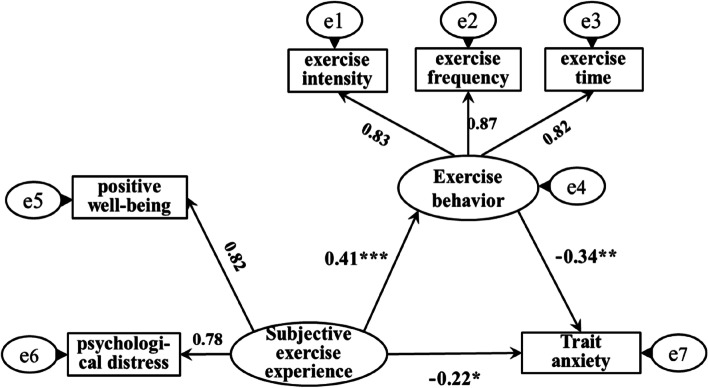
Using the Subjective Exercise Experience Scale (SEES), Physical Exercise Rating Scale (PARS-3), and Trait Anxiety Inventory (T-AI), a questionnaire survey was conducted among 500 adolescents in Southwest China, and the SPSS21.0 and AMOS21.0 statistical analysis software was used to statistics and analysis on the questionnaires.
The good subjective exercise experience not only has direct benefits for improving trait anxiety in adolescents but also helps to improve their exercise behavior, enrich daily physical exercise activities, and indirectly promote the reduction of trait anxiety.
探讨主观运动体验对青少年特质焦虑的影响,并揭示运动行为的中介作用。
采用主观运动体验量表(SEES)、运动评价量表(PARS-3)和特质焦虑量表(T-AI),对中国西南地区 500 名青少年进行问卷调查,采用 SPSS21.0 和 AMOS21.0 统计软件对问卷进行统计分析。
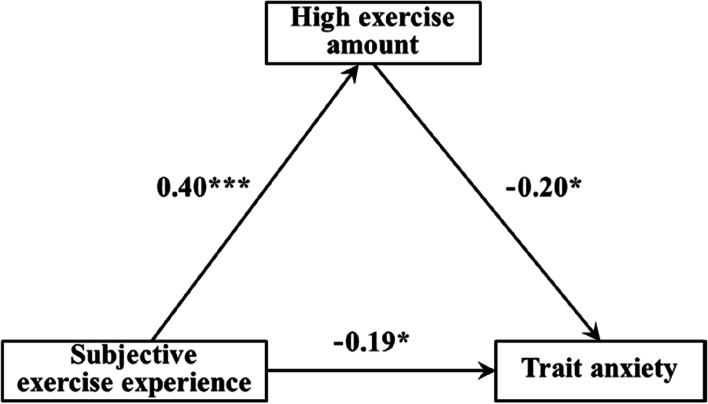
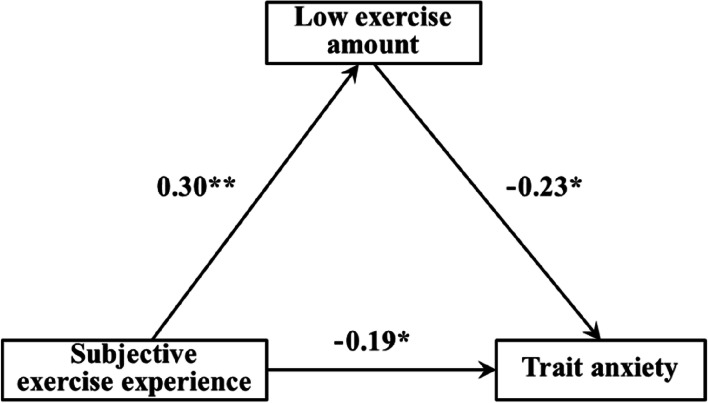
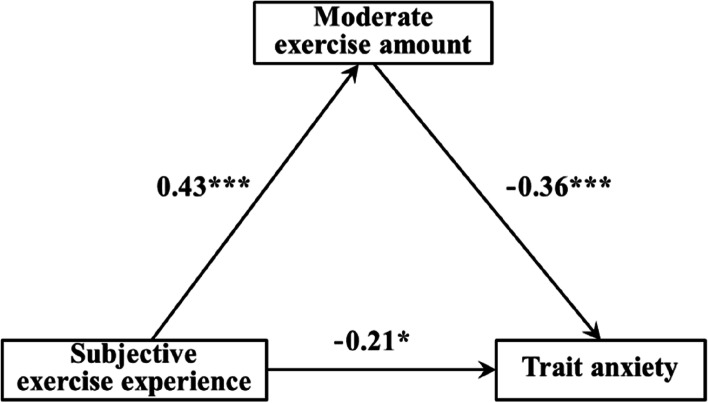
1)青少年中,男生的运动行为显著高于女生(p<0.05),9 至 12 岁学生的主观运动体验显著高于 12 至 15 岁学生(p<0.05)。2)主观运动体验可直接正向预测运动行为(β=0.45,p<0.001),负向预测特质焦虑(β=-0.26,p<0.05),运动行为可直接负向预测特质焦虑(β=-0.32,p<0.01)。3)运动行为在主观运动体验和特质焦虑之间存在部分中介效应(中介效应为-0.14)。其中,与低、高运动量相比,中运动量的运动行为在主观运动体验和特质焦虑之间的中介作用最强。
良好的主观运动体验不仅对改善青少年特质焦虑有直接益处,还有助于改善其运动行为,丰富日常体育锻炼活动,从而间接地促进特质焦虑的降低。