Environmental and Occupational Sciences Institute, Rutgers University, Piscataway, 170 Frelinghuysen Road, Piscataway, NJ, 08854, USA.
Department of Biostatistics and Epidemiology, Rutgers School of Public Health, Piscataway, NJ, USA.
Environ Health. 2023 Sep 2;22(1):61. doi: 10.1186/s12940-023-01009-3.
Per- and polyfluoroalkyl substances (PFAS) are synthetic chemicals found in drinking water and consumer products, resulting in ubiquitous human exposure. PFAS have been linked to endocrine disruption and altered weight gain across the lifespan. A limited and inconsistent body of research suggests PFAS may impact gestational weight gain (GWG) and postpartum body mass index (BMI), which are important predictors of overall infant and maternal health, respectively.
In the Understanding Pregnancy Signals and Infant Development (UPSIDE/UPSIDE-MOMs) study (n = 243; Rochester, NY), we examined second trimester serum PFAS (PFOS: perfluorooctanesulfonic acid, PFOA: perfluorooctanoic acid, PFNA: perfluorononanoic acid, PFHxS: perfluorohexanesulfonic acid, PFDA: perfluorodecanoic acid) in relation to GWG (kg, and weekly rate of gain) and in the postpartum, weight retention (PPWR (kg) and total body fat percentage (measured by bioelectrical impedance)). We fit multivariable linear regression models examining these outcomes in relation to log-transformed PFAS in the whole cohort as well as stratified by maternal pre-pregnancy BMI (< 25 vs. = > 25 kg/m), adjusting for demographics and lifestyle factors. We used weighted quantile sum regression to find the combined influence of the 5 PFAS on GWG, PPWR, and body fat percentage.
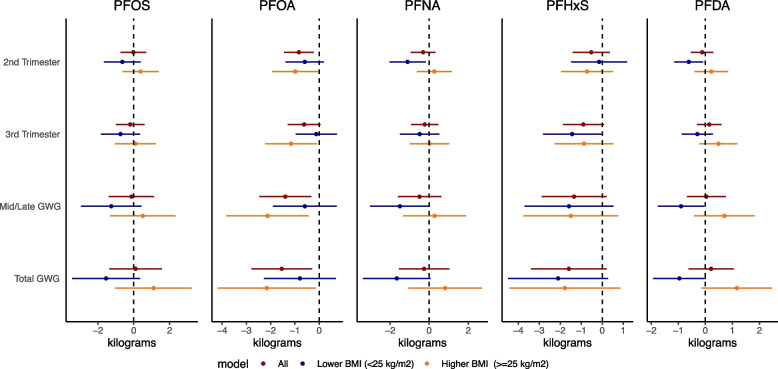
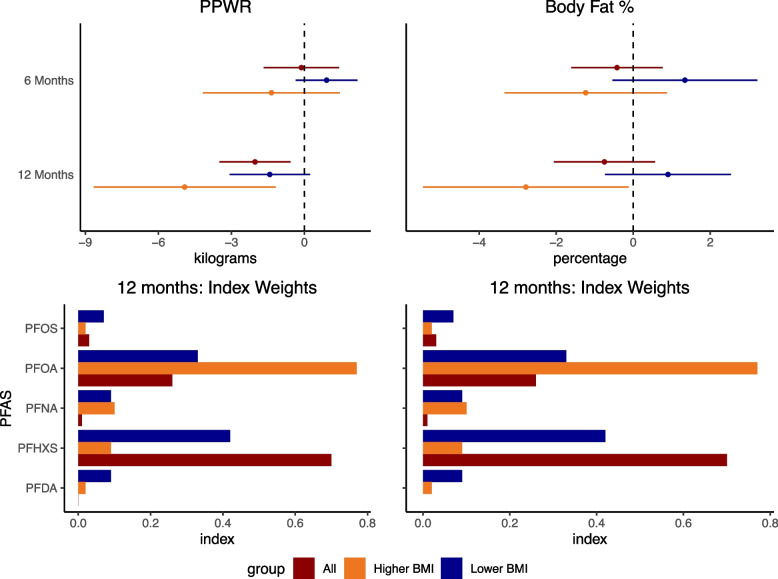
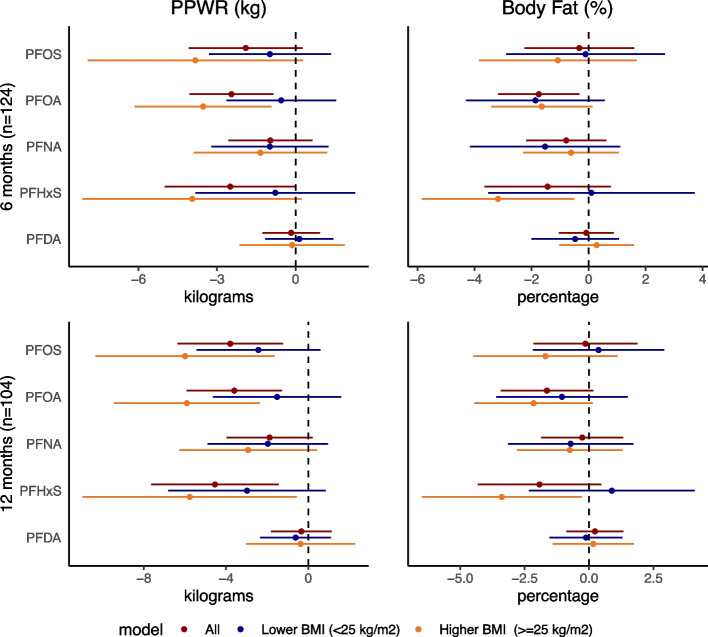
PFOA and PFHxS were inversely associated with total GWG (PFOA: ß = -1.54 kg, 95%CI: -2.79, -0.30; rate ß = -0.05 kg/week, 95%CI: -0.09, -0.01; PFHxS: ß = -1.59 kg, 95%CI: -3.39, 0.21; rate ß = -0.05 kg/week, 95%CI: -0.11, 0.01) and PPWR at 6 and 12 months (PFOA 6 months: ß = -2.39 kg, 95%CI: -4.17, -0.61; 12 months: ß = -4.02 kg, 95%CI: -6.58, -1.46; PFHxS 6 months: ß = -2.94 kg, 95%CI: -5.52, -0.35; 12 months: ß = -5.13 kg, 95%CI: -8.34, -1.93). PFOA was additionally associated with lower body fat percentage at 6 and 12 months (ß = -1.75, 95%CI: -3.17, -0.32; ß = -1.64, 95%CI: -3.43, 0.16, respectively) with stronger associations observed in participants with higher pre-pregnancy BMI. The PFAS mixture was inversely associated with weight retention at 12 months (ß = -2.030, 95%CI: -3.486, -0.573) amongst all participants.
PFAS, in particular PFOA and PFHxS, in pregnancy are associated with altered patterns of GWG and postpartum adiposity with potential implications for fetal development and long-term maternal cardiometabolic health.
全氟和多氟烷基物质(PFAS)是存在于饮用水和消费产品中的合成化学物质,导致人类普遍接触。PFAS 与内分泌干扰和整个生命周期中的体重增加改变有关。有限且不一致的研究表明,PFAS 可能会影响妊娠体重增加(GWG)和产后体重指数(BMI),这分别是婴儿和产妇整体健康的重要预测指标。
在理解妊娠信号和婴儿发育(UPSIDE/UPSIDE-MOMs)研究(n=243;纽约罗切斯特)中,我们研究了妊娠中期血清 PFAS(PFOS:全氟辛烷磺酸、PFOA:全氟辛酸、PFNA:全氟壬酸、PFHxS:全氟己烷磺酸、PFDA:全氟癸酸)与 GWG(kg 和每周增重率)以及产后体重保留(PPWR(kg)和总体脂肪百分比(通过生物电阻抗测量))的关系。我们使用多变量线性回归模型检查了整个队列中 PFAS 与这些结果的关系,以及按母体孕前 BMI(<25 与≥25 kg/m2)进行分层,调整了人口统计学和生活方式因素。我们使用加权分位数总和回归来寻找 5 种 PFAS 对 GWG、PPWR 和体脂肪百分比的综合影响。
PFOA 和 PFHxS 与总 GWG 呈负相关(PFOA:ß=-1.54 kg,95%CI:-2.79,-0.30;速率ß=-0.05 kg/周,95%CI:-0.09,-0.01;PFHxS:ß=-1.59 kg,95%CI:-3.39,0.21;速率ß=-0.05 kg/周,95%CI:-0.11,0.01)和产后 6 个月和 12 个月的 PPWR(PFOA 6 个月:ß=-2.39 kg,95%CI:-4.17,-0.61;12 个月:ß=-4.02 kg,95%CI:-6.58,-1.46;PFHxS 6 个月:ß=-2.94 kg,95%CI:-5.52,-0.35;12 个月:ß=-5.13 kg,95%CI:-8.34,-1.93)。PFOA 还与产后 6 个月和 12 个月的体脂肪百分比较低有关(ß=-1.75,95%CI:-3.17,-0.32;ß=-1.64,95%CI:-3.43,0.16),在 BMI 较高的参与者中观察到更强的关联。在所有参与者中,PFAS 混合物与产后 12 个月的体重保留呈负相关(ß=-2.030,95%CI:-3.486,-0.573)。
妊娠期间的 PFAS,特别是 PFOA 和 PFHxS,与 GWG 模式改变和产后肥胖有关,这可能对胎儿发育和长期产妇心脏代谢健康有影响。