Spine Center, Schulthess Klinik, Zurich, Switzerland.
Department of Biomedical Sciences for Health, University of Milan, Milan, Italy.
Eur Radiol Exp. 2023 Sep 4;7(1):47. doi: 10.1186/s41747-023-00361-w.
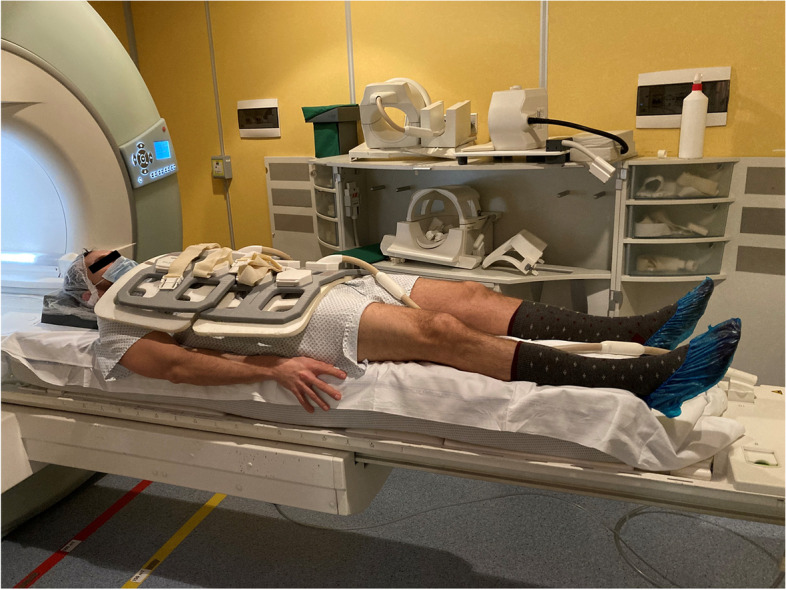
Humans should sleep for about a third of their lifetime and the choice of the mattress is very important from a quality-of-life perspective. Therefore, the primary aim of this study was to assess the changes of lumbar angles, evaluated in a supine position using magnetic resonance imaging (MRI), on a mattress versus a rigid surface.
Twenty healthy subjects (10 females, 10 males), aged 32.3 ± 6.5 (mean ± standard deviation), with body mass index 22.4 ± 2.9, completed three evaluations: (i) spine MRI in supine position on a mattress (MAT); (ii) spine MRI in supine position on rigid surface (CON); and (iii) biplanar radiographic imaging in standing position. The following indexes were calculated for both MAT and CON: lumbar lordosis angles L1-L5, L1-S1, L5-S1, and the sacral slope (SS). Further, pelvic incidence (PI) was calculated from the biplanar radiographic images.
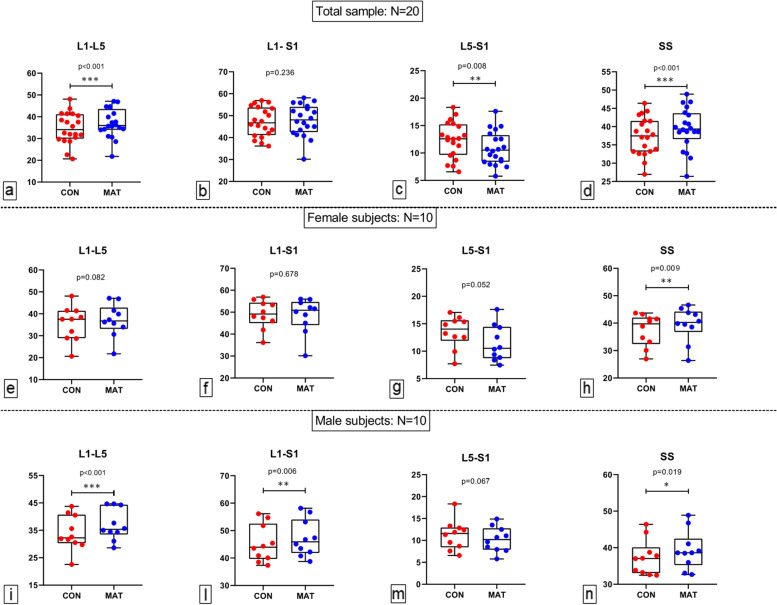
Main findings were (i) L1-L5 and SS were greater in MAT than CON (L1:L5: +2.9°; SS: +2.0°); (ii) L5-S1 was lower in MAT than CON (-1.6°); (iii) L1-S1 was greater in MAT than CON only for male subjects (+2.0°); (iv) significant and positive correlations between PI and L1-L5, L1-S1 and SS were observed in both CON and MAT.
The use of a mattress determined small but statistically significant changes in lumbar angles.
The use of a mattress determines small but statistically significant changes in radiological angles describing the sagittal alignment of the lumbar spine when lying in the supine position.
• Lordosis angle L1-L5 was greater in MAT than in CON condition (+2.9°). • Sacral slope was greater in MAT than in CON condition (+2.0°). • Lordosis angle L5-S1 was lower in MAT than in CON condition (-1.6°).
人类一生中大约有三分之一的时间都在睡觉,因此从生活质量的角度来看,选择床垫非常重要。因此,本研究的主要目的是评估使用磁共振成像(MRI)在仰卧位时,床垫与刚性表面上腰椎角度的变化。
20 名健康受试者(10 名女性,10 名男性),年龄 32.3±6.5(平均值±标准差),体重指数 22.4±2.9,完成了三次评估:(i)在床垫(MAT)上仰卧位进行脊柱 MRI;(ii)在刚性表面(CON)上仰卧位进行脊柱 MRI;(iii)站立位双平面放射成像。对于 MAT 和 CON,计算了以下指标:腰椎前凸角 L1-L5、L1-S1、L5-S1 和骶骨倾斜角(SS)。此外,从双平面放射图像计算骨盆入射角(PI)。
主要发现为(i)L1-L5 和 SS 在 MAT 中大于 CON(L1:L5:+2.9°;SS:+2.0°);(ii)L5-S1 在 MAT 中低于 CON(-1.6°);(iii)仅男性受试者在 MAT 中 L1-S1 大于 CON(+2.0°);(iv)在 CON 和 MAT 中均观察到 PI 与 L1-L5、L1-S1 和 SS 之间存在显著正相关。
使用床垫会导致腰椎角度的小但有统计学意义的变化。
当仰卧位时,使用床垫会导致描述腰椎矢状排列的放射学角度发生小但有统计学意义的变化。
• MAT 时 L1-L5 前凸角大于 CON 条件(+2.9°)。• MAT 时 SS 大于 CON 条件(+2.0°)。• MAT 时 L5-S1 前凸角低于 CON 条件(-1.6°)。