Institute of Inflammation and Ageing, University of Birmingham, Birmingham, United Kingdom.
National Institute for Health Research Surgical Reconstruction and Microbiology Research Centre, Queen Elizabeth Hospital Birmingham, Birmingham, United Kingdom.
Front Immunol. 2023 Aug 15;14:1239683. doi: 10.3389/fimmu.2023.1239683. eCollection 2023.
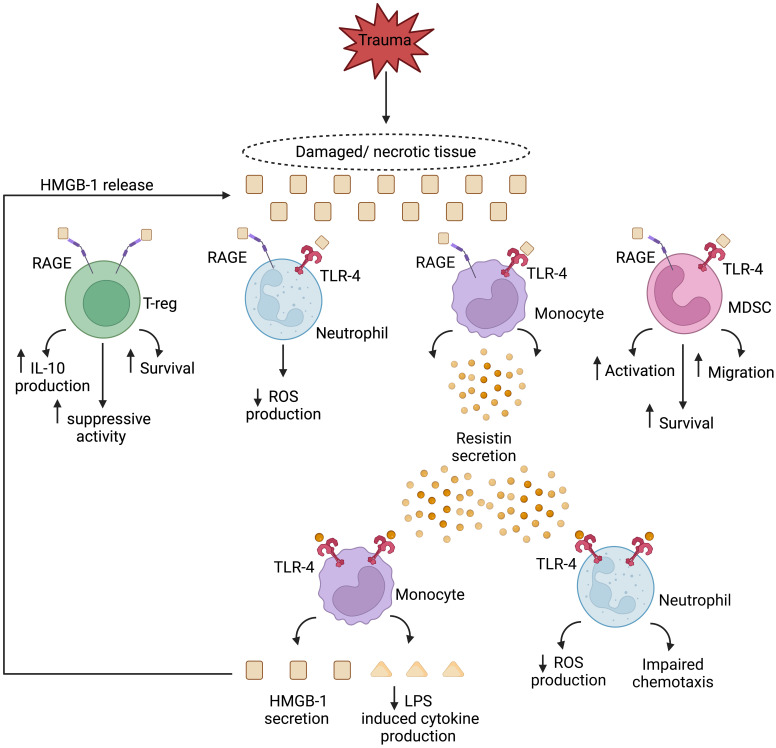
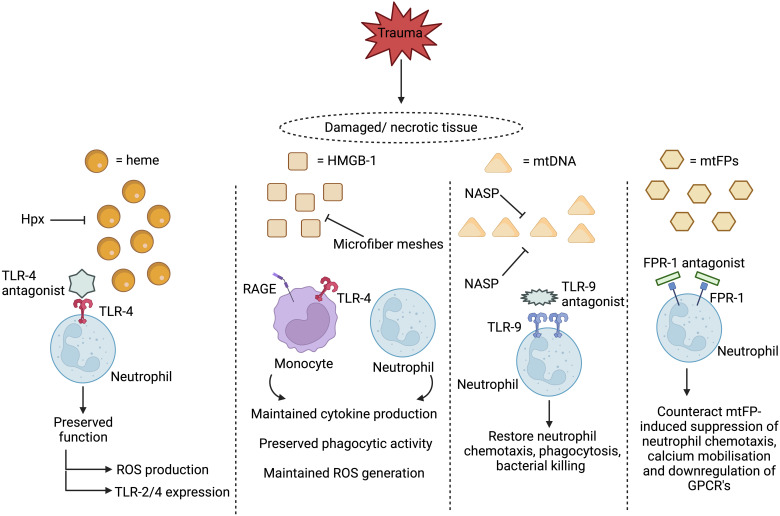
Associated with the development of hospital-acquired infections, major traumatic injury results in an immediate and persistent state of systemic immunosuppression, yet the underlying mechanisms are poorly understood. Detected in the circulation in the minutes, days and weeks following injury, damage associated molecular patterns (DAMPs) are a heterogeneous collection of proteins, lipids and DNA renowned for initiating the systemic inflammatory response syndrome. Suggesting additional immunomodulatory roles in the post-trauma immune response, data are emerging implicating DAMPs as potential mediators of post-trauma immune suppression. Discussing the results of and studies, the purpose of this review is to summarise the emerging immune tolerising properties of cytosolic, nuclear and mitochondrial-derived DAMPs. Direct inhibition of neutrophil antimicrobial activities, the induction of endotoxin tolerance in monocytes and macrophages, and the recruitment, activation and expansion of myeloid derived suppressor cells and regulatory T cells are examples of some of the immune suppressive properties assigned to DAMPs so far. Crucially, with studies identifying the molecular mechanisms by which DAMPs promote immune suppression, therapeutic strategies that prevent and/or reverse DAMP-induced immunosuppression have been proposed. Approaches currently under consideration include the use of synthetic polymers, or the delivery of plasma proteins, to scavenge circulating DAMPs, or to treat critically-injured patients with antagonists of DAMP receptors. However, as DAMPs share signalling pathways with pathogen associated molecular patterns, and pro-inflammatory responses are essential for tissue regeneration, these approaches need to be carefully considered in order to ensure that modulating DAMP levels and/or their interaction with immune cells does not negatively impact upon anti-microbial defence and the physiological responses of tissue repair and wound healing.
与医院获得性感染的发展相关,严重创伤导致即刻和持续的全身免疫抑制状态,但潜在机制尚不清楚。在损伤后数分钟、数天和数周内循环中检测到的损伤相关分子模式 (DAMPs) 是一组异质的蛋白质、脂质和 DNA,以引发全身炎症反应综合征而闻名。数据表明 DAMPs 在创伤后免疫反应中具有额外的免疫调节作用,表明 DAMPs 可能是创伤后免疫抑制的潜在介质。讨论 和 研究的结果,本综述的目的是总结细胞溶质、核和线粒体来源的 DAMPs 新出现的免疫耐受特性。直接抑制中性粒细胞的抗菌活性、单核细胞和巨噬细胞中内毒素耐受的诱导,以及髓源性抑制细胞和调节性 T 细胞的募集、激活和扩增,是迄今为止 DAMPs 赋予的一些免疫抑制特性的例子。至关重要的是,随着研究确定了 DAMPs 促进免疫抑制的分子机制,已经提出了预防和/或逆转 DAMP 诱导的免疫抑制的治疗策略。目前正在考虑的方法包括使用合成聚合物或递送来清除循环 DAMPs 的血浆蛋白,或用 DAMPs 受体拮抗剂治疗严重受伤的患者。然而,由于 DAMPs 与病原体相关分子模式共享信号通路,并且促炎反应对于组织再生是必不可少的,因此需要仔细考虑这些方法,以确保调节 DAMPs 水平和/或它们与免疫细胞的相互作用不会对抗微生物防御和组织修复及伤口愈合的生理反应产生负面影响。