Hu Chen, Yang Jing, Qi Ziping, Wu Hong, Wang Beilei, Zou Fengming, Mei Husheng, Liu Jing, Wang Wenchao, Liu Qingsong
Anhui Province Key Laboratory of Medical Physics and Technology Institute of Health and Medical Technology Hefei Institutes of Physical Science Chinese Academy of Sciences Hefei Anhui P. R. China.
Hefei Cancer Hospital Chinese Academy of Sciences Hefei Anhui P. R. China.
MedComm (2020). 2022 Aug 2;3(3):e161. doi: 10.1002/mco2.161. eCollection 2022 Sep.
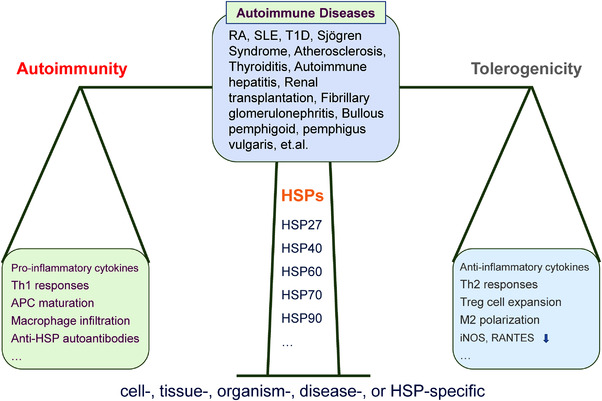
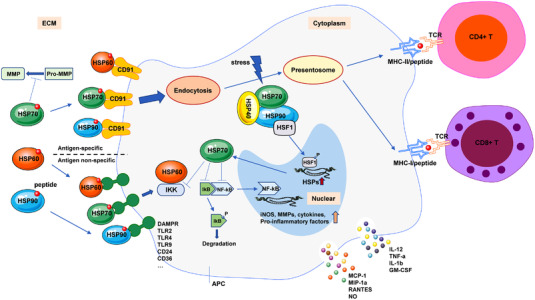
The heat shock proteins (HSPs) are ubiquitous and conserved protein families in both prokaryotic and eukaryotic organisms, and they maintain cellular proteostasis and protect cells from stresses. HSP protein families are classified based on their molecular weights, mainly including large HSPs, HSP90, HSP70, HSP60, HSP40, and small HSPs. They function as molecular chaperons in cells and work as an integrated network, participating in the folding of newly synthesized polypeptides, refolding metastable proteins, protein complex assembly, dissociating protein aggregate dissociation, and the degradation of misfolded proteins. In addition to their chaperone functions, they also play important roles in cell signaling transduction, cell cycle, and apoptosis regulation. Therefore, malfunction of HSPs is related with many diseases, including cancers, neurodegeneration, and other diseases. In this review, we describe the current understandings about the molecular mechanisms of the major HSP families including HSP90/HSP70/HSP60/HSP110 and small HSPs, how the HSPs keep the protein proteostasis and response to stresses, and we also discuss their roles in diseases and the recent exploration of HSP related therapy and diagnosis to modulate diseases. These research advances offer new prospects of HSPs as potential targets for therapeutic intervention.
热休克蛋白(HSPs)是原核生物和真核生物中普遍存在且保守的蛋白质家族,它们维持细胞蛋白质稳态并保护细胞免受应激。HSP蛋白家族根据其分子量进行分类,主要包括大HSPs、HSP90、HSP70、HSP60、HSP40和小HSPs。它们在细胞中作为分子伴侣发挥作用,并作为一个整合网络发挥作用,参与新合成多肽的折叠、亚稳态蛋白质的重新折叠、蛋白质复合物组装、蛋白质聚集体解离以及错误折叠蛋白质的降解。除了其伴侣功能外,它们还在细胞信号转导、细胞周期和细胞凋亡调控中发挥重要作用。因此,HSPs功能异常与许多疾病相关,包括癌症、神经退行性疾病和其他疾病。在本综述中,我们描述了目前对主要HSP家族(包括HSP90/HSP70/HSP60/HSP110和小HSPs)分子机制的理解,HSPs如何维持蛋白质稳态并对应激作出反应,我们还讨论了它们在疾病中的作用以及最近对HSP相关治疗和诊断以调节疾病的探索。这些研究进展为HSPs作为治疗干预的潜在靶点提供了新的前景。