Chen Jincai, Huang Lin, Liao Xiaofei
Department of Orthopedics, First Affiliated Hospital of Gannan Medical University, Ganzhou, Jiangxi 341000, P.R. China.
Department of Internal Medicine, Ganzhou Hospital of Traditional Chinese Medicine, Ganzhou, Jiangxi 341000, P.R. China.
Exp Ther Med. 2023 Aug 11;26(4):465. doi: 10.3892/etm.2023.12164. eCollection 2023 Oct.
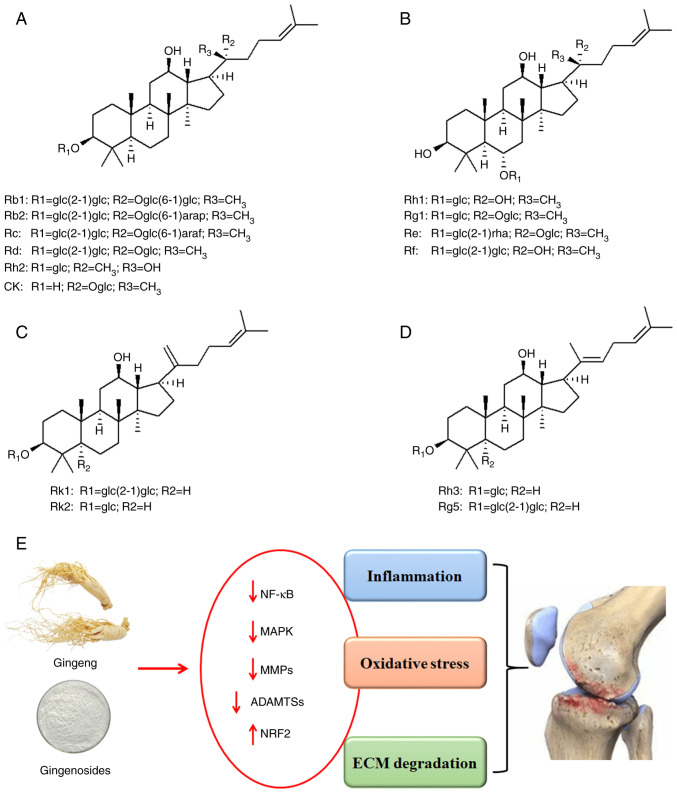
Osteoarthritis (OA) is a chronic inflammatory joint disease. Traditional chinese medicine provides a resource for drug screening for OA treatment. Ginseng and the associated bioactive compound, ginsenosides, may reduce inflammation, which is considered a risk factor for the development of OA. Specifically, ginsenosides may exhibit anti-inflammatory and anti-oxidative stress activities, and inhibit extracellular matrix degradation by suppressing the NF-κB and MAPK signaling pathways. Notably, specific ginsenosides, such as compound K and Rk1, may physically interact with IκB kinase and inhibit the associated phosphorylation. Thus, ginsenosides exhibit potential as therapeutic candidates in the management of OA. However, the low water solubility limits the clinical applications of ginsenosides. Numerous effective strategies have been explored to improve bioavailability; however, further investigations are still required.
骨关节炎(OA)是一种慢性炎症性关节疾病。传统中医为OA治疗的药物筛选提供了资源。人参及相关生物活性化合物人参皂苷可能减轻炎症,而炎症被认为是OA发生发展的一个风险因素。具体而言,人参皂苷可能具有抗炎和抗氧化应激活性,并通过抑制NF-κB和MAPK信号通路来抑制细胞外基质降解。值得注意的是,特定的人参皂苷,如化合物K和Rk1,可能与IκB激酶发生物理相互作用并抑制相关的磷酸化。因此,人参皂苷在OA管理中显示出作为治疗候选药物的潜力。然而,低水溶性限制了人参皂苷的临床应用。人们已经探索了许多有效的策略来提高生物利用度;然而,仍需要进一步研究。