Department of Evolutionary Neuroethology, Max Planck Institute for Chemical Ecology, Hans-Knöll-Straße 8, D-07745, Jena, Germany.
Next Generation Insect Chemical Ecology, Max Planck Centre, Max Planck Institute for Chemical Ecology, Hans-Knöll-Straße 8, D-07745, Jena, Germany.
Commun Biol. 2023 Sep 4;6(1):905. doi: 10.1038/s42003-023-05280-5.
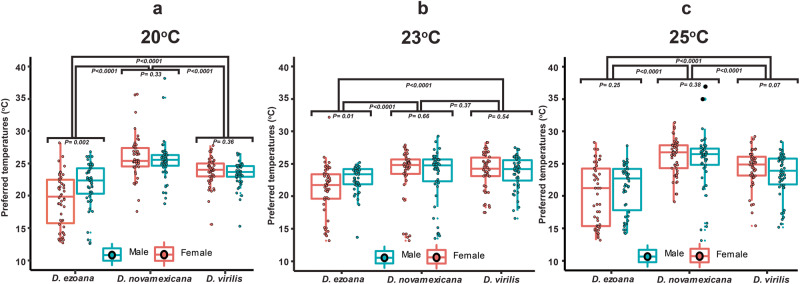
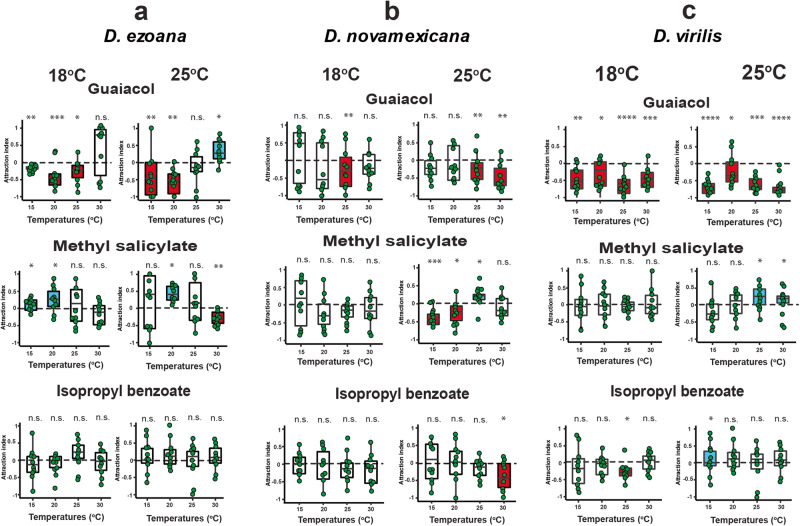
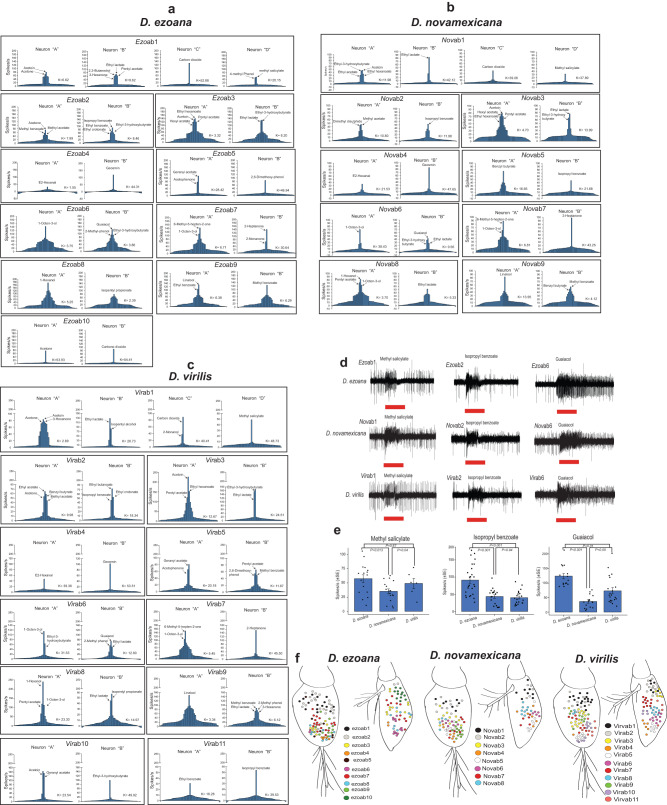
Rapid and ongoing climate change increases global temperature, impacts feeding, and reproduction in insects. The olfaction plays an important underlying role in these behaviors in most insect species. Here, we investigated how changing temperatures affect odor detection and ensuing behavior in three drosophilid flies: Drosophila novamexicana, D. virilis and D. ezoana, species adapted to life in desert, global, and subarctic climates, respectively. Using a series of thermal preference assays, we confirmed that the three species indeed exhibit distinct temperature preferences. Next, using single sensillum recording technique, we classified olfactory sensory neurons (OSNs) present in basiconic sensilla on the antenna of the three species and thereby identified ligands for each OSN type. In a series of trap assays we proceeded to establish the behavioral valence of the best ligands and chose guaiacol, methyl salicylate and isopropyl benzoate as representatives of a repellent, attractant and neutral odor. Next, we assessed the behavioral valence of these three odors in all three species across a thermal range (10-35 °C), with flies reared at 18 °C and 25 °C. We found that both developmental and experimental temperatures affected the behavioral performance of the flies. Our study thus reveals temperature-dependent changes in odor-guided behavior in drosophilid flies.
快速且持续的气候变化正在提升全球温度,影响着昆虫的摄食和繁殖。在大多数昆虫物种中,嗅觉在这些行为中扮演着重要的基础角色。在这里,我们研究了温度变化如何影响三种果蝇(Drosophila novamexicana、D. virilis 和 D. ezoana)的气味检测和后续行为,这三种果蝇分别适应于沙漠、全球和亚北极气候。通过一系列热偏好实验,我们证实这三个物种确实表现出不同的温度偏好。接下来,我们使用单感器记录技术,对这三种物种触角上的锥形感器中存在的嗅觉感觉神经元(OSN)进行了分类,从而确定了每种 OSN 类型的配体。在一系列诱捕实验中,我们确定了最佳配体的行为效价,并选择了愈创木酚、甲基水杨酸酯和邻苯二甲酸异丙酯作为驱避剂、引诱剂和中性气味的代表。接下来,我们在三种温度范围(10-35°C)下评估了这三种气味在所有三种物种中的行为效价,实验用果蝇在 18°C 和 25°C 下培养。我们发现,发育和实验温度都会影响果蝇的行为表现。因此,我们的研究揭示了果蝇在气味引导行为方面的温度依赖性变化。