Faculty of Medicine, PhD in Epidemiology Program, Pontificia Universidad Católica de Chile, Santiago, Chile.
Facultad de Odontologia, Universidad de los Andes, Santiago de Chile, Chile.
BMC Oral Health. 2023 Sep 4;23(1):633. doi: 10.1186/s12903-023-03374-4.
Previous studies have established an association between tooth loss and depression. However, longitudinal evidence is scarce and needs to be verified in other populations. The aim of this study was to examine the longitudinal association between the number of remaining teeth and incident depression at 2- and 4-years follow-up in individuals enrolled in the Maule cohort (MAUCO) in Chile.
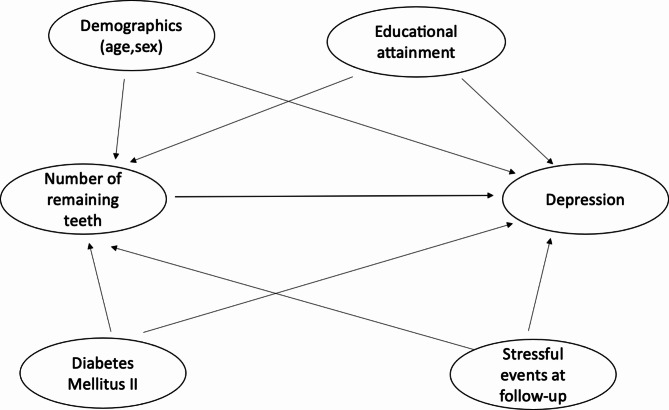
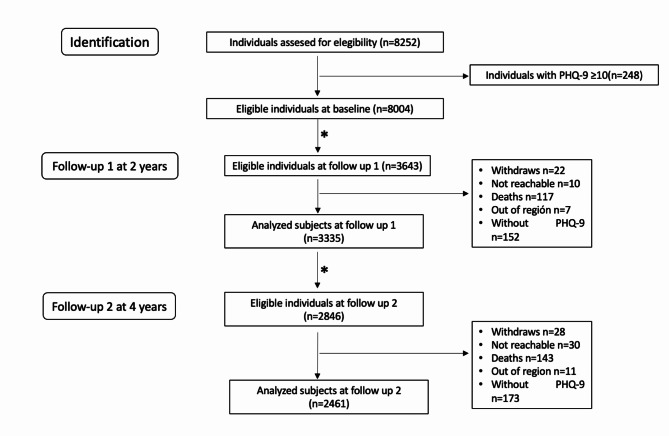
This prospective study used the information of individuals, aged 38 to 74 years, excluding those with depression at baseline. The number of remaining teeth at baseline was determined in four groups: "20 or more teeth", "10 to 19 teeth", "1 to 9 teeth" and "no natural teeth". Depression was measured through the PHQ-9. Logistic regression was performed to calculate the odds ratios (OR) for incidence depression at both periods of follow-ups, adjusting for age, sex, educational attainment, diabetes mellitus II, and stressful events at follow-up. Also, we performed adjusted multinomial logistic models to analysis the association between the number of remaining teeth and depression severity.
In total individuals (n = 3335 at follow 1, n = 2461 at follow 2), all groups have ORs for incident depression above 1 considering 20 or more teeth as reference. In men, those with 10-19 teeth have 2.44 times higher odds of incident depression than those with 20 or more teeth (OR 2.44, CI 95% 1.33-4.50). Edentulous subjects at 4 years follow-up had 2.24 times higher odds of depression than those with more than 20 teeth (OR 2.24 CI 95%1.35-3.72). In women, the ORs (CI 95%) of incident depression were 2.56 (1.50-4.39), 1.56 (1.02-2.40) and 1.27 (0.90-1.81) for "none", "1-9", "10-19" respectively in comparison to the reference group. In edentulous individuals at baseline, the odds for each of the comparisons "mild vs no", "moderate vs no", "moderately severe vs no" and "severe vs no" were above 1, at both follow-ups.
Individuals with less than 20 teeth in the mouth could had higher odds of incident depression at 2- and 4-years follow-up, with differences between men and women. Also, in our study, edentulism was associated with increased odds of incident depression at 4-years follow-up in women, and with higher levels of severity of depressive symptoms.
先前的研究已经证实了牙齿缺失与抑郁之间存在关联。然而,纵向证据仍然有限,需要在其他人群中进行验证。本研究旨在探讨在智利莫勒队列(MAUCO)中招募的个体中,在 2 年和 4 年的随访期间,剩余牙齿数量与新发抑郁之间的纵向关联。
这项前瞻性研究使用了年龄在 38 至 74 岁之间的个体信息,排除了基线时有抑郁的个体。在基线时,剩余牙齿数量分为以下四组:“20 颗或更多牙齿”、“10 到 19 颗牙齿”、“1 到 9 颗牙齿”和“无天然牙齿”。抑郁通过 PHQ-9 进行测量。使用逻辑回归计算两个随访期间新发抑郁的优势比(OR),调整因素包括年龄、性别、教育程度、II 型糖尿病和随访时的压力事件。此外,我们还进行了调整后的多项逻辑回归模型分析,以分析剩余牙齿数量与抑郁严重程度之间的关系。
在总计的个体(随访 1 时为 3335 人,随访 2 时为 2461 人)中,与 20 颗或更多牙齿作为参考相比,所有组的新发抑郁的 OR 均大于 1。在男性中,与 20 颗或更多牙齿相比,10-19 颗牙齿的男性发生新发抑郁的可能性高出 2.44 倍(OR 2.44,95%CI 1.33-4.50)。在 4 年随访时无牙的受试者发生抑郁的可能性比 20 颗或更多牙齿的受试者高 2.24 倍(OR 2.24,95%CI 1.35-3.72)。在女性中,与参考组相比,新发抑郁的 OR(95%CI)分别为“无”、“1-9”、“10-19”组的 2.56(1.50-4.39)、1.56(1.02-2.40)和 1.27(0.90-1.81)。在基线时无牙的个体中,在两个随访期间,“轻度与无”、“中度与无”、“中度严重与无”和“严重与无”的比较中,每个比较的比值比均大于 1。
在 2 年和 4 年的随访中,口中剩余牙齿少于 20 颗的个体新发抑郁的可能性更高,男性和女性之间存在差异。此外,在我们的研究中,无牙与女性新发抑郁的可能性增加以及抑郁症状严重程度的升高有关。