Department of Radiology, Affiliated Hospital of Chengdu University, 82 2Nd N Section of Second Ring Rd, Chengdu, 610081, Sichuan Province, China.
Department of Research and Development, Shanghai United Imaging Intelligence Co., Ltd, Shanghai, 200232, China.
Osteoporos Int. 2024 Jan;35(1):117-128. doi: 10.1007/s00198-023-06900-w. Epub 2023 Sep 5.
This study utilized deep learning to classify osteoporosis and predict bone density using opportunistic CT scans and independently tested the models on data from different hospitals and equipment. Results showed high accuracy and strong correlation with QCT results, showing promise for expanding osteoporosis screening and reducing unnecessary radiation and costs.
To explore the feasibility of using deep learning to establish a model for osteoporosis classification and bone density value prediction based on opportunistic CT scans and to verify its generalization and diagnostic ability using an independent test set.
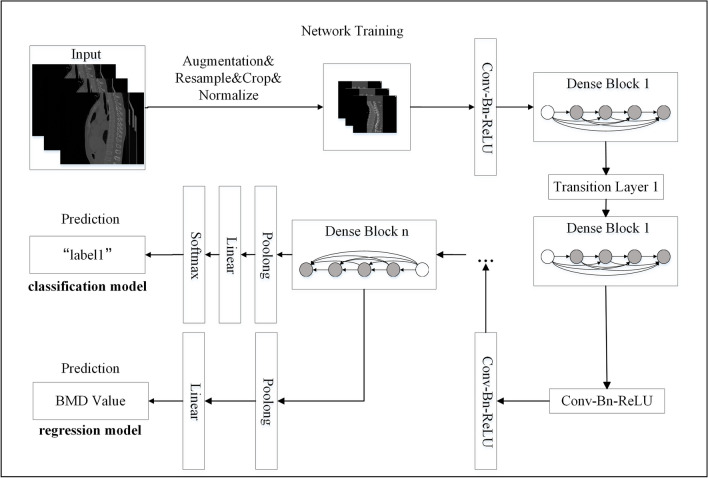
A total of 1219 cases of opportunistic CT scans were included in this study, with QCT results as the reference standard. The training set: test set: independent test set ratio was 703: 176: 340, and the independent test set data of 340 cases were from 3 different hospitals and 4 different CT scanners. The VB-Net structure automatic segmentation model was used to segment the trabecular bone, and DenseNet was used to establish a three-classification model and bone density value prediction regression model. The performance parameters of the models were calculated and evaluated.
The ROC curves showed that the mean AUCs of the three-category classification model for categorizing cases into "normal," "osteopenia," and "osteoporosis" for the training set, test set, and independent test set were 0.999, 0.970, and 0.933, respectively. The F1 score, accuracy, precision, recall, precision, and specificity of the test set were 0.903, 0.909, 0.899, 0.908, and 0.956, respectively, and those of the independent test set were 0.798, 0.815, 0.792, 0.81, and 0.899, respectively. The MAEs of the bone density prediction regression model in the training set, test set, and independent test set were 3.15, 6.303, and 10.257, respectively, and the RMSEs were 4.127, 8.561, and 13.507, respectively. The R-squared values were 0.991, 0.962, and 0.878, respectively. The Pearson correlation coefficients were 0.996, 0.981, and 0.94, respectively, and the p values were all < 0.001. The predicted values and bone density values were highly positively correlated, and there was a significant linear relationship.
Using deep learning neural networks to process opportunistic CT scan images of the body can accurately predict bone density values and perform bone density three-classification diagnosis, which can reduce the radiation risk, economic consumption, and time consumption brought by specialized bone density measurement, expand the scope of osteoporosis screening, and have broad application prospects.
探索利用深度学习建立基于机会性 CT 扫描的骨质疏松分类及骨密度值预测模型的可行性,并通过独立测试集验证其泛化及诊断效能。
本研究纳入 1219 例机会性 CT 扫描,以 QCT 结果为参考标准。训练集:测试集:独立测试集的比例为 703:176:340,其中 340 例独立测试集数据来自 3 家不同医院、4 种不同 CT 扫描仪。采用 VB-Net 结构自动分割模型对骨小梁进行分割,使用 DenseNet 建立三分类模型和骨密度值预测回归模型。计算并评估模型的性能参数。
ROC 曲线显示,训练集、测试集和独立测试集的分类模型将病例分为“正常”“骨量减少”和“骨质疏松”的平均 AUC 分别为 0.999、0.970 和 0.933。测试集的 F1 评分、准确率、敏感度、特异度、阳性预测值和阴性预测值分别为 0.903、0.909、0.899、0.908 和 0.956,独立测试集分别为 0.798、0.815、0.792、0.81 和 0.899。骨密度预测回归模型在训练集、测试集和独立测试集的 MAE 分别为 3.15、6.303 和 10.257,RMSE 分别为 4.127、8.561 和 13.507。R-squared 值分别为 0.991、0.962 和 0.878。Pearson 相关系数分别为 0.996、0.981 和 0.94,p 值均<0.001。预测值与骨密度值高度正相关,呈显著线性关系。
利用深度学习神经网络处理人体机会性 CT 扫描图像,能够准确预测骨密度值并进行骨密度三分类诊断,可减少专门的骨密度测量带来的辐射风险、经济消耗和时间消耗,扩大骨质疏松筛查范围,具有广阔的应用前景。