Department of Radiology, Ruijin Hospital, Shanghai Jiao Tong University School of Medicine, Shanghai, 200025, China.
LinkingMed, Beijing, 100000, China.
Eur Radiol. 2020 Jul;30(7):4107-4116. doi: 10.1007/s00330-020-06679-y. Epub 2020 Feb 19.
Osteoporosis is a prevalent and treatable condition, but it remains underdiagnosed. In this study, a deep learning-based system was developed to automatically measure bone mineral density (BMD) for opportunistic osteoporosis screening using low-dose chest computed tomography (LDCT) scans obtained for lung cancer screening.
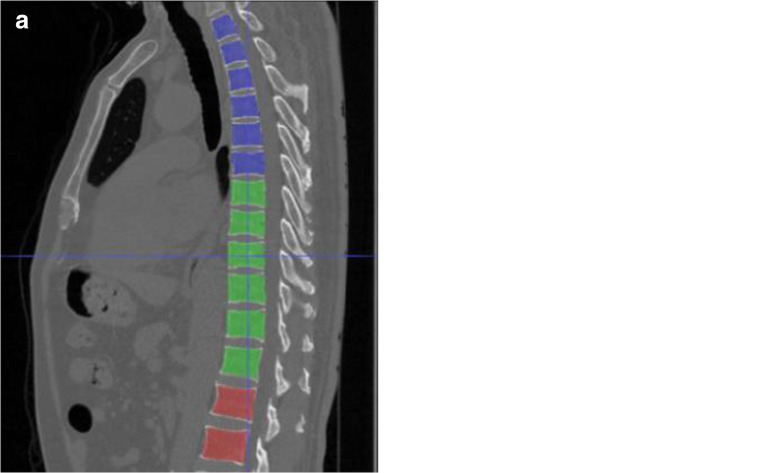
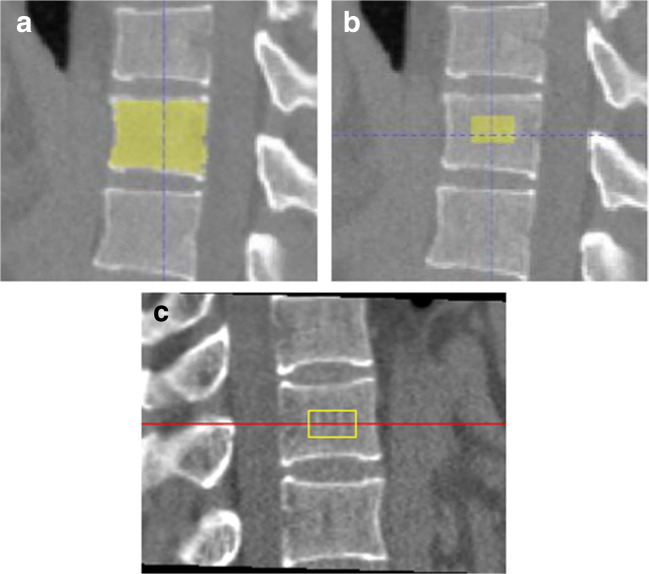
First, a deep learning model was trained and tested with 200 annotated LDCT scans to segment and label all vertebral bodies (VBs). Then, the mean CT numbers of the trabecular area of target VBs were obtained based on the segmentation mask through geometric operations. Finally, a linear function was built to map the trabecular CT numbers of target VBs to their BMDs collected from approved software used for osteoporosis diagnosis. The diagnostic performance of the developed system was evaluated using an independent dataset of 374 LDCT scans with standard BMDs and osteoporosis diagnosis.
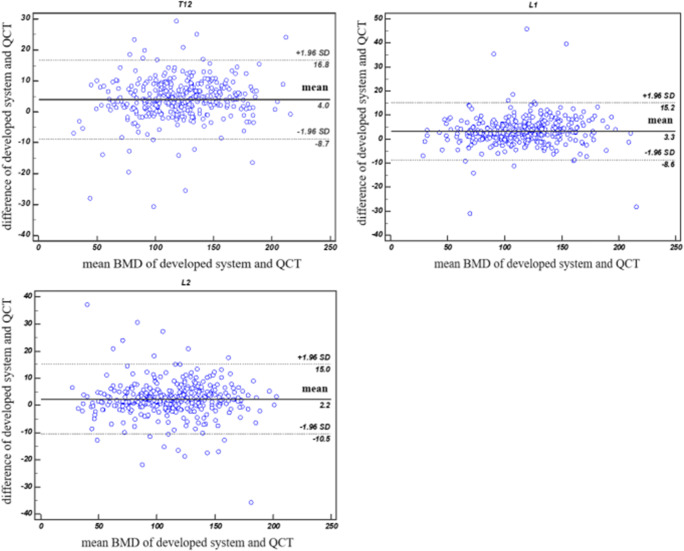
Our deep learning model achieved a mean Dice coefficient of 86.6% for VB segmentation and 97.5% accuracy for VB labeling. Line regression and Bland-Altman analyses showed good agreement between the predicted BMD and the ground truth, with correlation coefficients of 0.964-0.968 and mean errors of 2.2-4.0 mg/cm. The area under the curve (AUC) was 0.927 for detecting osteoporosis and 0.942 for distinguishing low BMD.
The proposed deep learning-based system demonstrated the potential to automatically perform opportunistic osteoporosis screening using LDCT scans obtained for lung cancer screening.
• Osteoporosis is a prevalent but underdiagnosed condition that can increase the risk of fracture. • A deep learning-based system was developed to fully automate bone mineral density measurement in low-dose chest computed tomography scans. • The developed system achieved high accuracy for automatic opportunistic osteoporosis screening using low-dose chest computed tomography scans obtained for lung cancer screening.
骨质疏松症是一种普遍存在且可治疗的疾病,但仍存在诊断不足的情况。本研究开发了一种基于深度学习的系统,用于使用肺癌筛查获得的低剂量胸部计算机断层扫描(LDCT)扫描进行机会性骨质疏松症筛查来自动测量骨密度(BMD)。
首先,使用 200 个已注释的 LDCT 扫描对深度学习模型进行训练和测试,以对所有椎体(VB)进行分割和标记。然后,通过几何运算从分割掩模中获得目标 VB 的小梁区域的平均 CT 数。最后,建立线性函数将目标 VB 的小梁 CT 数映射到使用经批准的骨质疏松症诊断软件采集的 BMD。使用具有标准 BMD 和骨质疏松症诊断的 374 个 LDCT 扫描的独立数据集评估所开发系统的诊断性能。
我们的深度学习模型在 VB 分割方面的平均 Dice 系数为 86.6%,在 VB 标记方面的准确率为 97.5%。线性回归和 Bland-Altman 分析表明,预测的 BMD 与真实值之间具有良好的一致性,相关系数为 0.964-0.968,平均误差为 2.2-4.0mg/cm。用于检测骨质疏松症的曲线下面积(AUC)为 0.927,用于区分低 BMD 的 AUC 为 0.942。
所提出的基于深度学习的系统具有使用肺癌筛查获得的 LDCT 扫描进行自动机会性骨质疏松症筛查的潜力。
•骨质疏松症是一种普遍存在但诊断不足的疾病,会增加骨折的风险。•开发了一种基于深度学习的系统,用于在低剂量胸部计算机断层扫描扫描中自动测量骨密度。•所开发的系统在使用肺癌筛查获得的低剂量胸部计算机断层扫描扫描进行自动机会性骨质疏松症筛查方面取得了很高的准确性。