• 文献检索
  • 文档翻译
  • 深度研究
  • 学术资讯
  • Suppr Zotero 插件Zotero 插件
  • 邀请有礼
  • 套餐&价格
  • 历史记录
应用&插件
Suppr Zotero 插件Zotero 插件浏览器插件Mac 客户端Windows 客户端微信小程序
定价
高级版会员购买积分包购买API积分包
服务
文献检索文档翻译深度研究API 文档MCP 服务
关于我们
关于 Suppr公司介绍联系我们用户协议隐私条款
关注我们

Suppr 超能文献

核心技术专利:CN118964589B侵权必究
粤ICP备2023148730 号-1Suppr @ 2026

文献检索

告别复杂PubMed语法,用中文像聊天一样搜索,搜遍4000万医学文献。AI智能推荐,让科研检索更轻松。

立即免费搜索

文件翻译

保留排版,准确专业,支持PDF/Word/PPT等文件格式,支持 12+语言互译。

免费翻译文档

深度研究

AI帮你快速写综述,25分钟生成高质量综述,智能提取关键信息,辅助科研写作。

立即免费体验

基于自监督深度学习的高效空间免疫表型分析。

Self-supervised deep learning for highly efficient spatial immunophenotyping.

机构信息

Centre for Evolution and Cancer, The Institute of Cancer Research, London, UK; Division of Molecular Pathology, The Institute of Cancer Research, London, UK.

Department of Oncology, UCL Cancer Institute, University College London, London, UK.

出版信息

EBioMedicine. 2023 Sep;95:104769. doi: 10.1016/j.ebiom.2023.104769. Epub 2023 Sep 4.

DOI:10.1016/j.ebiom.2023.104769
PMID:37672979
原文链接:https://pmc.ncbi.nlm.nih.gov/articles/PMC10493897/
Abstract

BACKGROUND

Efficient biomarker discovery and clinical translation depend on the fast and accurate analytical output from crucial technologies such as multiplex imaging. However, reliable cell classification often requires extensive annotations. Label-efficient strategies are urgently needed to reveal diverse cell distribution and spatial interactions in large-scale multiplex datasets.

METHODS

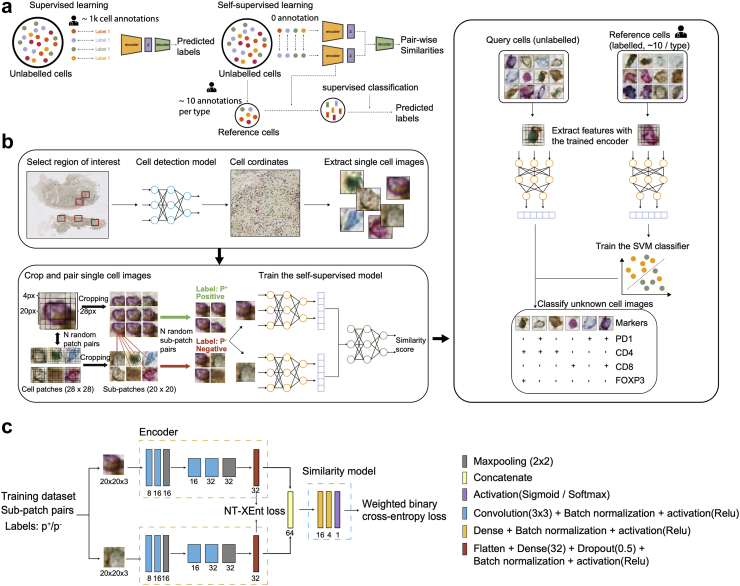
This study proposed Self-supervised Learning for Antigen Detection (SANDI) for accurate cell phenotyping while mitigating the annotation burden. The model first learns intrinsic pairwise similarities in unlabelled cell images, followed by a classification step to map learnt features to cell labels using a small set of annotated references. We acquired four multiplex immunohistochemistry datasets and one imaging mass cytometry dataset, comprising 2825 to 15,258 single-cell images to train and test the model.

FINDINGS

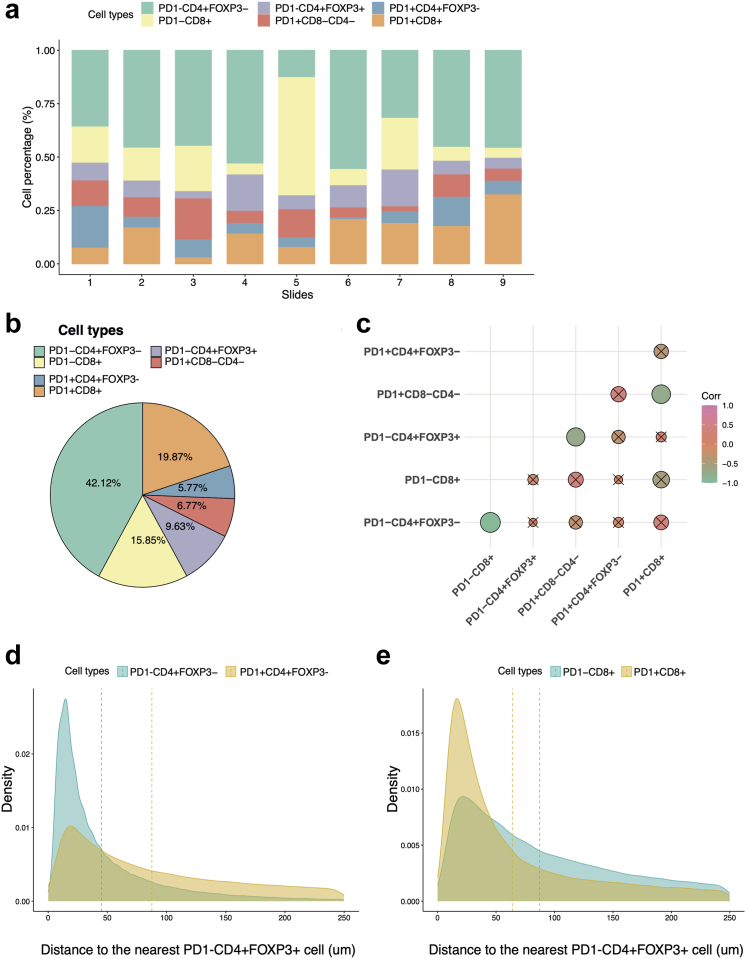
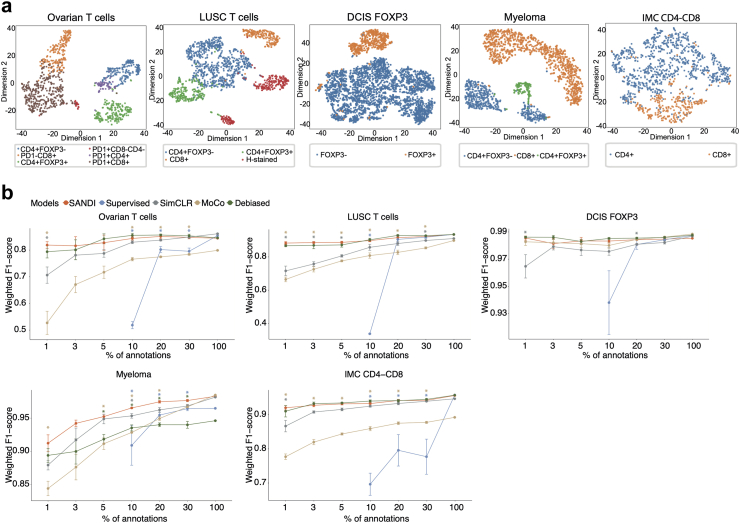
With 1% annotations (18-114 cells), SANDI achieved weighted F1-scores ranging from 0.82 to 0.98 across the five datasets, which was comparable to the fully supervised classifier trained on 1828-11,459 annotated cells (-0.002 to -0.053 of averaged weighted F1-score, Wilcoxon rank-sum test, P = 0.31). Leveraging the immune checkpoint markers stained in ovarian cancer slides, SANDI-based cell identification reveals spatial expulsion between PD1-expressing T helper cells and T regulatory cells, suggesting an interplay between PD1 expression and T regulatory cell-mediated immunosuppression.

INTERPRETATION

By striking a fine balance between minimal expert guidance and the power of deep learning to learn similarity within abundant data, SANDI presents new opportunities for efficient, large-scale learning for histology multiplex imaging data.

FUNDING

This study was funded by the Royal Marsden/ICR National Institute of Health Research Biomedical Research Centre.

摘要

背景

高效的生物标志物发现和临床转化依赖于多重成像等关键技术的快速、准确的分析输出。然而,可靠的细胞分类通常需要广泛的注释。迫切需要标签高效策略来揭示大规模多重数据集的多样化细胞分布和空间相互作用。

方法

本研究提出了用于抗原检测的自监督学习(SANDI),以在减轻注释负担的同时实现准确的细胞表型分析。该模型首先学习未标记细胞图像中的内在成对相似性,然后通过分类步骤使用一小部分标记的参考将学习到的特征映射到细胞标签。我们获取了四个多重免疫组织化学数据集和一个成像质谱细胞数据集,包含 2825 到 15258 个单细胞图像来训练和测试模型。

结果

使用 1%的注释(18-114 个细胞),SANDI 在五个数据集上实现了加权 F1 分数从 0.82 到 0.98 的范围,与在 1828-11459 个注释细胞上训练的完全监督分类器相当(平均加权 F1 分数的-0.002 到-0.053,Wilcoxon 秩和检验,P=0.31)。利用卵巢癌切片中染色的免疫检查点标记物,基于 SANDI 的细胞识别揭示了 PD1 表达的辅助性 T 细胞和 T 调节细胞之间的空间驱逐,表明 PD1 表达与 T 调节细胞介导的免疫抑制之间存在相互作用。

解释

通过在最少的专家指导和深度学习在丰富数据中学习相似性的能力之间取得良好平衡,SANDI 为组织学多重成像数据的高效、大规模学习提供了新的机会。

资金

本研究由皇家马斯登/ICR 国家卫生研究院生物医学研究中心资助。

https://cdn.ncbi.nlm.nih.gov/pmc/blobs/3219/10493897/6b6f3f5a2444/gr4.jpg
https://cdn.ncbi.nlm.nih.gov/pmc/blobs/3219/10493897/12928ecd97a8/gr1.jpg
https://cdn.ncbi.nlm.nih.gov/pmc/blobs/3219/10493897/1b019f51497c/gr2.jpg
https://cdn.ncbi.nlm.nih.gov/pmc/blobs/3219/10493897/2f055ff5e5cb/gr3.jpg
https://cdn.ncbi.nlm.nih.gov/pmc/blobs/3219/10493897/6b6f3f5a2444/gr4.jpg
https://cdn.ncbi.nlm.nih.gov/pmc/blobs/3219/10493897/12928ecd97a8/gr1.jpg
https://cdn.ncbi.nlm.nih.gov/pmc/blobs/3219/10493897/1b019f51497c/gr2.jpg
https://cdn.ncbi.nlm.nih.gov/pmc/blobs/3219/10493897/2f055ff5e5cb/gr3.jpg
https://cdn.ncbi.nlm.nih.gov/pmc/blobs/3219/10493897/6b6f3f5a2444/gr4.jpg

相似文献

1
Self-supervised deep learning for highly efficient spatial immunophenotyping.基于自监督深度学习的高效空间免疫表型分析。
EBioMedicine. 2023 Sep;95:104769. doi: 10.1016/j.ebiom.2023.104769. Epub 2023 Sep 4.
2
TransAnno-Net: A Deep Learning Framework for Accurate Cell Type Annotation of Mouse Lung Tissue Using Self-supervised Pretraining.TransAnno-Net:一种使用自监督预训练对小鼠肺组织进行准确细胞类型注释的深度学习框架。
Comput Methods Programs Biomed. 2025 Jul;267:108809. doi: 10.1016/j.cmpb.2025.108809. Epub 2025 Apr 24.
3
Semi-Supervised Learning Allows for Improved Segmentation With Reduced Annotations of Brain Metastases Using Multicenter MRI Data.半监督学习可利用多中心MRI数据,通过减少脑转移瘤的标注来改进分割。
J Magn Reson Imaging. 2025 Jun;61(6):2469-2479. doi: 10.1002/jmri.29686. Epub 2025 Jan 10.
4
Deep learning-based image analysis methods for brightfield-acquired multiplex immunohistochemistry images.基于深度学习的明场获取多重免疫组化图像的图像分析方法。
Diagn Pathol. 2020 Jul 28;15(1):100. doi: 10.1186/s13000-020-01003-0.
5
Label-efficient sequential model-based weakly supervised intracranial hemorrhage segmentation in low-data non-contrast CT imaging.低数据量非增强CT成像中基于标签高效序列模型的弱监督颅内出血分割
Med Phys. 2025 Apr;52(4):2123-2144. doi: 10.1002/mp.17689. Epub 2025 Feb 17.
6
Local contrastive loss with pseudo-label based self-training for semi-supervised medical image segmentation.基于伪标签自训练的局部对比损失的半监督医学图像分割。
Med Image Anal. 2023 Jul;87:102792. doi: 10.1016/j.media.2023.102792. Epub 2023 Mar 11.
7
Self-Supervised Feature Learning and Phenotyping for Assessing Age-Related Macular Degeneration Using Retinal Fundus Images.使用视网膜眼底图像评估年龄相关性黄斑变性的自监督特征学习和表型分析。
Ophthalmol Retina. 2022 Feb;6(2):116-129. doi: 10.1016/j.oret.2021.06.010. Epub 2021 Jul 2.
8
Self-supervised pre-training with contrastive and masked autoencoder methods for dealing with small datasets in deep learning for medical imaging.基于对比和掩蔽自动编码器方法的自监督预训练在医学影像深度学习中小数据集处理中的应用。
Sci Rep. 2023 Nov 20;13(1):20260. doi: 10.1038/s41598-023-46433-0.
9
Transferable automatic hematological cell classification: Overcoming data limitations with self-supervised learning.可转移的自动血液细胞分类:通过自监督学习克服数据限制
Comput Methods Programs Biomed. 2025 Mar;260:108560. doi: 10.1016/j.cmpb.2024.108560. Epub 2024 Dec 9.
10
Combining weakly and strongly supervised learning improves strong supervision in Gleason pattern classification.弱监督和强监督学习的结合提高了 Gleason 模式分类中的强监督。
BMC Med Imaging. 2021 May 8;21(1):77. doi: 10.1186/s12880-021-00609-0.

引用本文的文献

1
AI in Histopathology Explorer for comprehensive analysis of the evolving AI landscape in histopathology.组织病理学中的人工智能探索器,用于全面分析组织病理学中不断发展的人工智能格局。
NPJ Digit Med. 2025 Mar 12;8(1):156. doi: 10.1038/s41746-025-01524-2.
2
Society for Immunotherapy of Cancer: updates and best practices for multiplex immunohistochemistry (IHC) and immunofluorescence (IF) image analysis and data sharing.癌症免疫治疗学会:多重免疫组织化学(IHC)和免疫荧光(IF)图像分析及数据共享的更新与最佳实践
J Immunother Cancer. 2025 Jan 8;13(1):e008875. doi: 10.1136/jitc-2024-008875.
3
Computational methods and biomarker discovery strategies for spatial proteomics: a review in immuno-oncology.
计算方法和生物标志物发现策略在空间蛋白质组学中的应用:免疫肿瘤学综述。
Brief Bioinform. 2024 Jul 25;25(5). doi: 10.1093/bib/bbae421.