Department of Health Informatics, College Medicine and Health Sciences, Debre Markos University, P.O.Box 269, Debre Markos, Ethiopia.
Department of Human Nutrition, College Medicine and Health Sciences, Debre Markos University, P.O.Box 269, Debre Markos, Ethiopia.
BMC Health Serv Res. 2023 Sep 7;23(1):967. doi: 10.1186/s12913-023-09927-1.
The COVID-19 pandemic has led to a surge in the use of telemedicine as a means of delivering healthcare services remotely. Healthcare providers play a key role in the adoption and implementation of telemedicine for its effectiveness. Despite its benefits, there have been unclear concerns about its effectiveness and acceptance in the process of implementing telemedicine. The objective of the study was to assess health professionals' perceptions towards the implementation of telemedicine during the COVID-19 pandemic.
A cross-sectional study design was conducted among eight hundred forty-five study participants from December 2020 to February 2021. A pre-test was performed on 5% of the total sample size, and the quality of the data was ensured by checking its completeness and consistency. Descriptive statistics and bivariable and multivariable logistic regression were used. The Variables with a P-value equal to or less than 0.25 in bivariable logistic regression were entered into a multivariable logistic regression, and model fitness was assessed.
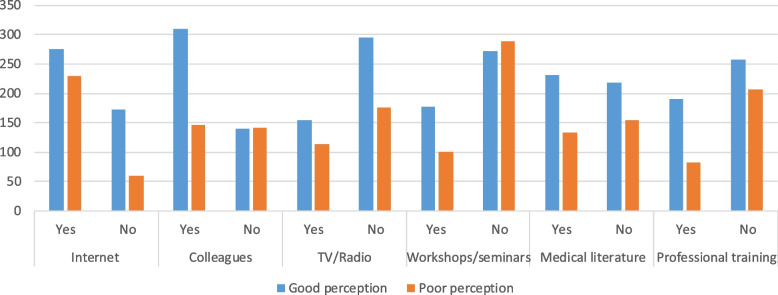
The study revealed that 60.9% of professionals had a good perception toward telemedicine implementation, with an 87.2% response rate. Health professionals with IT support staff, ICT training, who use social media platforms regularly, and availability of computer or smartphone within/outside their health facility were 4.7, 3.3, 3.7, and 13.2 times more likely to have a positive association towards telemedicine implementation respectively.
More than half of the health professionals had a good perception of telemedicine. Social media use, ICT training, computer accessibility, and the presence of IT support staff were all found to have positive associations with the telemedicine perception. In the era of the COVID-19 pandemic, the government should take the initiative to strengthen opportunities for health professionals to learn and apply telemedicine in their medical practice by providing ICT training, IT infrastructure and support staff, improving computer access, and recommending health professionals' positive use of social media in the health facility.
COVID-19 大流行导致远程医疗作为提供医疗服务的手段得到了广泛应用。医疗保健提供者在远程医疗的采用和实施中发挥着关键作用,因为远程医疗是有效的。尽管远程医疗具有诸多益处,但在实施远程医疗的过程中,其有效性和可接受性仍存在一些不清楚的问题。本研究旨在评估医疗专业人员在 COVID-19 大流行期间对实施远程医疗的看法。
本研究于 2020 年 12 月至 2021 年 2 月期间,对来自 845 名研究参与者的进行了横断面研究设计。对总样本量的 5%进行了预测试,并通过检查数据的完整性和一致性来确保数据质量。使用描述性统计和双变量和多变量逻辑回归。在双变量逻辑回归中 P 值等于或小于 0.25 的变量被纳入多变量逻辑回归,并评估模型拟合度。
研究结果显示,60.9%的专业人员对远程医疗的实施有较好的看法,回应率为 87.2%。有 IT 支持人员、接受过信息通信技术培训、经常使用社交媒体平台以及在医疗机构内/外有电脑或智能手机的卫生专业人员,对远程医疗实施有积极关联的可能性分别为 4.7 倍、3.3 倍、3.7 倍和 13.2 倍。
超过一半的卫生专业人员对远程医疗有较好的看法。社交媒体使用、信息通信技术培训、计算机可及性以及 IT 支持人员的存在,均与远程医疗的认知呈正相关。在 COVID-19 大流行时代,政府应主动为卫生专业人员提供信息通信技术培训、IT 基础设施和支持人员、改善计算机可及性以及建议卫生专业人员在医疗机构内积极使用社交媒体的机会,以加强他们在医疗实践中学习和应用远程医疗的机会。