Liu Haodong, Liu Wei-Wei, Haro-Moreno Jose M, Xu Bu, Zheng Yanfen, Liu Jiwen, Tian Jiwei, Zhang Xiao-Hua, Zhou Ning-Yi, Qin Liping, Zhu Yuanqing, Rodriguez-Valera Francisco, Zhang Chuanlun
Shenzhen Key Laboratory of Marine Archaea Geo-Omics, Department of Ocean Science & Engineering, Southern University of Science and Technology, Shenzhen 518055, China.
Southern Marine Science and Engineering Guangdong Laboratory (Guangzhou), Guangzhou 510000, China.
iScience. 2023 Aug 17;26(9):107664. doi: 10.1016/j.isci.2023.107664. eCollection 2023 Sep 15.
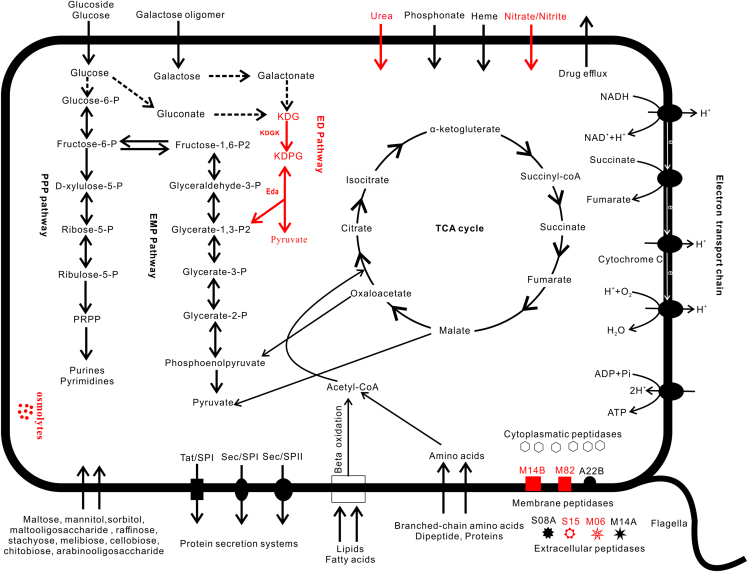
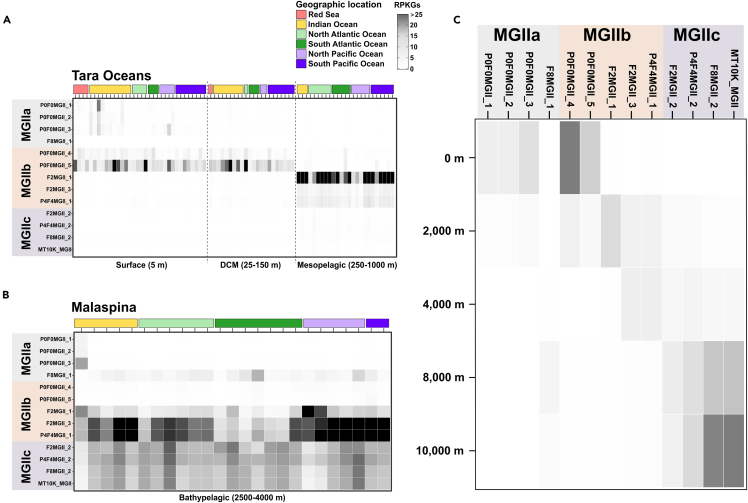
Marine group II (MGII) is the most abundant planktonic heterotrophic archaea in the ocean. The evolutionary history of MGII archaea is elusive. In this study, 13 new MGII metagenome-assembled genomes were recovered from surface to the hadal zone in Challenger Deep of the Mariana Trench; four of them from the deep ocean represent a novel group. The optimal growth temperature (OGT) of the common ancestor of MGII has been estimated to be at about 60°C and OGTs of MGIIc, MGIIb, and MGIIa at 47°C-50ºC, 37°C-44ºC, and 30°C-37ºC, respectively, suggesting the adaptation of these species to different temperatures during evolution. The estimated OGT range of MGIIc was supported by experimental measurements of cloned β-galactosidase that showed optimal enzyme activity around 50°C. These results indicate that MGIIc may have originated from a common ancestor that lived in warm or even hot marine environment, such as hydrothermal vents.
海洋第二类群(MGII)是海洋中数量最多的浮游异养古菌。MGII古菌的进化历史尚不清楚。在本研究中,从马里亚纳海沟挑战者深渊的表层到超深渊带共获得了13个新的MGII宏基因组组装基因组;其中4个来自深海的基因组代表一个新类群。据估计,MGII共同祖先的最适生长温度(OGT)约为60°C,而MGIIc、MGIIb和MGIIa的OGT分别为47°C - 50°C、37°C - 44°C和30°C - 37°C,这表明这些物种在进化过程中适应了不同的温度。对克隆的β - 半乳糖苷酶的实验测量结果支持了MGIIc估计的OGT范围,该结果显示酶活性在50°C左右达到最佳。这些结果表明,MGIIc可能起源于生活在温暖甚至炎热海洋环境(如热液喷口)中的共同祖先。