CAS-Key Laboratory of Synthetic Biology, CAS Center for Excellence in Molecular Plant Sciences, Institute of Plant Physiology and Ecology, Chinese Academy of Sciences, Shanghai, China.
University of Chinese Academy of Sciences, Beijing, China.
Genome Biol. 2021 Jul 13;22(1):207. doi: 10.1186/s13059-021-02408-w.
The full biosphere structure and functional exploration of the microbial communities of the Challenger Deep of the Mariana Trench, the deepest known hadal zone on Earth, lag far behind that of other marine realms.
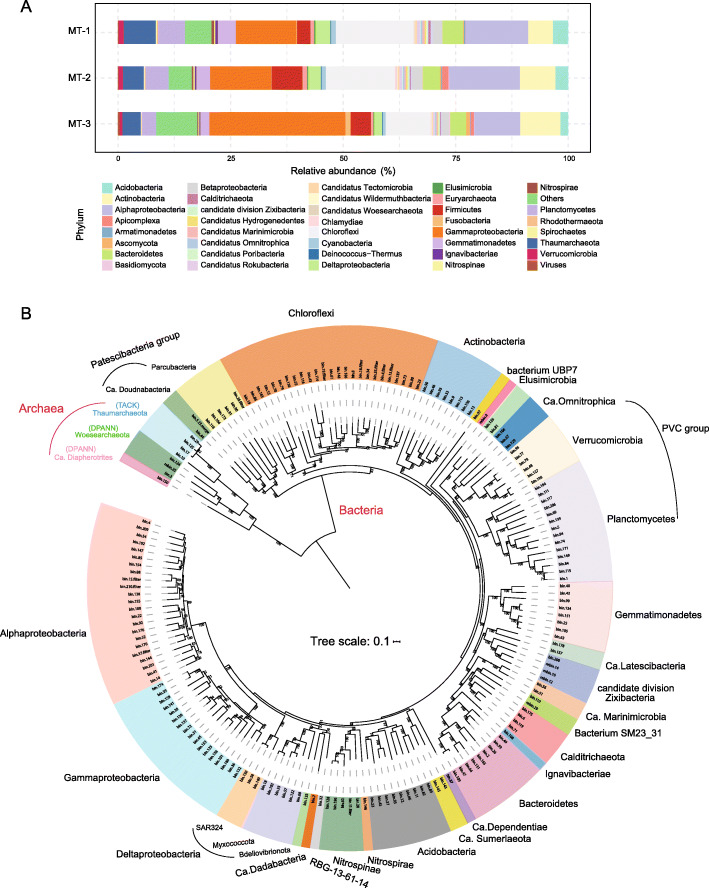
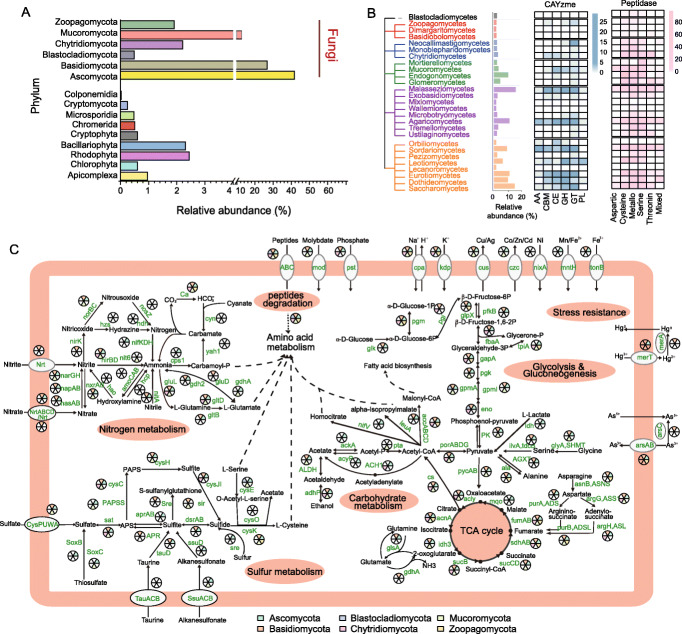
We adopt a deep metagenomics approach to investigate the microbiome in the sediment of Challenger Deep, Mariana Trench. We construct 178 metagenome-assembled genomes (MAGs) representing 26 phyla, 16 of which are reported from hadal sediment for the first time. Based on the MAGs, we find the microbial community functions are marked by enrichment and prevalence of mixotrophy and facultative anaerobic metabolism. The microeukaryotic community is found to be dominated by six fungal groups that are characterized for the first time in hadal sediment to possess the assimilatory and dissimilatory nitrate/sulfate reduction, and hydrogen sulfide oxidation pathways. By metaviromic analysis, we reveal novel hadal Caudovirales clades, distinctive virus-host interactions, and specialized auxiliary metabolic genes for modulating hosts' nitrogen/sulfur metabolism. The hadal microbiome is further investigated by large-scale cultivation that cataloged 1070 bacterial and 19 fungal isolates from the Challenger Deep sediment, many of which are found to be new species specialized in the hadal habitat.
Our hadal MAGs and isolates increase the diversity of the Challenger Deep sediment microbial genomes and isolates present in the public. The deep metagenomics approach fills the knowledge gaps in structure and diversity of the hadal microbiome, and provides novel insight into the ecology and metabolism of eukaryotic and viral components in the deepest biosphere on earth.
对地球上已知的最深处海沟——马里亚纳海沟挑战者深渊的微生物群落的完整生物圈结构和功能的探索远远落后于其他海洋领域。
我们采用深度宏基因组学方法来研究马里亚纳海沟挑战者深渊沉积物中的微生物组。我们构建了 178 个代表 26 个门的宏基因组组装基因组(MAG),其中 16 个门是首次从深海沉积物中报道的。基于 MAG,我们发现微生物群落功能的特点是混合营养和兼性厌氧代谢的富集和流行。真核微生物群落由六个真菌群组成,这些真菌群的特征是首次在深海沉积物中具有同化和异化硝酸盐/硫酸盐还原以及硫化氢氧化途径。通过宏病毒组分析,我们揭示了新的深海 Caudovirales 进化枝、独特的病毒-宿主相互作用以及专门用于调节宿主氮/硫代谢的辅助代谢基因。通过大规模培养进一步研究了深海微生物组,从挑战者深渊沉积物中分离出 1070 株细菌和 19 株真菌,其中许多被发现是专门适应深海生境的新物种。
我们的深海 MAG 和分离株增加了挑战者深渊沉积物微生物基因组和分离株的多样性,目前已在公共数据库中呈现。深度宏基因组学方法填补了深海微生物组结构和多样性的知识空白,并为地球上最深处生物圈中真核生物和病毒成分的生态学和代谢提供了新的见解。