Sravya Surapaneni Lakshmi, Swain Jayshree, Sahoo Abhay Kumar, Mangaraj Swayamsidha, Kanwar Jayabhanu, Jadhao Pooja, Das Srijit
Department of Endocrinology, IMS & SUM Hospital, Bhubaneswar 751003, India.
Department of Human & Clinical Anatomy, College of Medicine & Health Sciences, Sultan Qaboos University, Muscat 123, Oman.
J Clin Med. 2023 Aug 24;12(17):5499. doi: 10.3390/jcm12175499.
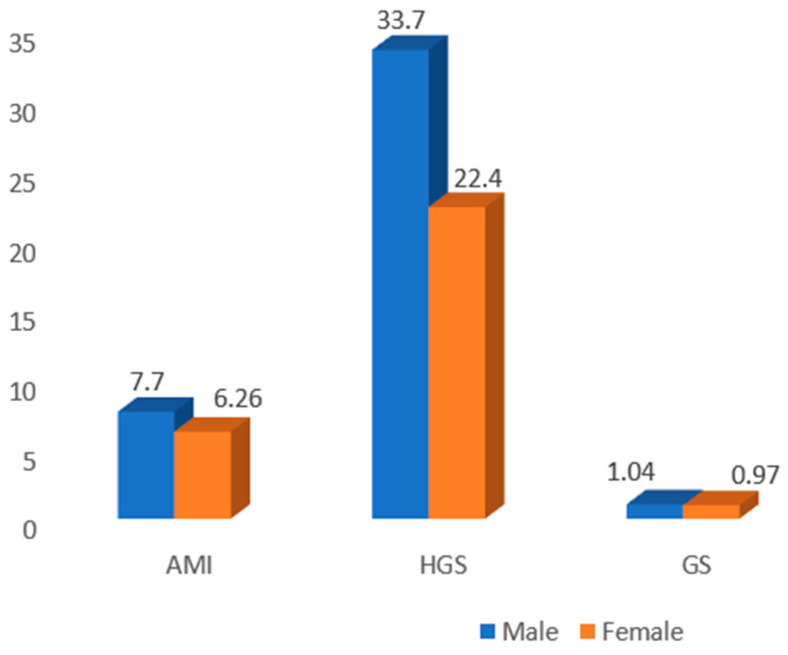
(1) Background: Sarcopenia has gained much interest in recent years due to an increase in morbidity. Sarcopenia is associated with type 2 diabetes mellitus (T2DM) and vice versa. There is a paucity of information regarding the prevalence and predictors of sarcopenia among T2DM individuals. The aim of the present study was to determine the prevalence and predictors of sarcopenia among T2DM individuals. (2) Methods: This study included 159 diabetics (cases) and 79 non-diabetics (controls) aged >50 years. The subjects were assessed for demographic and anthropometric parameters. Sarcopenia (according to the Asian Working Group for Sarcopenia 2019 criteria) was assessed using Jammer's hydraulic dynamometer for handgrip strength, dual-energy X-ray absorptiometry for muscle mass, and 6m gait speed. The biochemical investigations included glycated hemoglobin; fasting and prandial glucose; fasting insulin; lipid, renal, liver, and thyroid profiles; serum calcium; phosphorous; vitamin D; and parathyroid hormone (PTH). Appropriate statistical methods were used to determine the significance of each parameter, and a multivariate regression analysis was applied to determine the predictors. (3) Results: The prevalence of sarcopenia was significantly higher among the cases than the controls (22.5% vs. 8.86%, -0.012). Body mass index (BMI) (OR-0.019, CI-0.001-0.248), physical activity (OR-0.45, CI-0.004-0.475), serum calcium levels (OR-0.155, CI-0.035-0.687), hypertension (OR-8.739, CI-1.913-39.922), and neuropathy (OR-5.57, CI-1.258-24.661) were significantly associated with sarcopenia following multivariate regression analysis. (4) Conclusions: T2DM individuals are prone to sarcopenia, especially those with a low BMI, low physical activity, hypertension, neuropathy, and low serum calcium levels. Hence, by modifying these risk factors among the elderly T2DM, sarcopenia can be prevented.
(1)背景:近年来,由于发病率上升,肌肉减少症备受关注。肌肉减少症与2型糖尿病(T2DM)相关,反之亦然。关于T2DM患者中肌肉减少症的患病率和预测因素的信息匮乏。本研究的目的是确定T2DM患者中肌肉减少症的患病率和预测因素。(2)方法:本研究纳入了159名年龄大于50岁的糖尿病患者(病例组)和79名非糖尿病患者(对照组)。对受试者进行人口统计学和人体测量学参数评估。使用Jammer液压测力计评估握力以诊断肌肉减少症(根据2019年亚洲肌肉减少症工作组标准),采用双能X线吸收法测量肌肉量,并测量6米步速。生化检查包括糖化血红蛋白、空腹和餐后血糖、空腹胰岛素、血脂、肾功能、肝功能、甲状腺功能、血清钙、磷、维生素D和甲状旁腺激素(PTH)。采用适当的统计方法确定各参数的显著性,并进行多因素回归分析以确定预测因素。(3)结果:病例组中肌肉减少症的患病率显著高于对照组(22.5%对8.86%,P = 0.012)。多因素回归分析后发现,体重指数(BMI)(OR = 0.019,CI = 0.001 - 0.248)、身体活动(OR = 0.45,CI = 0.004 - 0.475)、血清钙水平(OR = 0.155,CI = 0.035 - 0.687)、高血压(OR = 8.739,CI = 1.913 - 39.922)和神经病变(OR = 5.57,CI = 1.258 -