Center for Translational Oral Research (TOR), Department of Clinical Dentistry, Faculty of Medicine, University of Bergen, 5009 Bergen, Norway.
Department of Oral Biology, University Clinic of Dentistry, Medical University of Vienna, 1090 Vienna, Austria.
Int J Mol Sci. 2023 Aug 22;24(17):13057. doi: 10.3390/ijms241713057.
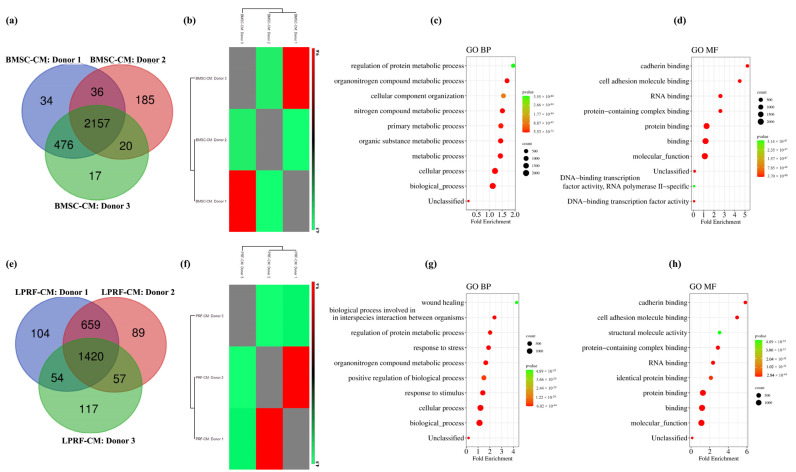
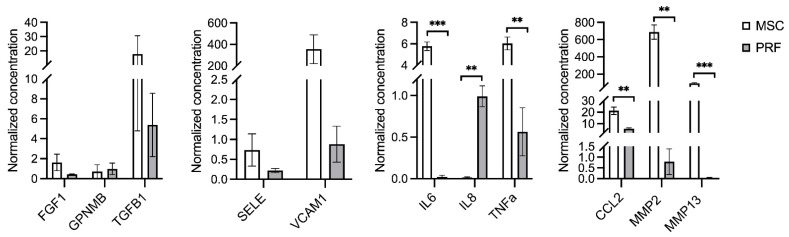
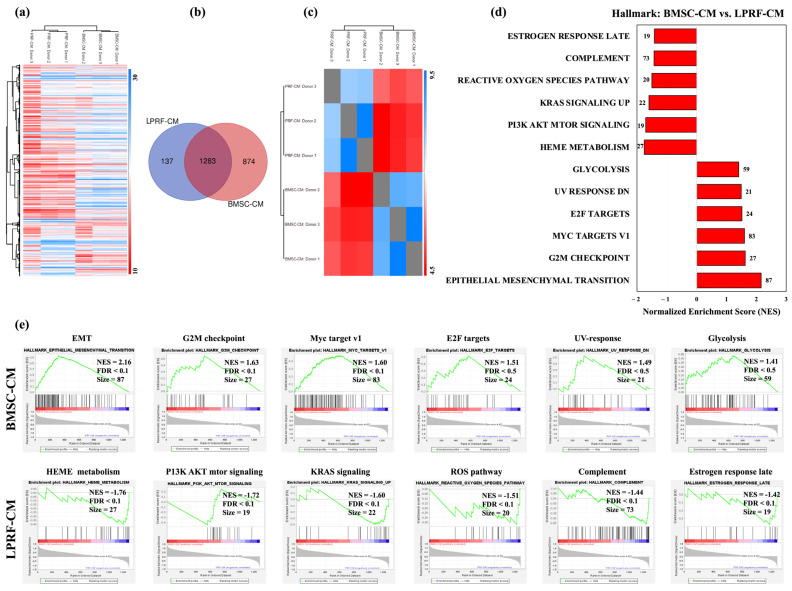
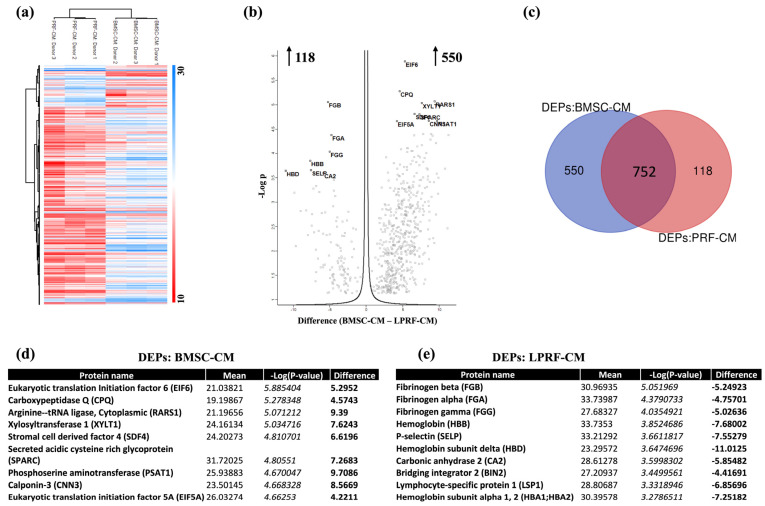
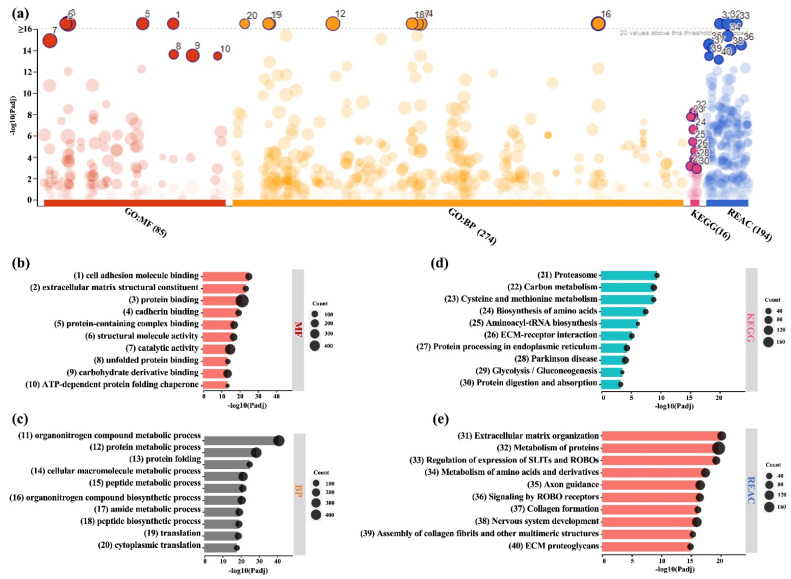
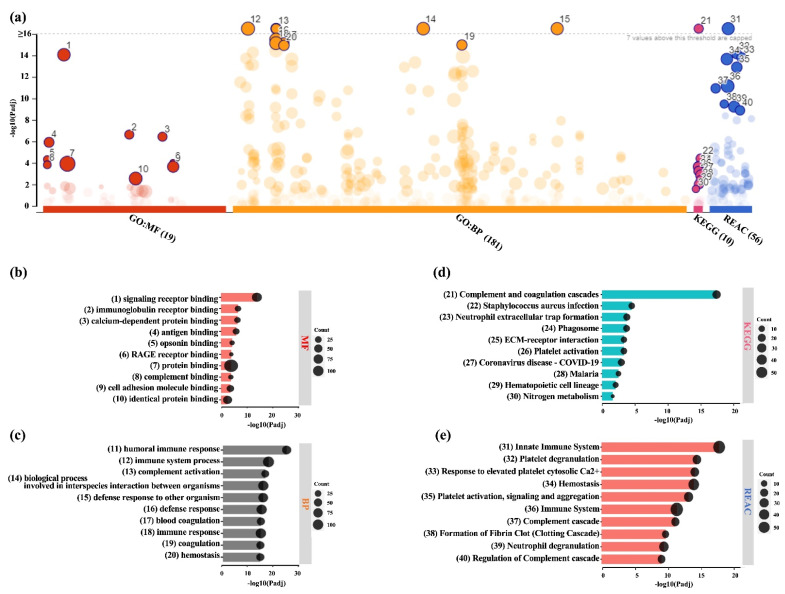
Secretomes of mesenchymal stromal cells (MSCs) are emerging as a novel growth factor (GF)-based strategy for periodontal and bone regeneration. The objective of this study was to compare the secretome of human bone marrow MSC (BMSC) to that of leukocyte- and platelet-rich fibrin (L-PRF), an established GF-based therapy, in the context of wound healing and regeneration. Conditioned media from human BMSCs (BMSC-CM) and L-PRF (LPRF-CM) were subjected to quantitative proteomic analysis using liquid chromatography with tandem mass spectrometry. Global profiles, gene ontology (GO) categories, differentially expressed proteins (DEPs), and gene set enrichment (GSEA) were identified using bioinformatic methods. Concentrations of selected proteins were determined using a multiplex immunoassay. Among the proteins identified in BMSC-CM (2157 proteins) and LPRF-CM (1420 proteins), 1283 proteins were common. GO analysis revealed similarities between the groups in terms of biological processes (cellular organization, protein metabolism) and molecular functions (cellular/protein-binding). Notably, more DEPs were identified in BMSC-CM ( = 550) compared to LPRF-CM ( = 118); these included several key GF, cytokines, and extracellular matrix (ECM) proteins involved in wound healing. GSEA revealed enrichment of ECM (especially bone ECM)-related processes in BMSC-CM and immune-related processes in LPRF-CM. Similar trends for intergroup differences in protein detection were observed in the multiplex analysis. Thus, the secretome of BMSC is enriched for proteins/processes relevant for periodontal and bone regeneration. The in vivo efficacy of this therapy should be evaluated in future studies.
间充质干细胞(MSCs)的分泌组正在成为一种新的基于生长因子(GF)的牙周和骨再生策略。本研究的目的是比较人骨髓间充质干细胞(BMSC)的分泌组与人白细胞和血小板丰富纤维蛋白(L-PRF),一种已建立的基于 GF 的治疗方法,在伤口愈合和再生方面的情况。使用液相色谱-串联质谱法对人 BMSC(BMSC-CM)和 L-PRF(LPRF-CM)的条件培养基进行定量蛋白质组学分析。使用生物信息学方法鉴定全局图谱、基因本体论(GO)类别、差异表达蛋白(DEPs)和基因集富集(GSEA)。使用多重免疫测定法测定选定蛋白的浓度。在 BMSC-CM(2157 种蛋白)和 LPRF-CM(1420 种蛋白)中鉴定的蛋白中,有 1283 种蛋白是共同的。GO 分析表明,两组在生物学过程(细胞组织、蛋白质代谢)和分子功能(细胞/蛋白质结合)方面具有相似性。值得注意的是,与 LPRF-CM(=118)相比,BMSC-CM 中鉴定出更多的 DEPs(=550);其中包括几种关键 GF、细胞因子和参与伤口愈合的细胞外基质(ECM)蛋白。GSEA 显示 BMSC-CM 中 ECM(特别是骨 ECM)相关过程富集,LPRF-CM 中免疫相关过程富集。在多重分析中观察到组间差异蛋白检测的相似趋势。因此,BMSC 的分泌组富含与牙周和骨再生相关的蛋白/过程。这种治疗方法的体内疗效应在未来的研究中进行评估。