Department of Drug Sciences, Unit of Pharmacology, University of Pavia, 27100 Pavia, Italy.
Department of Biology and Biotechnology, University of Pavia, 27100 Pavia, Italy.
Int J Mol Sci. 2023 Aug 28;24(17):13338. doi: 10.3390/ijms241713338.
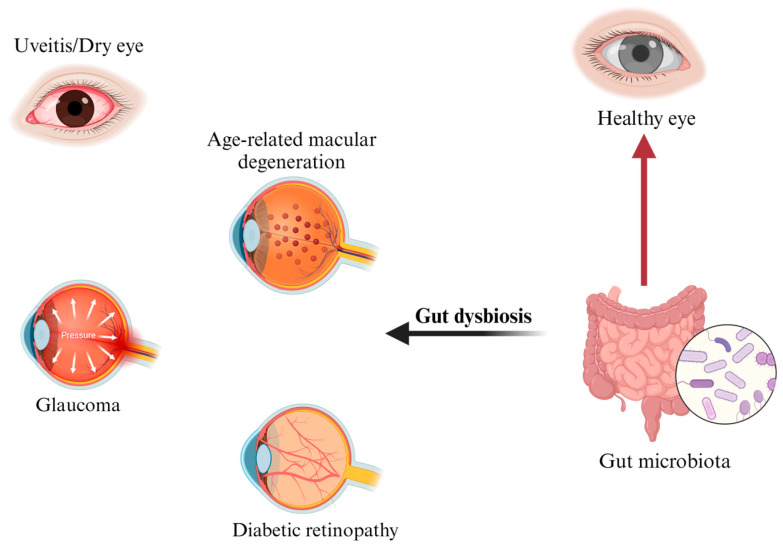
The human microbiota refers to a large variety of microorganisms (bacteria, viruses, and fungi) that live in different human body sites, including the gut, oral cavity, skin, and eyes. In particular, the presence of an ocular surface microbiota with a crucial role in maintaining ocular surface homeostasis by preventing colonization from pathogen species has been recently demonstrated. Moreover, recent studies underline a potential association between gut microbiota (GM) and ocular health. In this respect, some evidence supports the existence of a gut-eye axis involved in the pathogenesis of several ocular diseases, including age-related macular degeneration, uveitis, diabetic retinopathy, dry eye, and glaucoma. Therefore, understanding the link between the GM and these ocular disorders might be useful for the development of new therapeutic approaches, such as probiotics, prebiotics, symbiotics, or faecal microbiota transplantation through which the GM could be modulated, thus allowing better management of these diseases.
人体微生物群是指大量存在于人体不同部位(肠道、口腔、皮肤和眼睛等)的微生物(细菌、病毒和真菌)。最近的研究表明,眼表微生物群在维持眼表稳态方面发挥着至关重要的作用,能够防止病原体的定植。此外,最近的研究还强调了肠道微生物群(GM)与眼部健康之间存在潜在的关联。在这方面,有一些证据表明,存在一个“肠-眼轴”,它与多种眼部疾病的发病机制有关,包括年龄相关性黄斑变性、葡萄膜炎、糖尿病性视网膜病变、干眼症和青光眼等。因此,了解 GM 与这些眼部疾病之间的联系可能有助于开发新的治疗方法,例如益生菌、益生元、合生菌或粪便微生物群移植,通过这些方法可以调节 GM,从而更好地管理这些疾病。