Tojjari Alireza, Choucair Khalil, Sadeghipour Arezoo, Saeed Azhar, Saeed Anwaar
Division of Hematology and Oncology, Department of Medicine, University of Pittsburgh Medical Center, Pittsburgh, PA 15213, USA.
Division of Hematology and Oncology, Department of Medicine, Barbara Ann Karmanos Cancer Institute, Detroit, MI 48201, USA.
Cancers (Basel). 2023 Aug 28;15(17):4294. doi: 10.3390/cancers15174294.
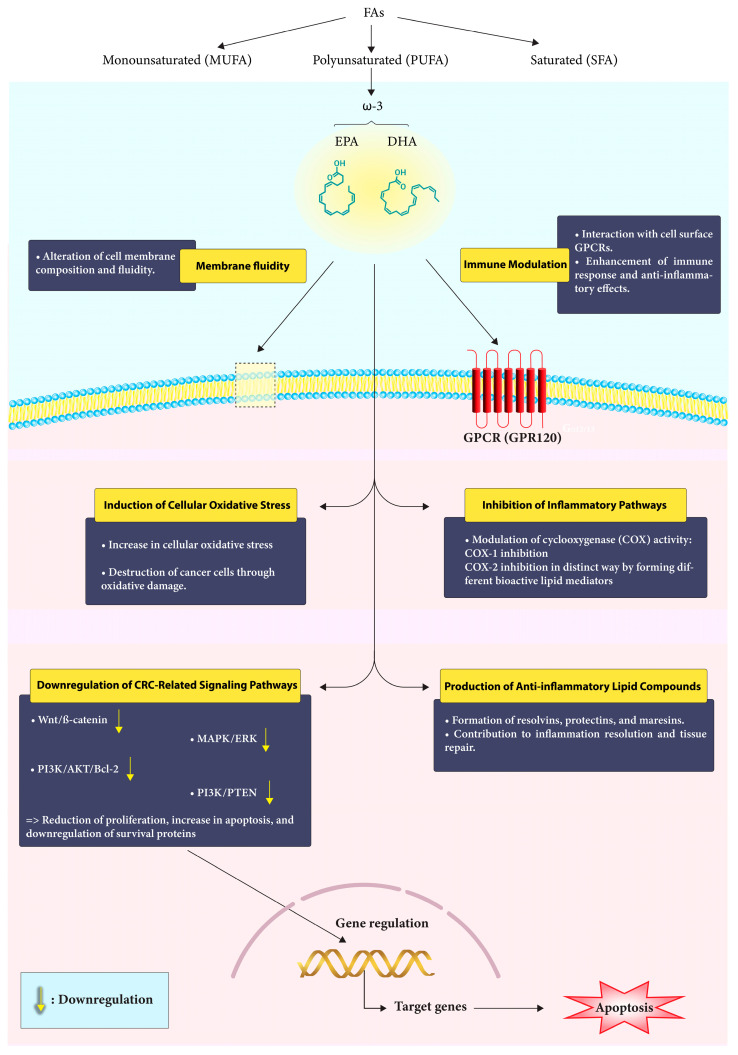
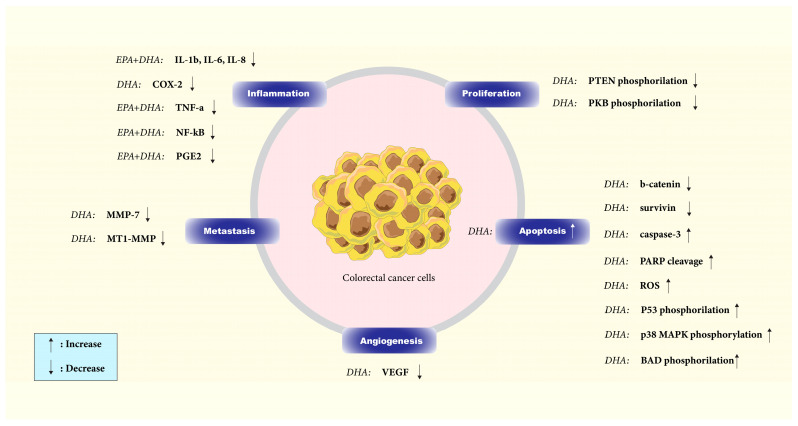
Colorectal cancer (CRC) remains a leading cause of death from cancer worldwide, with increasing incidence in the Western world. Diet has become the focus of research as a significant risk factor for CRC occurrence, and the role of dietary polyunsaturated fatty acids (PUFAs) has become an area of interest given their potential role in modulating inflammation, particularly in the pro-carcinogenic inflammatory environment of the colon. This work reviews the main types of PUFAs, their characteristics, structure, and physiologic role. We then highlight their potential role in preventing CRC, their signaling function vis-à-vis tumorigenic signaling, and their subsequent potential role in modulating response to different treatment modalities. We review pre-clinical and clinical data and discuss their potential use as adjunct therapies to currently existing treatment modalities. Given our understanding of PUFAs' immune and inflammation modulatory effects, we explore the possible combination of PUFAs with immune checkpoint inhibitors and other targeted therapies.
结直肠癌(CRC)仍然是全球癌症死亡的主要原因,在西方世界发病率呈上升趋势。饮食作为CRC发生的一个重要风险因素,已成为研究的焦点,鉴于膳食多不饱和脂肪酸(PUFAs)在调节炎症方面的潜在作用,尤其是在结肠的促癌炎症环境中,其作用已成为一个研究热点。本文综述了PUFAs的主要类型、特性、结构和生理作用。然后,我们强调了它们在预防CRC中的潜在作用、相对于致癌信号的信号传导功能,以及它们随后在调节对不同治疗方式的反应中的潜在作用。我们回顾了临床前和临床数据,并讨论了它们作为现有治疗方式辅助疗法的潜在用途。鉴于我们对PUFAs免疫和炎症调节作用的理解,我们探讨了PUFAs与免疫检查点抑制剂和其他靶向疗法联合使用的可能性。