Department of Food Science, University of Massachusetts, Amherst, MA 01002, USA.
Department of Food Science and Technology, National Engineering Research Center of Seafood, Collaborative Innovation Center of Seafood Deep Processing, Dalian Polytechnic University, Dalian 116034, China.
Nutrients. 2020 Oct 28;12(11):3301. doi: 10.3390/nu12113301.
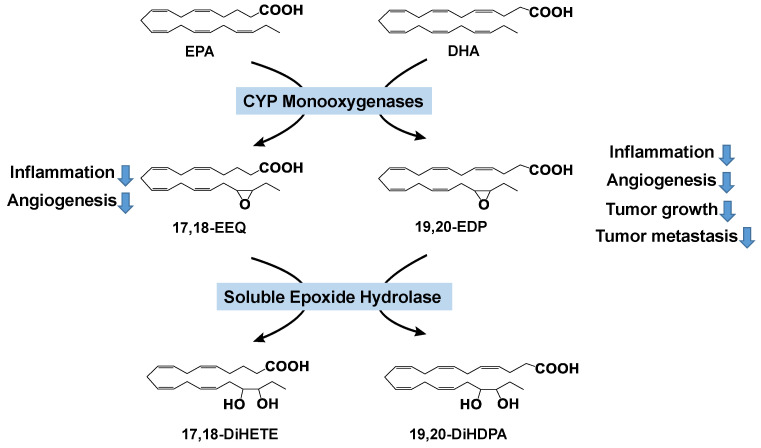
Substantial human and animal studies support the beneficial effects of ω-3 polyunsaturated fatty acids (PUFAs) on colonic inflammation and colorectal cancer (CRC). However, there are inconsistent results, which have shown that ω-3 PUFAs have no effect or even detrimental effects, making it difficult to effectively implement ω-3 PUFAs for disease prevention. A better understanding of the molecular mechanisms for the anti-inflammatory and anticancer effects of ω-3 PUFAs will help to clarify their potential health-promoting effects, provide a scientific base for cautions for their use, and establish dietary recommendations. In this review, we summarize recent studies of ω-3 PUFAs on colonic inflammation and CRC and discuss the potential roles of ω-3 PUFA-metabolizing enzymes, notably the cytochrome P450 monooxygenases, in mediating the actions of ω-3 PUFAs.
大量的人体和动物研究支持 ω-3 多不饱和脂肪酸 (PUFA) 对结直肠炎症和结直肠癌 (CRC) 的有益作用。然而,也有不一致的结果表明 ω-3 PUFAs 没有效果,甚至有不良影响,这使得难以有效地将 ω-3 PUFAs 用于疾病预防。更好地了解 ω-3 PUFAs 的抗炎和抗癌作用的分子机制将有助于阐明它们的潜在健康促进作用,为其使用提供科学依据,并建立饮食建议。在这篇综述中,我们总结了最近关于 ω-3 PUFAs 对结直肠炎症和 CRC 的研究,并讨论了 ω-3 PUFAs 代谢酶,特别是细胞色素 P450 单加氧酶,在介导 ω-3 PUFAs 作用中的潜在作用。