Department of Human Nutrition, Institute of Human Nutrition Sciences, Warsaw University of Life Sciences (SGGW-WULS), 02-776 Warsaw, Poland.
Nutrients. 2023 Aug 28;15(17):3759. doi: 10.3390/nu15173759.
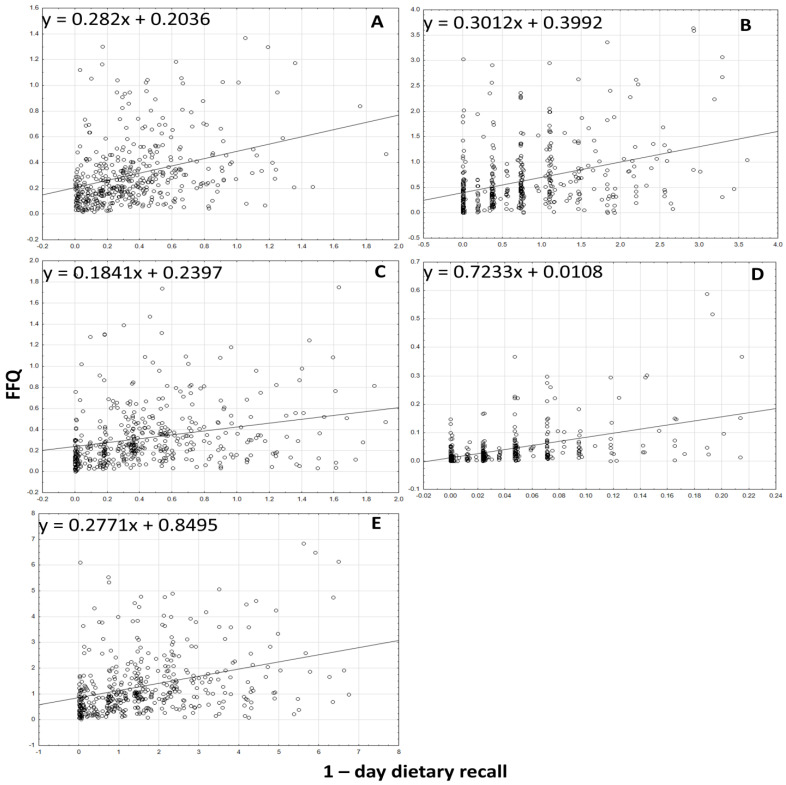
Due to the documented health benefits of tocopherols and tocotrienols as bioactive compounds, it seems important to assess their intake. The aim of this study was to develop a new tool and its application for assessment of tocopherol and tocotrienol intake in adults. Dietary data were collected by semiquantitative FFQ (VitE-FFQ) and by a 1-day dietary record in a group of 447 subjects. The database of the US Department of Agriculture (USDA) was used to calculate the individual isoforms of vitamin E and develop the tool-VIT_E.CAL. The assessment of measuring agreement between the two methods was conducted by analysis of the correlations and Bland-Altman plots. The average α-tocopherol intake was 11.3 mg/day for the data obtained using the FFQ method and 12.8 mg/day for the results obtained using the 1-day dietary record. Depending on the adopted recommendation, only 40-57% of the subjects had adequate vitamin E intake. The intake of α-tocopherol did not exceed the UL value in any of the respondents. The dominant forms of vitamin E in the diet of the studied group were α- and γ- forms (55% and 38% of the total sum) among tocopherols and β- and γ- forms (49% and 24% of the total sum) among tocotrienols. VIT_E.CAL allows us to calculate not only the total amount of vitamin E but also its eight isoforms. It can be a useful tool to assess individual and group intake of various forms of vitamin E in the diet. The use of VIT_E.CAL enables the proper assessment of vitamin E (as α-tocopherol and not α-tocopherol equivalent) in the diet of Poles, and most likely also in the European diet. The obtained results indicate the need to take into account the content of individual forms of vitamin E in food/diet, which will allow for a reliable assessment of its consumption. It also seems necessary to standardize the nomenclature regarding the name of vitamin E and its use for correct nutritional assessment.
由于生育酚和三烯生育酚作为生物活性化合物具有已被记录的健康益处,因此评估其摄入量似乎很重要。本研究的目的是开发一种新工具及其在评估成年人生育酚和三烯生育酚摄入量中的应用。通过半定量 FFQ(VitE-FFQ)和 447 名受试者的 1 天饮食记录收集饮食数据。使用美国农业部(USDA)的数据库来计算维生素 E 的个体异构体并开发工具-VIT_E.CAL。通过分析相关性和 Bland-Altman 图来评估两种方法的测量一致性。使用 FFQ 方法获得的平均 α-生育酚摄入量为 11.3mg/天,使用 1 天饮食记录获得的结果为 12.8mg/天。根据采用的建议,只有 40-57%的受试者有足够的维生素 E 摄入。在任何受访者中,α-生育酚的摄入量都未超过 UL 值。在所研究组的饮食中,生育酚的主要形式是 α-和 γ-形式(占总 sum 的 55%和 38%),而三烯生育酚的主要形式是 β-和 γ-形式(占总 sum 的 49%和 24%)。VIT_E.CAL 不仅可以计算维生素 E 的总量,还可以计算其 8 种异构体。它可以成为评估饮食中各种形式维生素 E 个体和群体摄入量的有用工具。使用 VIT_E.CAL 可以正确评估波兰人(以及可能还有欧洲人)饮食中的维生素 E(作为 α-生育酚,而不是 α-生育酚当量)。所得结果表明需要考虑食物/饮食中维生素 E 各个形式的含量,这将允许对其消耗进行可靠评估。似乎还需要标准化有关维生素 E 名称及其在正确营养评估中的使用的命名法。