Polytechnique Montréal, Department of Engineering Physics, Montreal, Québec, Canada.
Centre de Recherche du Centre Hospitalier de l'Université de Montréal, Montréal, Quebec, Canada.
J Biomed Opt. 2023 Sep;28(9):090501. doi: 10.1117/1.JBO.28.9.090501. Epub 2023 Sep 9.
Lung cancer is the most frequently diagnosed cancer overall and the deadliest cancer in North America. Early diagnosis through current bronchoscopy techniques is limited by poor diagnostic yield and low specificity, especially for lesions located in peripheral pulmonary locations. Even with the emergence of robotic-assisted platforms, bronchoscopy diagnostic yields remain below 80%.
The aim of this study was to determine whether single-point fingerprint (800 to ) Raman spectroscopy coupled with machine learning could detect lung cancer within an otherwise heterogenous background composed of normal tissue and tissue associated with benign conditions, including emphysema and bronchiolitis.
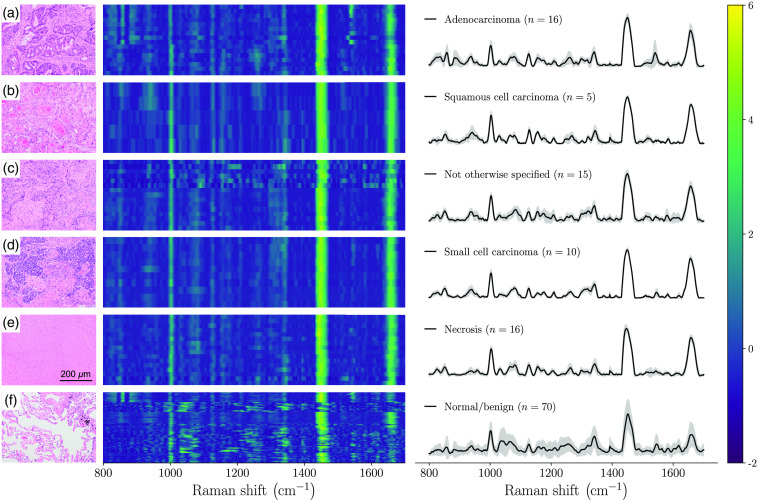
A Raman spectroscopy probe was used to measure the spectral fingerprint of normal, benign, and cancer lung tissue in 10 patients. Each interrogated specimen was characterized by histology to determine cancer type, i.e., small cell carcinoma or non-small cell carcinoma (adenocarcinoma and squamous cell carcinoma). Biomolecular information was extracted from the fingerprint spectra to identify biomolecular features that can be used for cancer detection.
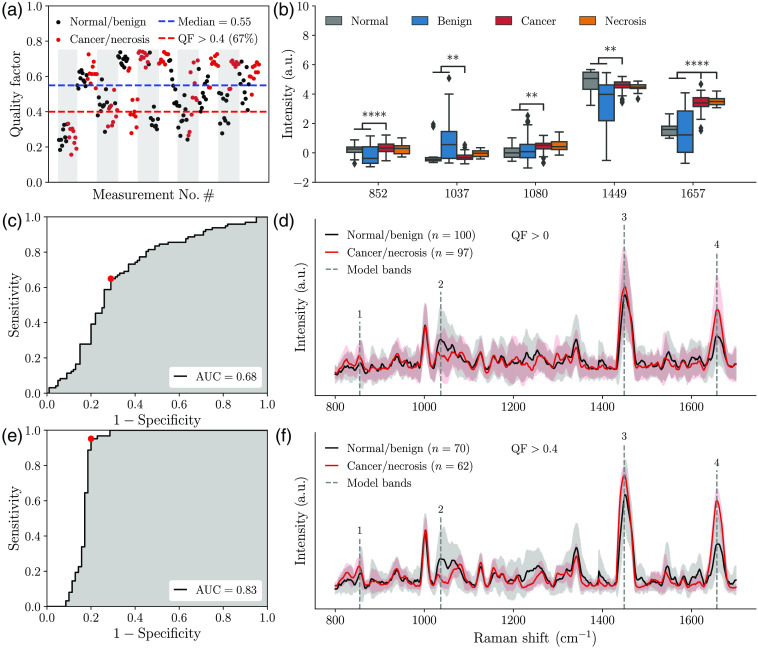
Supervised machine learning models were trained using leave-one-patient-out cross-validation, showing lung cancer could be detected with a sensitivity of 94% and a specificity of 80%.
This proof of concept demonstrates fingerprint Raman spectroscopy is a promising tool for the detection of lung cancer during diagnostic procedures and can capture biomolecular changes associated with the presence of cancer among a complex heterogeneous background within less than 1 s.
肺癌是全球最常见的癌症,也是北美最致命的癌症。通过当前的支气管镜技术进行早期诊断受到诊断率低和特异性低的限制,尤其是对于位于肺外周部位的病变。即使出现了机器人辅助平台,支气管镜检查的诊断率仍低于 80%。
本研究旨在确定单点指纹(800 至 )拉曼光谱结合机器学习是否可以在由正常组织和与良性状况相关的组织(包括肺气肿和细支气管炎)组成的异质背景中检测肺癌。
使用拉曼光谱探头测量了 10 名患者的正常、良性和癌性肺组织的光谱指纹。每个被询问的标本都通过组织学进行了特征分析,以确定癌症类型,即小细胞癌或非小细胞癌(腺癌和鳞状细胞癌)。从指纹光谱中提取生物分子信息,以识别可用于癌症检测的生物分子特征。
使用留一患者交叉验证对监督机器学习模型进行了训练,结果表明肺癌的检测灵敏度为 94%,特异性为 80%。
这一概念验证证明了指纹拉曼光谱是在诊断过程中检测肺癌的有前途的工具,它可以在不到 1 秒的时间内捕获与癌症存在相关的生物分子变化,即使在复杂的异质背景中也是如此。