Smith Tess A, Kievit Rogier A, Astle Duncan E
MRC Cognition and Brain Sciences Unit, University of Cambridge, 15 Chaucer Road, Cambridge, UK.
Donders Institute for Brain, Cognition and Behaviour, Radboud University, Nijmegen, Netherlands.
Curr Psychol. 2023;42(25):21967-21978. doi: 10.1007/s12144-022-03181-0. Epub 2022 Jun 9.
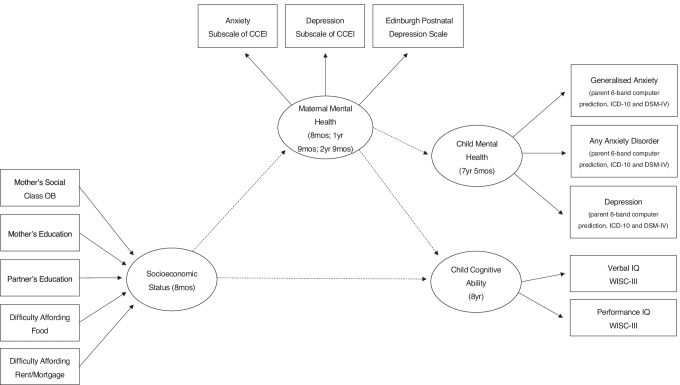
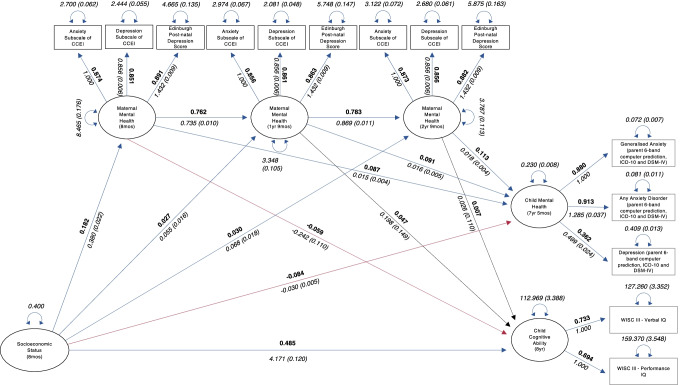
The impact of socioeconomic status (SES) on early child development is well-established, but the mediating role of parental mental health is poorly understood. Data were obtained from The Avon Longitudinal Study of Parents and Children (ALSPAC; = 13,855), including measures of early SES (age 8 months), key aspects of development during mid-late childhood (ages 7-8 years), and maternal mental health during early childhood (ages 0-3 years). In the first year of life, better maternal mental health was shown to weaken the negative association between SES and child mental health. Better maternal mental health was additionally shown to weaken the association between SES and child cognitive ability. These findings highlight the variability and complexity of the mediating role of parental mental health on child development. They further emphasise the importance of proximal factors in the first year of life, such as parental mental health, in mediating key developmental outcomes.
社会经济地位(SES)对儿童早期发育的影响已得到充分证实,但父母心理健康的中介作用却鲜为人知。数据来自雅芳亲子纵向研究(ALSPAC;样本量=13855),包括早期SES(8个月大时)、儿童中后期(7-8岁)发育的关键方面以及儿童早期(0-3岁)母亲的心理健康状况。在生命的第一年,母亲更好的心理健康状况被证明会减弱SES与儿童心理健康之间的负相关。此外,母亲更好的心理健康状况还被证明会减弱SES与儿童认知能力之间的关联。这些发现凸显了父母心理健康在儿童发育中的中介作用的可变性和复杂性。它们进一步强调了生命第一年的近端因素,如父母心理健康,在调节关键发育结果方面的重要性。