Dong Mingze, Su David, Kluger Harriet, Fan Rong, Kluger Yuval
Interdepartmental Program in Computational Biology & Bioinformatics, Yale University, New Haven, CT, USA.
Department of Pathology, Yale School of Medicine, New Haven, CT, USA.
bioRxiv. 2024 Oct 10:2023.08.28.554970. doi: 10.1101/2023.08.28.554970.
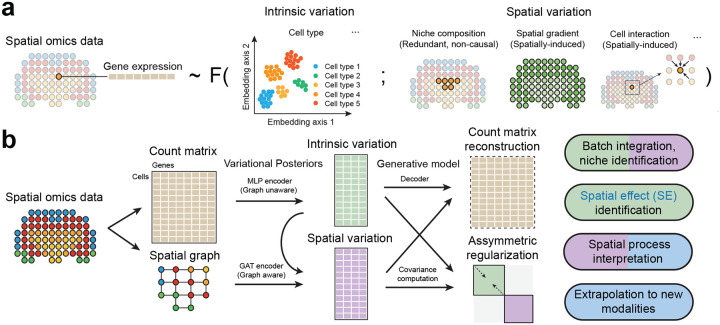
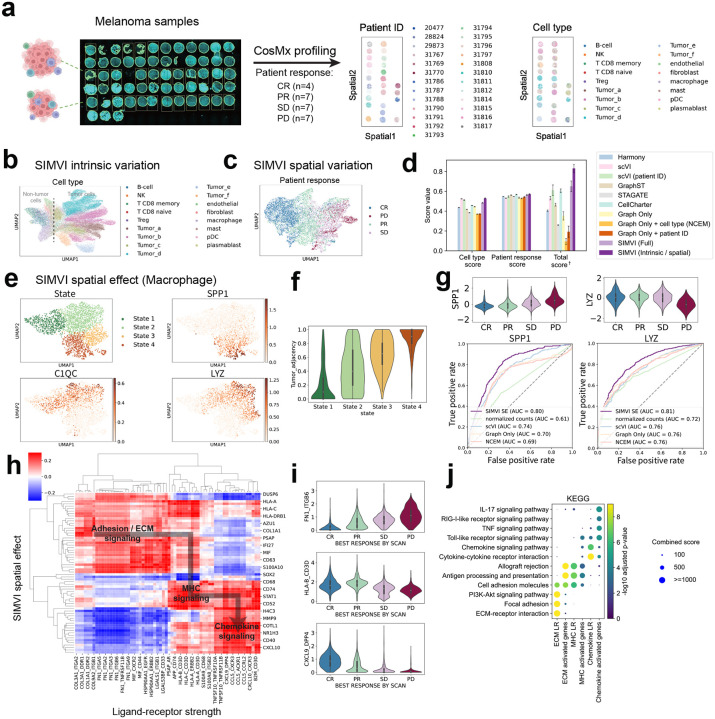
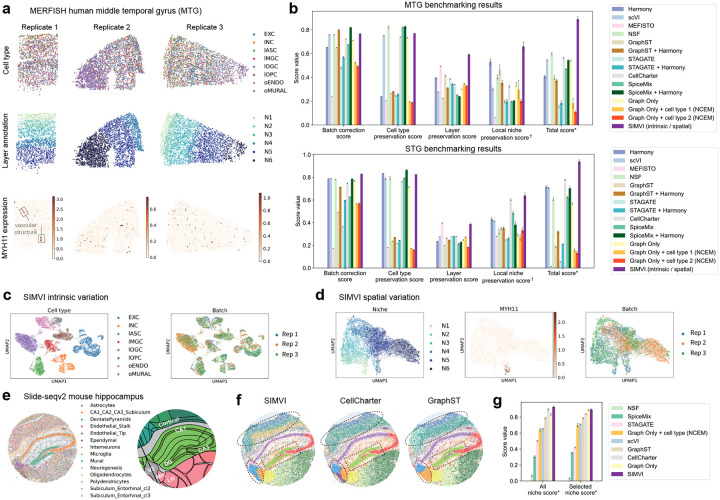
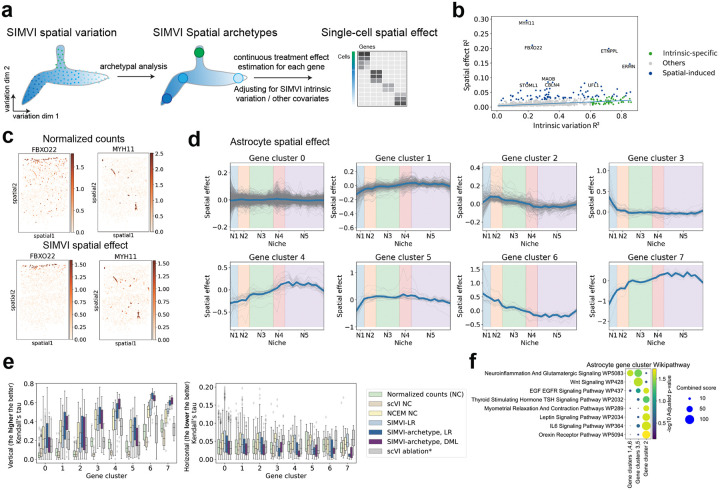
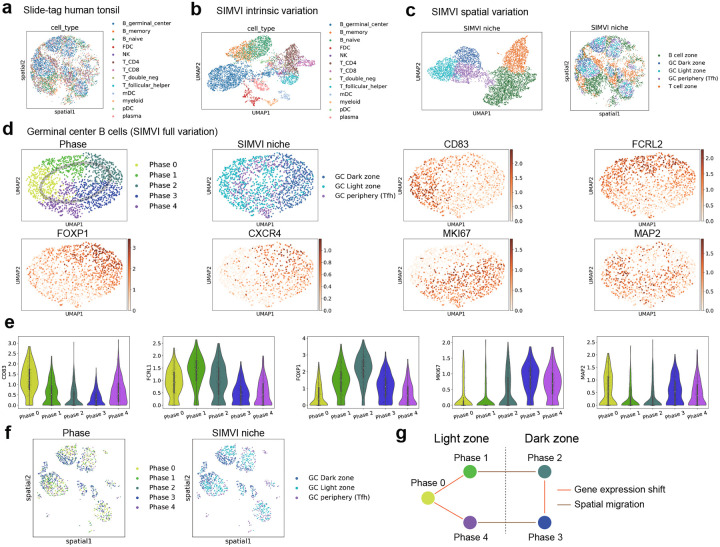
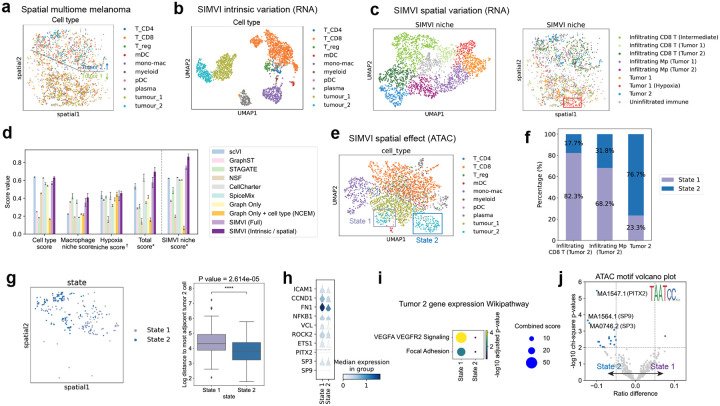
Spatial omics technologies enable the analysis of gene expression and interaction dynamics in relation to tissue structure and function. However, existing computational methods may not properly distinguish cellular intrinsic variability and intercellular interactions, and may thus fail to capture spatial regulations for further biological discoveries. Here, we present Spatial Interaction Modeling using Variational Inference (SIMVI), an annotation-free framework that disentangles cell intrinsic and spatial-induced latent variables for modeling gene expression in spatial omics data. We derive theoretical support for SIMVI in disentangling intrinsic and spatial-induced variations. By this disentanglement, SIMVI enables estimation of spatial effects (SE) at a single-cell resolution, and opens up various opportunities for novel downstream analyses. To demonstrate the potential of SIMVI, we applied SIMVI to spatial omics data from diverse platforms and tissues (MERFISH human cortex, Slide-seqv2 mouse hippocampus, Slide-tags human tonsil, spatial multiome human melanoma, cohort-level CosMx melanoma). In all tested datasets, SIMVI effectively disentangles variations and infers accurate spatial effects compared with alternative methods. Moreover, on these datasets, SIMVI uniquely uncovers complex spatial regulations and dynamics of biological significance. In the human tonsil data, SIMVI illuminates the cyclical spatial dynamics of germinal center B cells during maturation. Applying SIMVI to both RNA and ATAC modalities of the multiome melanoma data reveals potential tumor epigenetic reprogramming states. Application of SIMVI on our newly-collected cohort-level CosMx melanoma dataset uncovers space-and-outcome-dependent macrophage states and the underlying cellular communication machinery in the tumor microenvironments.
空间组学技术能够分析与组织结构和功能相关的基因表达及相互作用动态。然而,现有的计算方法可能无法正确区分细胞内在变异性和细胞间相互作用,因此可能无法捕获空间调控信息以用于进一步的生物学发现。在此,我们提出了使用变分推理的空间相互作用建模(SIMVI),这是一个无注释框架,它能够解开细胞内在和空间诱导的潜在变量,以对空间组学数据中的基因表达进行建模。我们为SIMVI在解开内在和空间诱导变异方面提供了理论支持。通过这种解缠,SIMVI能够在单细胞分辨率下估计空间效应(SE),并为新颖的下游分析开辟了各种机会。为了证明SIMVI的潜力,我们将SIMVI应用于来自不同平台和组织的空间组学数据(MERFISH人类皮质、Slide-seqv2小鼠海马体、Slide-tags人类扁桃体、空间多组学人类黑色素瘤、队列水平的CosMx黑色素瘤)。在所有测试数据集中,与其他方法相比,SIMVI有效地解开了变异并推断出准确的空间效应。此外,在这些数据集上,SIMVI独特地揭示了具有生物学意义的复杂空间调控和动态。在人类扁桃体数据中,SIMVI阐明了生发中心B细胞成熟过程中的周期性空间动态。将SIMVI应用于多组学黑色素瘤数据的RNA和ATAC模态,揭示了潜在的肿瘤表观遗传重编程状态。将SIMVI应用于我们新收集的队列水平的CosMx黑色素瘤数据集,揭示了与空间和结果相关的巨噬细胞状态以及肿瘤微环境中潜在的细胞通讯机制。