Department of Pathology, Xuzhou Medical University, Xuzhou, China.
Department of Human Anatomy, Nanchang University Fuzhou Medical College, Fuzhou, China.
Hepatol Commun. 2023 Sep 11;7(10). doi: 10.1097/HC9.0000000000000246. eCollection 2023 Oct 1.
Ferroptosis is a unique form of regulated cell death that provided a new opportunity for cancer therapy. Ferroptosis suppressor protein 1 (FSP1) is a key regulator in the NAD(P)H/FSP1/CoQ10 antioxidant system, which sever as an oxide redox enzyme to scavenge harmful lipid hydroperoxides and escape from ferroptosis in cells. This study aimed to investigate the role of FSP1 on sorafenib-induced ferroptosis and disclosed the underlying mechanisms.
Cell viability, malondialdehyde (MDA), glutathione (GSH), and lipid reactive oxygen species levels were assessed using indicated assay kits. The levels of FSP1 and glutathione peroxidase 4 (GPX4) in the patients with HCC were analyzed based on the database. Western blot and quantitative real-time PCR were performed to detect the protein and mRNA expression. Co-immunoprecipitation was applied to detect the interaction between proteins. Tumor xenograft experiments were used to evaluate whether overexpression of FSP1-inhibited sorafenib-induced ferroptosis in vivo.
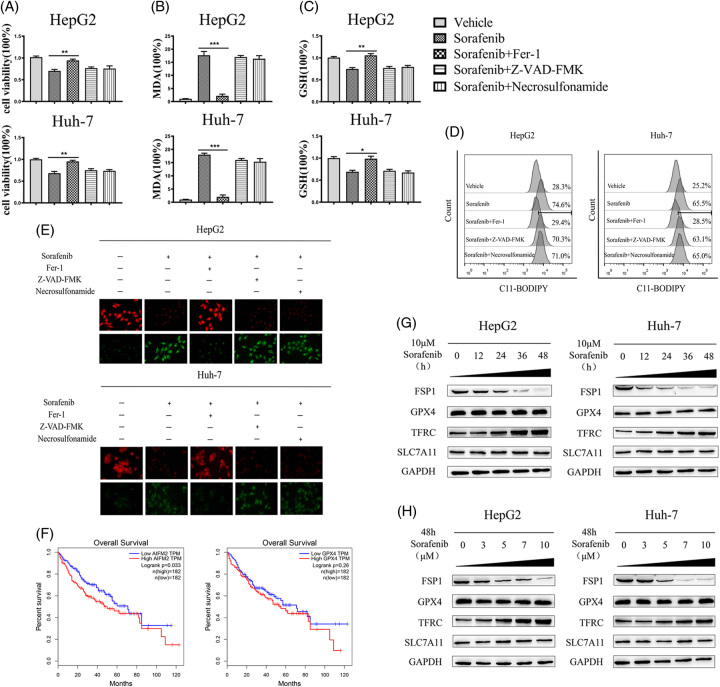
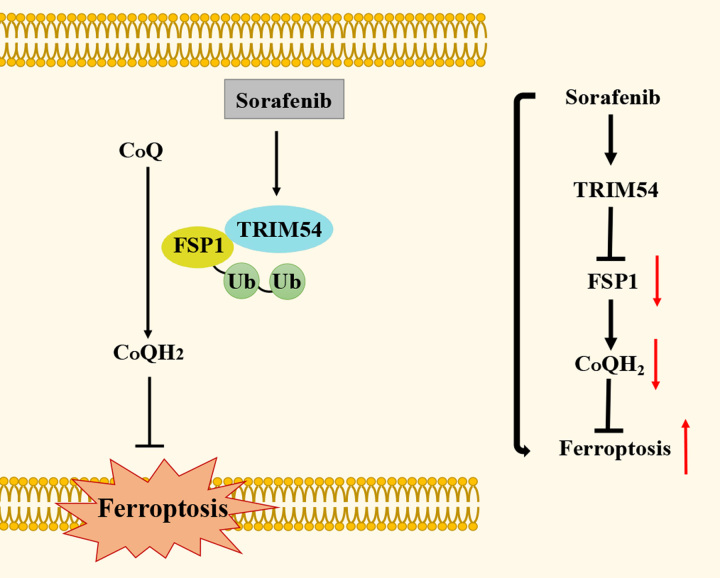
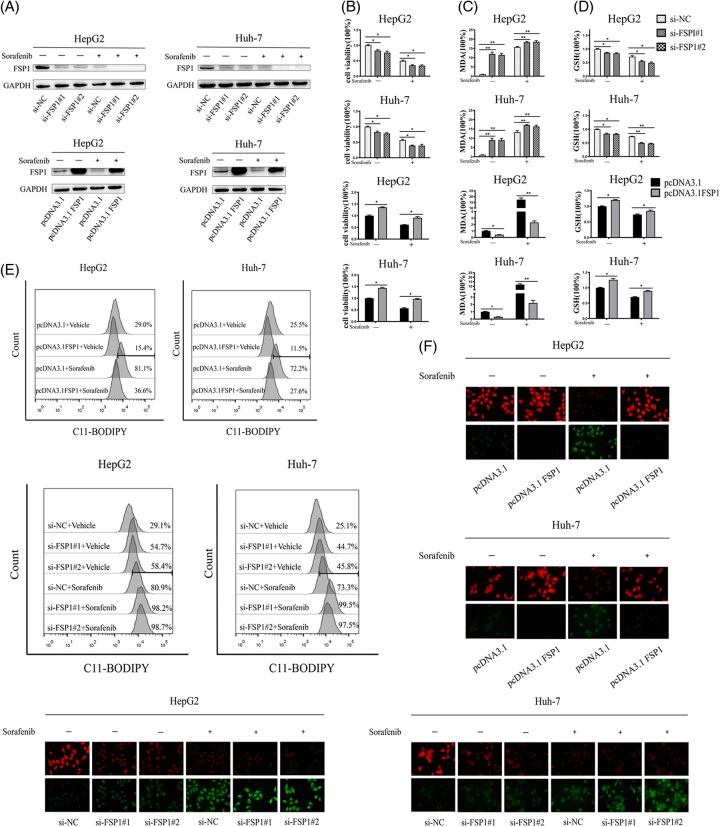
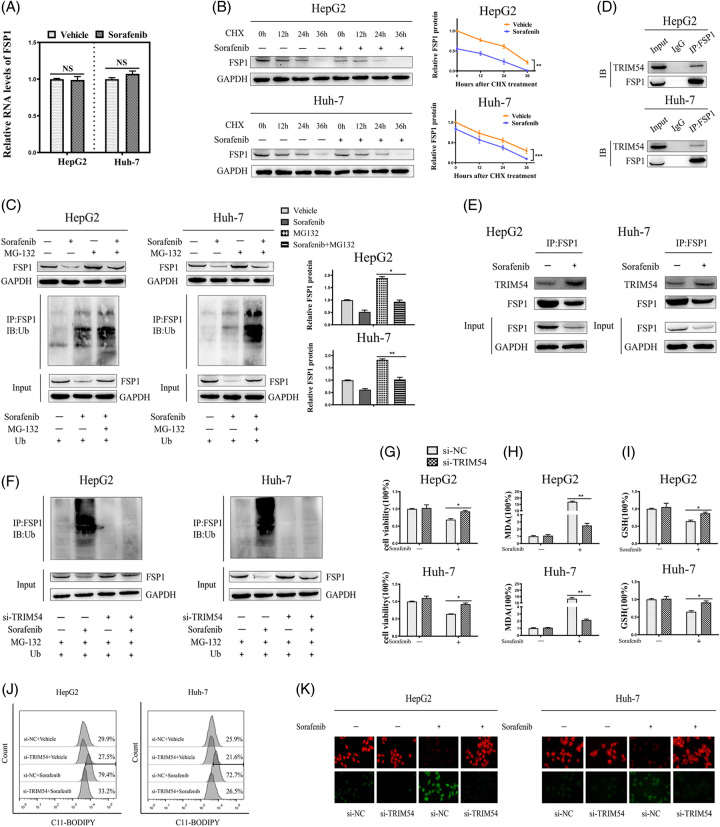
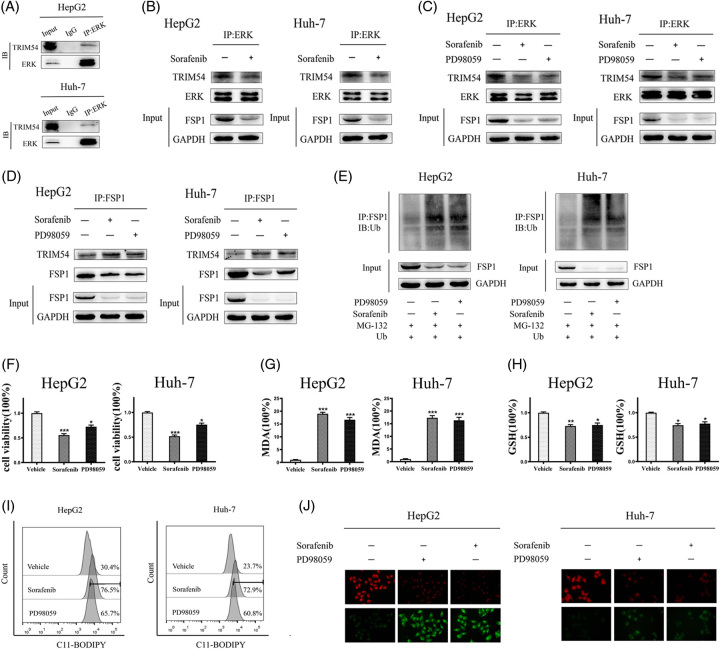
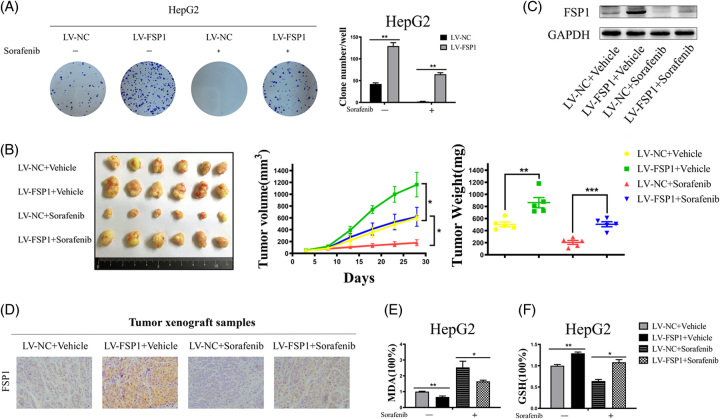
We verified that sorafenib-induced ferroptosis in HCC. Furthermore, we found that sorafenib decreased the protein level of FSP1, and knockdown FSP1 rendered HCC cells susceptible to sorafenib-induced ferroptosis. Co-immunoprecipitation and ubiquitination assays showed that sorafenib accelerated the TRIM54-mediated FSP1 ubiquitination and degradation. Sorafenib-induced ferroptosis was abrogated by TRIM54 suppression. Mechanically, sorafenib-promoted TRIM54 ubiquitinated and degraded FSP1 by means of the ERK pathway. Moreover, FSP1 enhanced tumor development and decreased HCC cellular susceptibility to sorafenib in vivo.
Sorafenib facilitated the TRIM54-mediated FSP1 ubiquitination through the ERK pathway, thereby inducing ferroptosis in HCC cells.
铁死亡是一种独特的细胞死亡形式,为癌症治疗提供了新的机会。铁死亡抑制蛋白 1(FSP1)是 NAD(P)H/FSP1/CoQ10 抗氧化系统中的关键调节因子,作为一种氧化还原酶,可清除有害的脂质过氧化物,使细胞逃避铁死亡。本研究旨在探讨 FSP1 在索拉非尼诱导的铁死亡中的作用,并揭示其潜在机制。
采用特定的检测试剂盒评估细胞活力、丙二醛(MDA)、谷胱甘肽(GSH)和脂质活性氧水平。根据数据库分析 HCC 患者中 FSP1 和谷胱甘肽过氧化物酶 4(GPX4)的水平。采用 Western blot 和实时定量 PCR 检测蛋白和 mRNA 表达。应用免疫共沉淀检测蛋白间的相互作用。肿瘤异种移植实验用于评估 FSP1 的过表达是否抑制体内索拉非尼诱导的铁死亡。
我们验证了索拉非尼诱导 HCC 中的铁死亡。此外,我们发现索拉非尼降低了 FSP1 的蛋白水平,敲低 FSP1 使 HCC 细胞对索拉非尼诱导的铁死亡敏感。免疫共沉淀和泛素化实验表明,索拉非尼加速了 TRIM54 介导的 FSP1 泛素化和降解。TRIM54 的抑制消除了索拉非尼诱导的铁死亡。机制上,索拉非尼通过 ERK 通路促进 TRIM54 泛素化和降解 FSP1。此外,FSP1 增强了肿瘤的发展并降低了 HCC 细胞对体内索拉非尼的敏感性。
索拉非尼通过 ERK 通路促进 TRIM54 介导的 FSP1 泛素化,从而诱导 HCC 细胞发生铁死亡。