Pain and Palliative Care Service, Clinical Center, National Institutes of Health, Bethesda, MD, USA.
Biostatistics and Clinical Epidemiology Service, Clinical Center, National Institutes of Health, Bethesda, MD, USA.
BMC Palliat Care. 2023 Sep 11;22(1):133. doi: 10.1186/s12904-023-01258-6.
Improvement of psychosocial-spiritual well-being in patients with life-threatening or life-limiting illness is desirable. Resilience and mindfulness are considered to be helpful for enhancing psychosocial-spiritual well-being. Mindfulness-based interventions have been shown to promote resilience to stress and enhance well-being. However, in medical patients, evidence for the associations between mindfulness and resilience is lacking. We hypothesize patients with higher levels of psychosocial-spiritual well-being demonstrate greater resilience and mindfulness.
200 patients (mean age = 50.2, SD = 15.5) with serious and or life-limiting illnesses were recruited from the NIH Clinical Center. Patients completed a demographic questionnaire, the NIH-HEALS measure of psychosocial-spiritual well-being, the Connor-Davidson Resilience Scale (CD-RISC-10), and the Mindful Attention Awareness Scale (MAAS). The demographic questionnaire also included a question on current stress level.
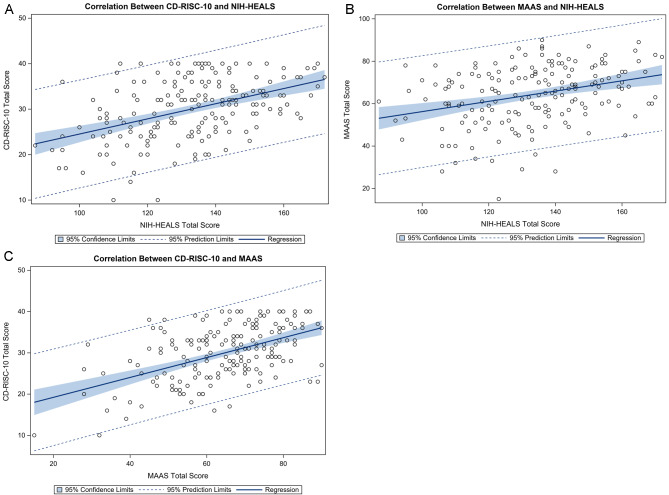
The NIH-HEALS was positively correlated to CD-RISC-10 (r=0.44, p < 0.001) and MAAS (r=0.32, p < 0.001). These findings were consistent across all three NIH-HEALS factors. Additionally, CD-RISC-10 and MAAS demonstrated a meaningful relationship to each other (r=0.46, p < 0.001). All three constructs were inversely related to current stress level.
Findings suggest that there is a meaningful relationship between psychosocial-spiritual well-being, mindfulness, and resilience. Mindfulness and resilience are positively correlated in a medical population. Clinical interventions aimed at enhancing psychosocial-spiritual well-being through mindfulness and resilience can be highly promising for patients with severe and or life limiting illness.
改善有生命威胁或生命有限疾病患者的社会心理-精神幸福感是可取的。韧性和正念被认为有助于增强社会心理-精神幸福感。正念为基础的干预措施已被证明可以促进对压力的韧性和增强幸福感。然而,在医疗患者中,正念与韧性之间的关联证据不足。我们假设具有较高社会心理-精神幸福感的患者表现出更大的韧性和正念。
从美国国立卫生研究院临床中心招募了 200 名(平均年龄=50.2,SD=15.5)患有严重或生命有限疾病的患者。患者完成了一份人口统计学问卷、NIH-HEALS 社会心理-精神幸福感量表、Connor-Davidson 韧性量表(CD-RISC-10)和正念注意意识量表(MAAS)。人口统计学问卷还包括一个关于当前压力水平的问题。
NIH-HEALS 与 CD-RISC-10(r=0.44,p<0.001)和 MAAS(r=0.32,p<0.001)呈正相关。这些发现适用于 NIH-HEALS 的所有三个因素。此外,CD-RISC-10 和 MAAS 之间存在有意义的关系(r=0.46,p<0.001)。所有三个结构都与当前压力水平呈负相关。
研究结果表明,社会心理-精神幸福感、正念和韧性之间存在着有意义的关系。在医疗人群中,正念和韧性呈正相关。通过正念和韧性来增强社会心理-精神幸福感的临床干预措施对患有严重或生命有限疾病的患者非常有前途。