Building Our Largest Dementia Infrastructure (BOLD) Public Health Center of Excellence on Dementia Caregiving, School of Public Health, University of Minnesota, Minneapolis, Minnesota, USA.
BOLD Public Health Center of Excellence on Early Detection, NYU Grossman School of Medicine, New York, New York, USA.
Alzheimers Dement. 2023 Dec;19(12):5837-5846. doi: 10.1002/alz.13437. Epub 2023 Sep 12.
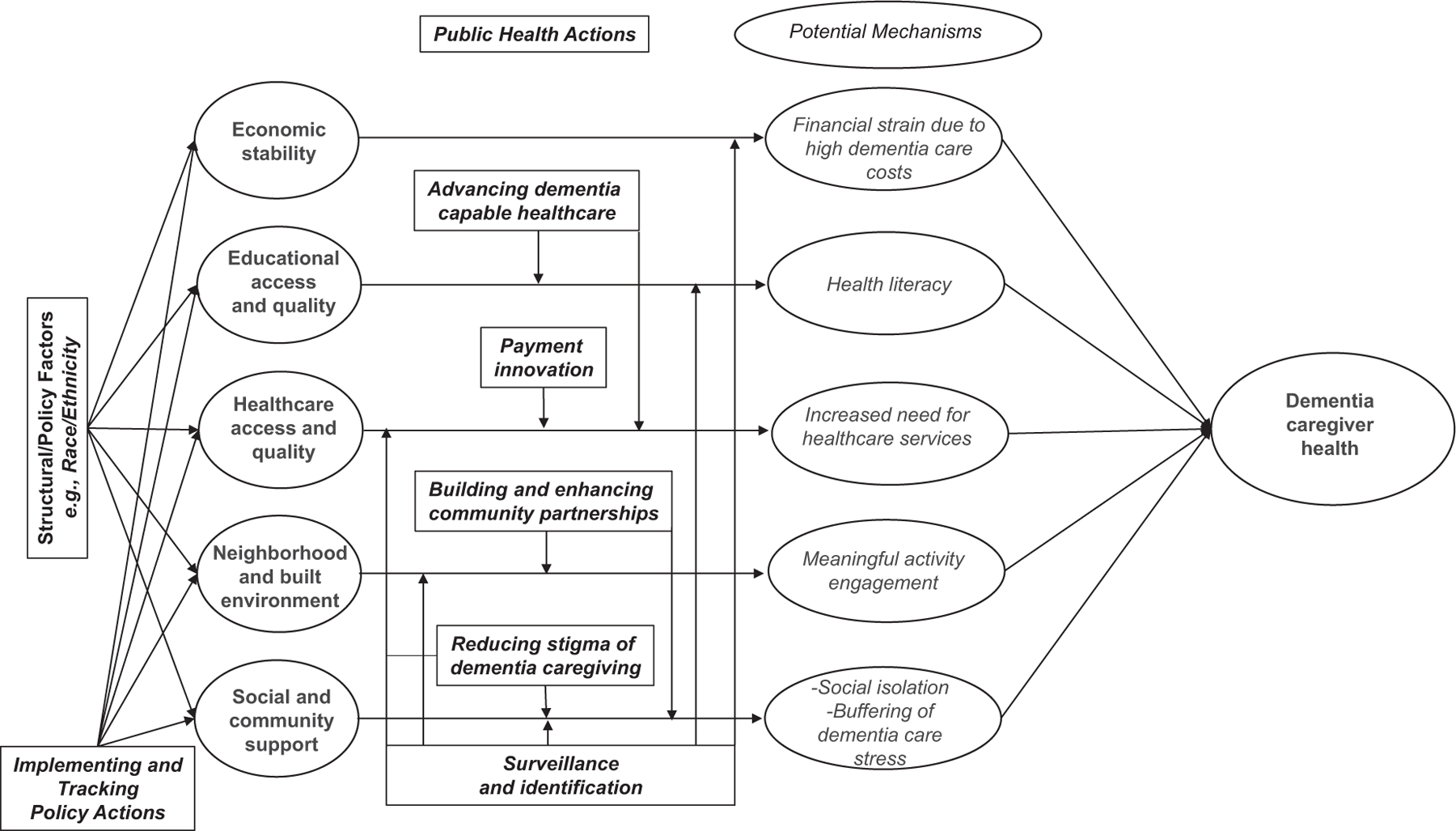
In this Perspective article, we highlight current research to illustrate the intersection of social determinants of health (SDOHs) and Alzheimer's disease and related dementia (ADRD) caregiving. We then outline how public health can support ADRD family caregivers in the United States. Emerging research suggests that family care for persons with ADRD is influenced by SDOHs. Public health actions that address these intersections such as improved surveillance and identification of ADRD caregivers; building and enhancing community partnerships; advancing dementia-capable health care and related payment incentives; and reducing the stigma of dementia and ADRD caregiving can potentially enhance the health and well-being of dementia caregivers. By engaging in one or all of these actions, public health practitioners could more effectively address the myriad of challenges facing ADRD caregivers most at risk for emotional, social, financial, psychological, and health disruption.
在这篇观点文章中,我们强调了当前的研究,以说明健康的社会决定因素 (SDOHs) 与阿尔茨海默病和相关痴呆症 (ADRD) 护理的交叉点。然后,我们概述了公共卫生如何支持美国的 ADRD 家庭护理人员。新兴研究表明,ADRD 患者的家庭护理受到 SDOHs 的影响。公共卫生行动可以解决这些交叉问题,例如改进对 ADRD 护理人员的监测和识别;建立和加强社区伙伴关系;推进有能力治疗痴呆症的医疗保健和相关支付激励措施;减少痴呆症和 ADRD 护理的耻辱感。通过采取其中一项或所有这些行动,公共卫生从业人员可以更有效地应对面临情感、社会、经济、心理和健康破坏风险最大的 ADRD 护理人员的各种挑战。