Applied Sports, Technology, Exercise and Medicine Research Centre (A-STEM), Swansea University, Swansea, UK.
Institute of Sport, Manchester Metropolitan University, Manchester, UK.
Sports Med. 2023 Dec;53(12):2477-2504. doi: 10.1007/s40279-023-01905-1. Epub 2023 Sep 12.
Movement quality is typically assessed by drawing comparisons against predetermined movement standards. Movements are often discretely scored or labelled against pre-set criteria, though movement quality can also be evaluated using motion-related measurements (e.g., spatio-temporal parameters and kinematic variables). Wearable technology has the potential to measure and assess movement quality and offer valuable, practical feedback.
A systematic approach was taken to examine the benefits associated with multi-sensor and multiple wearable-device usage, compared with unimodal applications, when assessing movement quality. Consequently, this review considers the additional variables and features that could be obtained through multi-sensor devices for use in movement analyses. Processing methods and applications of the various configurations were also explored.
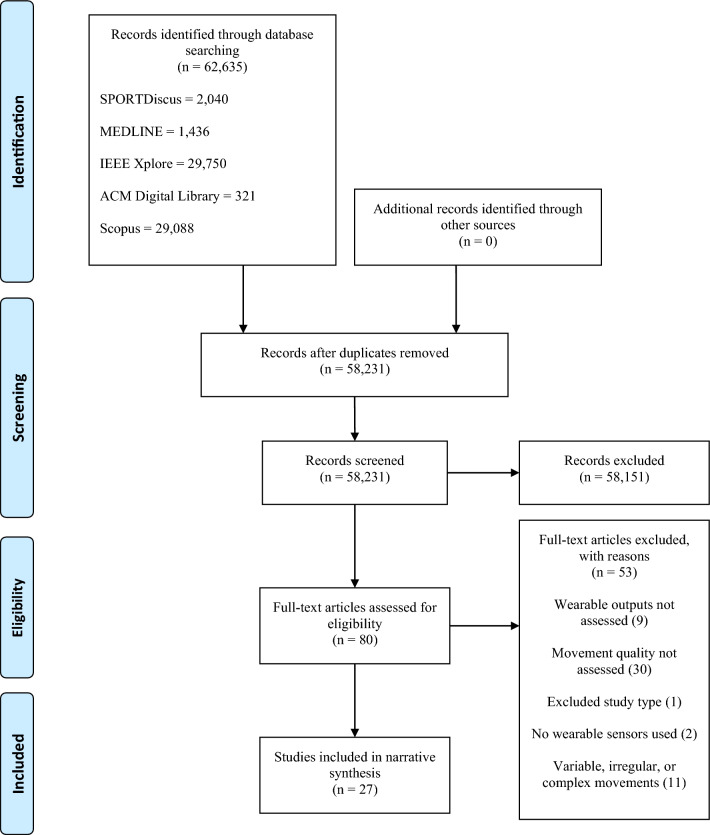
Articles were included within this review if they were written in English, specifically studied the use of wearable sensors to assess movement quality, and were published between January 2010 and December 2022. Of the 62,635 articles initially identified, 27 papers were included in this review. The quality of included studies was determined using a modified Downs and Black checklist, with 24/27 high quality.
Fifteen of the 27 included studies used a classification approach, 11 used a measurement approach, and one used both methods. Accelerometers featured in all 27 studies, in isolation (n = 5), with a gyroscope (n = 9), or with both a gyroscope and a magnetometer (n = 13). Sampling frequencies across all studies ranged from 50 to 200 Hz. The most common classification methods were traditional feature-based classifiers (n = 5) and support vector machines (SVM; n = 5). Sensor fusion featured in six of the 16 classification studies and nine of the 12 measurement studies, with the Madgwick algorithm most prevalent (n = 7).
This systematic review highlights the differences between the applications and processing methods associated with the use of unimodal and multi-sensor wearable devices when assessing movement quality. Further, the use of multiple devices appears to increase the feasibility of effectively assessing holistic movements, while multi-sensor devices offer the ability to obtain more output metrics.
运动质量通常通过与预定运动标准进行比较来评估。运动通常是根据预先设定的标准对离散的运动进行评分或标记,但运动质量也可以使用与运动相关的测量值(例如时空参数和运动学变量)进行评估。可穿戴技术具有测量和评估运动质量并提供有价值、实用反馈的潜力。
采用系统方法检查与单模态应用相比,在评估运动质量时使用多传感器和多个可穿戴设备的相关益处。因此,本综述考虑了通过多传感器设备获得的可用于运动分析的其他变量和功能。还探讨了各种配置的处理方法和应用。
如果文章是用英语写的,专门研究使用可穿戴传感器来评估运动质量,并且是在 2010 年 1 月至 2022 年 12 月期间发表的,则将这些文章纳入本综述。在最初确定的 62635 篇文章中,有 27 篇文章被纳入本综述。使用改良的唐斯和布莱克清单来确定纳入研究的质量,其中 24/27 项为高质量。
27 篇纳入研究中有 15 篇使用分类方法,11 篇使用测量方法,1 篇同时使用两种方法。在 27 项研究中都使用了加速度计,单独使用(n=5),与陀螺仪(n=9)一起使用,或与陀螺仪和磁力计(n=13)一起使用。所有研究的采样频率范围从 50 到 200 Hz。最常见的分类方法是基于传统特征的分类器(n=5)和支持向量机(SVM;n=5)。传感器融合在 16 项分类研究中的 6 项和 12 项测量研究中的 9 项中都有体现,其中 Madgwick 算法最为普遍(n=7)。
本系统综述强调了在评估运动质量时,使用单模态和多传感器可穿戴设备的应用和处理方法之间的差异。此外,使用多个设备似乎可以提高有效评估整体运动的可行性,而多传感器设备提供了获得更多输出指标的能力。