Department of Oral Health Sciences, University of Washington, Seattle, WA, United States of America.
Department of Epidemiology, University of Washington, Seattle, WA, United States of America.
PLoS One. 2023 Sep 12;18(9):e0290287. doi: 10.1371/journal.pone.0290287. eCollection 2023.
There are oral health disparities in the U.S. and children in food-insecure households have a higher burden of tooth decay. Identifying the mechanisms underlying the food insecurity-tooth decay relationship could inform public health interventions. This study examined how sugar-sweetened beverage (SSB) intake and frequent convenience store shopping mediated the food insecurity-tooth decay relationship for lower-income children.
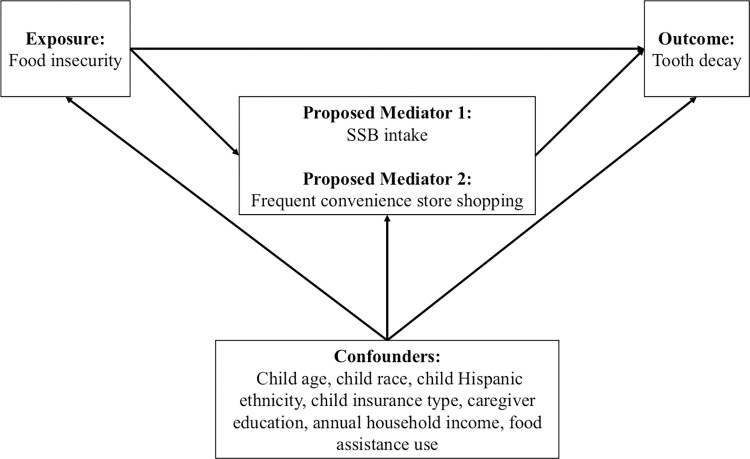
Cross-sectional study data included a household survey, beverage questionnaire, and dental examination. The sample included 452 lower-income, racially-diverse, child-caregiver dyads in 2018 from King County in Washington state. The exposure was household food insecurity, the outcome was untreated decayed tooth surfaces, and the proposed mediators were SSB intake and frequent convenience store shopping (≥2 times/week). Causal mediation analyses via the potential outcomes framework was used to estimate natural indirect and direct effects.
Fifty-five percent of participants were in food-insecure households, the mean number of decayed tooth surfaces among children was 0.87 (standard deviation [SD] = 1.99), the mean SSB intake was 17 fluid ounces (fl/oz)/day (SD = 35), and 18% of households frequently shopped at a convenience store. After adjusting for confounders, household food insecurity and log-transformed SSB intake (fluid ounces/day) were positively associated with decayed tooth surfaces, but not at the a α = 0.05 level (mean ratio [MR] 1.60; 95% confidence interval [CI] 0.89, 2.88; p = .12 and MR 1.16; 95% CI 0.93, 1.46; p = .19, respectively). Frequent convenience store shopping was associated with 2.75 times more decayed tooth surfaces (95% CI 1.61, 4.67; p < .001). SSB intake mediated 10% of the food insecurity-tooth decay relationship (p = .35) and frequent convenience store shopping mediated 22% (p = .33).
Interventions aimed at addressing oral health disparities in children in food-insecure households could potentially focus on reducing intake of SSBs and improving access to healthful foods in lower-income communities.
美国存在口腔健康方面的差异,食物无保障家庭的儿童患龋齿的负担更重。确定食物无保障与龋齿之间关系的机制可以为公共卫生干预措施提供信息。本研究探讨了含糖饮料 (SSB) 摄入量和经常光顾便利店如何为低收入儿童介导食物无保障与龋齿之间的关系。
横断面研究数据包括家庭调查、饮料问卷和牙科检查。样本包括 2018 年来自华盛顿州金县的 452 对低收入、种族多样化的儿童-照顾者。暴露因素是家庭食物无保障,结果是未经治疗的龋齿表面,提出的中介变量是 SSB 摄入量和经常光顾便利店(每周≥2 次)。通过潜在结果框架的因果中介分析来估计自然间接和直接效应。
55%的参与者来自食物无保障的家庭,儿童平均龋齿表面数为 0.87(标准差 [SD] = 1.99),平均 SSB 摄入量为 17 液盎司(fl/oz)/天(SD = 35),18%的家庭经常光顾便利店。在调整了混杂因素后,家庭食物无保障和 SSB 摄入量(液盎司/天)的对数与龋齿表面呈正相关,但未达到 α = 0.05 水平(平均比 [MR] 1.60;95%置信区间 [CI] 0.89, 2.88;p =.12 和 MR 1.16;95% CI 0.93, 1.46;p =.19,分别)。经常光顾便利店与 2.75 倍更多的龋齿表面相关(95% CI 1.61, 4.67;p <.001)。SSB 摄入量介导了 10%的食物无保障与龋齿的关系(p =.35),而经常光顾便利店则介导了 22%(p =.33)。
针对食物无保障家庭儿童口腔健康差异的干预措施可能侧重于减少 SSB 的摄入,并改善低收入社区健康食品的获取。