Faculty of Medicine, Prince of Songkla University, 15 Kanjanavanich Road, Hat Yai, Songkhla, 90110, Thailand.
Critical Care Medicine Unit, Division of Internal Medicine, Faculty of Medicine, Prince of Songkla University, 15 Kanjanavanich Road, Hat Yai, Songkhla, 90110, Thailand.
BMC Pulm Med. 2023 Sep 12;23(1):342. doi: 10.1186/s12890-023-02643-w.
Coronavirus disease 2019 (COVID-19) pneumonia remains a major public health concern. Vital sign indices-shock index (SI; heart rate [HR]/systolic blood pressure [SBP]), shock index age (SIA, SI × age), MinPulse (MP; maximum HR-HR), Pulse max index (PMI; HR/maximum HR), and blood pressure-age index (BPAI; SBP/age)-are better predictors of mortality in patients with trauma compared to traditional vital signs. We hypothesized that these vital sign indices may serve as predictors of mortality in patients with severe COVID-19 pneumonia. This study aimed to describe the association between vital sign indices at admission and COVID-19 pneumonia mortality and to modify the CURB-65 with the best performing vital sign index to establish a new mortality prediction tool.
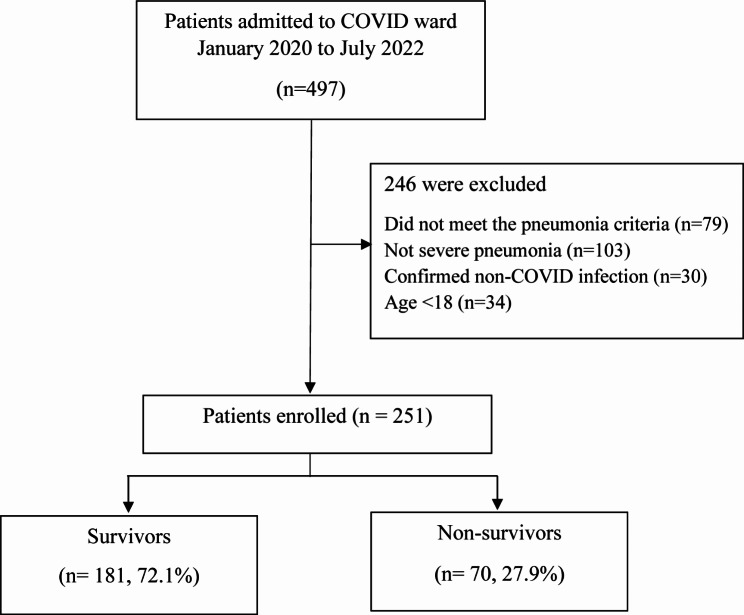
This retrospective study was conducted at a tertiary care center in southern Thailand. Adult patients diagnosed with COVID-19 pneumonia were enrolled in this study between January 2020 and July 2022. Patient demographic and clinical data on admission were collected from an electronic database. The area under the receiver operating characteristic (AUC) curve analysis was used to assess the predictive power of the resultant multivariable logistic regression model after univariate and multivariate analyses of variables with identified associations with in-hospital mortality.
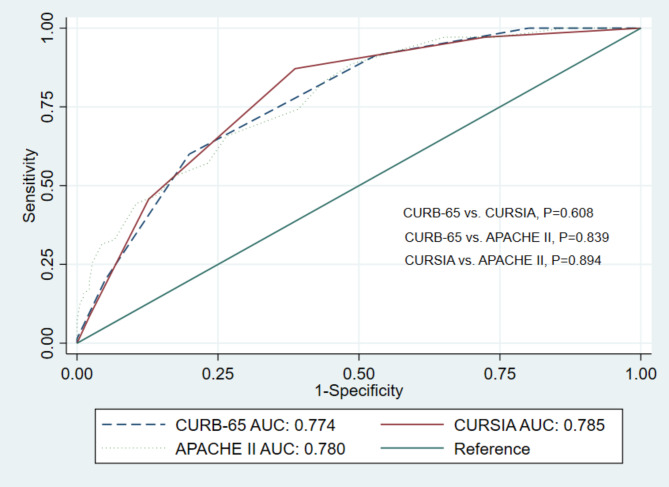
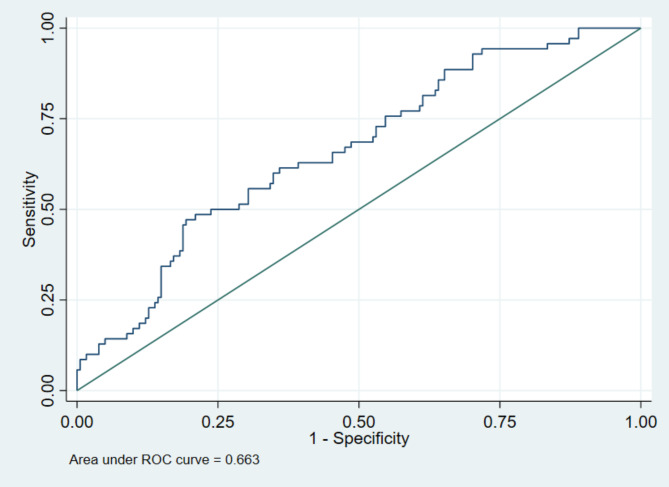
In total, 251 patients with COVID-19 pneumonia were enrolled in this study. The in-hospital mortality rate was 27.9%. Non-survivors had significantly higher HR, respiratory rate, SIA, and PMI and lower MP and BPAI than survivors. A cutoff value of 51 for SIA (AUC, 0.663; specificity, 80%) was used to predict mortality. When SIA was introduced as a modifier for the CURB-65 score, the new score (the CURSIA score) showed a higher AUC than the Acute Physiology and Chronic Health Evaluation II and CURB-65 scores (AUCs: 0.785, 0.780, and 0.774, respectively) without statistical significance.
SIA and CURSIA scores were significantly associated with COVID-19 pneumonia mortality. These scores may contribute to better patient triage than traditional vital signs.
2019 年冠状病毒病(COVID-19)肺炎仍然是一个主要的公共卫生关注点。生命体征指数-休克指数(SI;心率[HR]/收缩压[SBP])、休克指数年龄(SIA,SI×年龄)、最小脉搏(MP;最大 HR-HR)、脉搏最大指数(PMI;HR/最大 HR)和血压年龄指数(BPAI;SBP/年龄)-在预测创伤患者死亡率方面优于传统生命体征。我们假设这些生命体征指数可能是预测严重 COVID-19 肺炎患者死亡率的指标。本研究旨在描述入院时生命体征指数与 COVID-19 肺炎死亡率之间的关系,并使用表现最佳的生命体征指数对 CURB-65 进行修正,以建立新的死亡率预测工具。
本回顾性研究在泰国南部的一家三级护理中心进行。本研究纳入了 2020 年 1 月至 2022 年 7 月期间被诊断患有 COVID-19 肺炎的成年患者。从电子数据库中收集患者入院时的人口统计学和临床数据。在对与住院死亡率有确定关联的变量进行单变量和多变量分析后,使用受试者工作特征(ROC)曲线下面积分析评估多变量逻辑回归模型的预测能力。
本研究共纳入 251 例 COVID-19 肺炎患者。住院死亡率为 27.9%。与幸存者相比,非幸存者的 HR、呼吸频率、SIA 和 PMI 显著更高,而 MP 和 BPAI 显著更低。SIA 的截断值为 51(AUC,0.663;特异性,80%),用于预测死亡率。当 SIA 作为 CURB-65 评分的修正因子引入时,新评分(CURSIA 评分)的 AUC 高于急性生理学和慢性健康评估 II 和 CURB-65 评分(AUC 分别为 0.785、0.780 和 0.774),但无统计学意义。
SIA 和 CURSIA 评分与 COVID-19 肺炎死亡率显著相关。这些评分可能比传统生命体征更有助于患者分诊。